Nucleosídeos
Os nucleosídeos são building blocks fundamentais dos ácidos nucleicos, compostos por uma base nitrogenada ligada a uma molécula de açúcar. Nesta seção, você encontrará uma ampla variedade de nucleosídeos essenciais para pesquisas em biologia molecular, bioquímica e farmacologia. Esses compostos desempenham papéis cruciais na síntese de DNA e RNA, e também são vitais em vários processos metabólicos. Os nucleosídeos são usados para estudar material genético, desenvolver terapias antivirais e anticancerígenas, e entender os mecanismos celulares. Na CymitQuimica, fornecemos nucleosídeos de alta qualidade para apoiar suas necessidades de pesquisa e desenvolvimento, garantindo pureza e confiabilidade para suas aplicações experimentais.
Foram encontrados 3569 produtos de "Nucleosídeos"
Ordenar por
Pureza (%)
0
100
|
0
|
50
|
90
|
95
|
100
2'-Deoxy-5'-O-DMT-N2-isobutyrylguanosine 3'-Rp-oxazaphospholidine
<p>2'-Deoxy-5'-O-DMT-N2-isobutyrylguanosine 3'-Rp-oxazaphospholidine is a novel nucleoside analog that is modified from 2'-deoxy-5'-O-dimethoxytritylguanosine 6'-Rp-oxazaphospholidine. It has antiviral and anticancer activities, as well as inhibiting DNA synthesis by competing with natural substrates for the enzyme DNA polymerase. It is synthesized from the corresponding phosphoramidites and can be used in high purity for chemical synthesis of oligonucleotides.</p>Pureza:Min. 95%O6-Methylguanosine
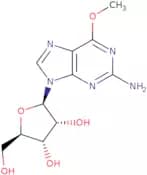
CAS:<p>Intermediate in the synthesis of nelarabine</p>Fórmula:C11H15N5O5Pureza:Min. 95%Cor e Forma:PowderPeso molecular:297.27 g/mol5'-O-DMT-thymidine 3'-CE phosphoramidite
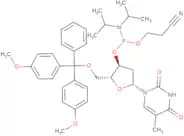
CAS:<p>5'-O-DMT-thymidine 3'-CE phosphoramidite is a building block for the introduction of thymidine units into oligonucleotides. 5'-O-DMT-thymidine 3'-CE phosphoramidite is utilised in a broad range of applications, including the synthesis of natural and unnatural DNA and RNA strands. Phosphoramidites are the reagent class of choice for oligonucleotide synthesis as they contain readily removable orthogonal protecting groups and can be produced at reasonable scales. The diisopropylamino leaving group is readily cleaved upon exposure to an azole catalyst allowing for a highly efficient coupling reaction with a free hydroxyl group on the growing oligonucleotide and oxidation of the subsequent phosphite triester, followed by beta-elimination of the cyanoethyl group affords the stable phosphodiester linkage.</p>Fórmula:C40H49N4O8PPureza:Min. 98 Area-%Cor e Forma:PowderPeso molecular:744.83 g/mol1-(3'-5'-Di-O-benzoyl-2'-deoxy-2'-fluoro-alpha-L-arabinofuranosyl)thymine
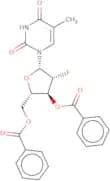
<p>1-(3`-5`-Di-O-benzoyl-2`-deoxy-2`-fluoro-alpha-L-arabinofuranosyl)thymine is a nucleoside analog with modifications that influence its biological activity. It is made up of a thymine base, benzoyl groups that protect hydroxyl functionalities during chemical synthesis and a α-L-linkage, which impacts its biological interactions compared to β-L-nucleosides. This molecule also contains the sugar 2'-Deoxy-2'-fluoro-α-L-arabinofuranose which has a L-arabinose configuration, an α-Anomeric linkage and a 2'-Fluoro substitution. The latter modification has the potential to increase the molecule's metabolic stability and resistance to enzymatic degradation</p>Fórmula:C24H21FN2O7Pureza:Min. 95%Peso molecular:484.89 g/mol8-Chloroadenosine-5'-monophosphate triethylammonium, about 28 mg/ml aqueous solution
CAS:<p>8-Chloroadenosine-5'-monophosphate triethylammonium is a novel phosphoramidite that is used in the synthesis of DNA. 8-Chloroadenosine-5'-monophosphate triethylammonium has been shown to activate antiviral and anticancer drugs with high specificity. It is also used as a reagent for the synthesis of deoxyribonucleosides and nucleosides. 8-Chloroadenosine-5'-monophosphate triethylammonium has high purity and can be used in the synthesis of DNA, RNA, and other nucleosides.</p>Fórmula:C10H13ClN5O7P•(C6H15N)2Pureza:Min. 95%Cor e Forma:Clear LiquidPeso molecular:584.05 g/mol3',5'-O-(1,1,3,3-Tetraisopropyl-1,3-disiloxanediyl)guanosine
CAS:<p>Used as a protected guanosine nucleoside in RNA synthesis. The 1,1,3,3-tetraisopropyl-1,3-disiloxanediyl (TIPDS or TBDPSi2) group acts as a bulky and selectively acid-labile protecting group for the 3' and 5' hydroxyl groups of the guanosine ribonucleoside during RNA oligonucleotide synthesis.</p>Fórmula:C22H39N5O6Si2Pureza:Min. 97 Area-%Cor e Forma:PowderPeso molecular:525.76 g/mol1-Methyl-2'-O-methylinosine
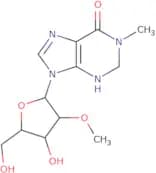
CAS:<p>1-Methyl-2'-O-methylinosine is a nucleoside that is naturally found in RNA. It is the methylated form of inosine, which is a nonessential amino acid and purine nucleotide. 1-Methyl-2'-O-methylinosine's chemical name is β--D--ribofuranosyl-(1'→2')--N--(6-fluoro-3-indoxyl)glycinamide monohydrochloride. This nucleoside has been researched for its potential use as an indexing tool for phylogenetic research of DNA and RNA. 1-Methyl-2'-O-methylinosine has also been shown to be structurally similar to other nucleic acids and has been classified as a nucleoside.</p>Fórmula:C12H16N4O5Pureza:Min. 95%Peso molecular:296.28 g/molCytidine 3'-monophosphate lithium salt
CAS:<p>Cytidine 3'-monophosphate lithium salt is a synthetic nucleoside that is used to inhibit the synthesis of DNA in cells. It is an analog of cytidine, with a phosphate group at the 3' position and a lithium cation at the 5' position. Cytidine 3'-monophosphate lithium salt has been shown to be effective in treating cancer and viral infections, although it does not have antiviral activity against influenza A virus.</p>Fórmula:C9H14N3O8P·xLiPureza:Min. 95%Peso molecular:323.2 g/molAdenosine 5′-phosphosulfate triethylammonium salt
<p>Adenosine 5′-phosphosulfate triethylammonium salt serves as a donor of sulfate groups in biochemical processes, such as in the synthesis of sulfate esters. The triethylammonium salt form improves the solubility and stability of the compound, making it useful in laboratory applications involving enzymatic assays and the synthesis of sulfated biomolecules.</p>Fórmula:C10H14N5O10PS·xC6H15NPureza:Min. 98.0 Area-%Cor e Forma:PowderPeso molecular:427.29 g/mol3'-Deoxy-5'-O-DMT-3'-C-methyluridine
<p>3'-Deoxy-5'-O-DMT-3'-C-methyluridine is an activator of DNA synthesis, which can be used to synthesize deoxyribonucleosides and ribonucleosides. 3'-Deoxy-5'-O-DMT-3'-C-methyluridine has been shown to have anticancer activity in vitro and in vivo. It is a novel synthetic monophosphate nucleoside that can be modified for use as a phosphoramidite or a ribonucleoside. 3'-Deoxy-5'-O-DMT-3'-C-methyluridine has also been shown to have antiviral activity against HIV in vitro.</p>Pureza:Min. 95%N2-Acetyl-5'-O-DMT-2'-O-methylguanosine 3'-CE phosphoramidite
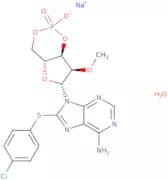
CAS:<p>N2-Acetyl-5'-O-DMT-2'-O-methylguanosine 3'-CE phosphoramidite is an organic compound that has been modified to be an anticancer agent. It has been shown to have antiviral and antiparasitic activities. N2-Acetyl-5'-O-DMT-2'-O-methylguanosine 3'-CE phosphoramidite is a nucleoside analog, which means it substitutes for the natural ribonucleoside in DNA or RNA. The modified nucleotide prevents the incorporation of the normal nucleotide into DNA or RNA, thereby inhibiting replication. This compound also inhibits tumor growth by interfering with viral replication and inhibiting tumor angiogenesis.</p>Fórmula:C43H52N7O9PPureza:Min. 95%Peso molecular:841.89 g/mol8-(4-Chlorophenylthio)-2'-O-methyladenosine 3',5'-cyclic monophosphate sodium salt
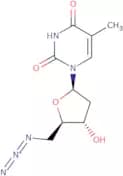
CAS:<p>8-(4-Chlorophenylthio)-2'-O-methyladenosine 3',5'-cyclic monophosphate sodium salt (8-CPT-cAMP) is a cyclic nucleotide that activates adenyl cyclase, which increases intracellular levels of the second messenger cAMP. It also inhibits P2Y receptors and other ion channels. 8-CPT-cAMP has been shown to be effective in activating cells expressing the enzyme camp levels, such as those found in heart muscle cells. This drug is used clinically to lower blood pressure, as it has been shown to activate amp-activated protein kinase and calcium chelator. 8-CPT-cAMP may have clinical applications for the treatment of cancer due to its ability to induce cell cycle arrest and apoptosis.</p>Fórmula:C17H16ClN5O6PS·NaPureza:Min. 95%Cor e Forma:PowderPeso molecular:507.82 g/mol5'-Azido-5'-deoxythymidine
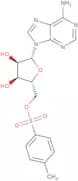
CAS:<p>5'-Azido-5'-deoxythymidine is a synthetic analogue of thymidine. The compound has been synthesised and fluorescently labelled with ferrocene. 5'-Azido-5'-deoxythymidine is not cytotoxic to cancer cells, but it is shown to be an effective inhibitor of DNA synthesis by binding to the enzyme DNA polymerase. This causes a decrease in the rate of DNA synthesis and thus inhibits cancer cell growth.</p>Fórmula:C10H13N5O4Pureza:Min. 95%Cor e Forma:White PowderPeso molecular:267.24 g/mol5'-Tosyladenosine
CAS:<p>Adenosine is a naturally occuring nucleoside and an essential building block in DNA synthesis. The tosyl protected adenosine at the 5' position, 5-tosyladenosine, allows for selective functionalistion at the the 3' and 4' positions, resulting in derivatised nucleotides that can incorporated into modified RNA which is an area of therapeutics that is currently expanding.</p>Fórmula:C17H19N5O6SPureza:Min. 95%Cor e Forma:White PowderPeso molecular:421.43 g/mol4’-C-Methyl-N6-methyladenosine
CAS:<p>4’-C-Methyl-N6-methyladenosine (4’-MeA) is a novel, synthetic nucleoside that has antiviral activity. It is a phosphoramidite nucleoside that is modified by the methylation of the adenosine moiety to give it antiviral activity. 4’-MeA can be used as an activator for oligonucleotide synthesis and as a potential anticancer drug.</p>Pureza:Min. 95%5'-O-DMT-2'-O-methyluridine 3'-CE phosphoramidite
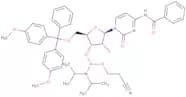
CAS:<p>5'-O-DMT-2'-O-methyluridine 3'-CE phosphoramidite is a modified, phosphoramidite nucleoside. It is used in the synthesis of DNA and RNA. 5'-O-DMT-2'-O-methyluridine 3'-CE phosphoramidite is an antiviral agent that inhibits viral replication by inhibiting viral protein synthesis. It has been shown to be active against HIV, Hepatitis B virus, and Hepatitis C virus. The compound also has anticancer properties and has been shown to inhibit tumor growth in animal models. 5'-O-DMT-2'-O-methyluridine 3'-CE phosphoramidite is a novel synthetic nucleoside that can be used as an alternative to deoxyribonucleosides in the synthesis of DNA and RNA.</p>Fórmula:C40H49N4O9PPureza:Min. 98 Area-%Cor e Forma:White PowderPeso molecular:760.83 g/molN4-Benzoyl-2'-deoxy-5'-O-DMT-2'-fluoro-cytidine 3-CE phosphoramidite
CAS:<p>N4-Benzoyl-2'-deoxy-5'-O-DMT-2'-fluoro-cytidine 3-CE phosphoramidite is a novel nucleoside phosphoramidite that is used for the synthesis of DNA and RNA. It has anticancer properties and has been shown to inhibit the replication of HIV and herpes virus. N4-Benzoyl-2'-deoxy-5'-O-DMT-2'-fluoro-cytidine 3-CE phosphoramidite is also a potent antiviral that inhibits the production of diphosphate by inhibiting ribonucleotide reductase, an enzyme involved in DNA synthesis.</p>Fórmula:C46H51FN5O8PPureza:Min. 95%Cor e Forma:White PowderPeso molecular:851.9 g/molN3-Methyl-2’-O-(2-methoxyethyl)uridine
CAS:<p>N3-Methyl-2’-O-(2-methoxyethyl)uridine is a modified nucleoside that is synthesized from deoxyribonucleosides and ribonucleosides. It has antiviral, anticancer, and antifungal properties. N3-Methyl-2’-O-(2-methoxyethyl)uridine has been shown to be an effective inhibitor of HIV replication in vitro and in vivo. This drug also inhibits the growth of human cancer cells in vitro and has been shown to be active against breast cancer cells. N3-Methyl-2’-O-(2-methoxyethyl)uridine is phosphorylated by cellular enzymes to form its active form, which binds to the viral reverse transcriptase enzyme and prevents DNA synthesis.</p>Fórmula:C13H20N2O7Pureza:Min. 95%Peso molecular:316.31 g/mol6-Thioinosine 5'-monophosphate
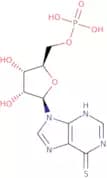
CAS:<p>6-Thioinosine 5'-monophosphate (6TIMP) is a hydrogen bond donor that possesses inhibitory properties against protein synthesis. It has been shown to have an anti-inflammatory effect and can be used for the treatment of inflammatory bowel disease. 6TIMP is also able to inhibit the bcr-abl kinase, which is implicated in the development of renal cell cancer. 6TIMP can be administered intravenously or orally and penetrates tissues well. The rate at which it enters cells is dependent on the transport rate, which is determined by its acidity. 6TIMP has been shown to cause DNA damage, leading to apoptosis and cell death in carcinoma cell lines. The mechanism of action appears to involve inhibition of cellular protein synthesis, acid formation, and DNA damage.</p>Fórmula:C10H13N4O7PSPureza:Min. 95%Cor e Forma:PowderPeso molecular:364.27 g/molN4-Benzoyl-2'-deoxy-5'-O-DMT-cytidine 3'-O-succinate triethylamine salt
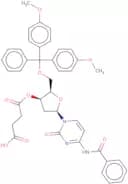
CAS:<p>N4-Benzoyl-2'-deoxy-5'-O-DMT-cytidine 3'-O-succinate triethylamine salt is a synthetic antiviral agent that can be used in the treatment of HIV. This drug inhibits the viral DNA polymerase and prevents virus replication. N4-Benzoyl-2'-deoxy-5'-O-DMT cytidine 3'-O succinate triethylamine salt is a novel nucleoside analogue with a monophosphate group at the 5' position and an N4 benzoyl group at the 2' position. It is an activator of DNA synthesis, which can be used for cancer chemotherapy. The chemical name for this drug is CAS No. 74405-44-0 (free base).</p>Fórmula:C41H39N3O10·C6H15NPureza:Min. 95%Cor e Forma:White Off-White PowderPeso molecular:834.95 g/mol