Nucleosídeos
Os nucleosídeos são building blocks fundamentais dos ácidos nucleicos, compostos por uma base nitrogenada ligada a uma molécula de açúcar. Nesta seção, você encontrará uma ampla variedade de nucleosídeos essenciais para pesquisas em biologia molecular, bioquímica e farmacologia. Esses compostos desempenham papéis cruciais na síntese de DNA e RNA, e também são vitais em vários processos metabólicos. Os nucleosídeos são usados para estudar material genético, desenvolver terapias antivirais e anticancerígenas, e entender os mecanismos celulares. Na CymitQuimica, fornecemos nucleosídeos de alta qualidade para apoiar suas necessidades de pesquisa e desenvolvimento, garantindo pureza e confiabilidade para suas aplicações experimentais.
Foram encontrados 3569 produtos de "Nucleosídeos"
Ordenar por
Pureza (%)
0
100
|
0
|
50
|
90
|
95
|
100
2'-Deoxy-2'-fluorouridine-5'-triphosphate tetralithium
CAS:2'-Deoxy-2'-fluorouridine-5'-triphosphate tetralithium (2'DFUR) is a fatty acid that is resistant to many antibacterial agents. 2'DFUR inhibits the biosynthesis of bacterial cell walls, leading to cell death. This drug has been shown to have potent antibacterial activity against Staphylococcus strains and other bacteria. The mechanism of action is not yet fully understood, but it may involve inhibition of nucleotidyltransferase and aminopropyl transferase enzymes.Fórmula:C9H11FN2O14P3Li4Pureza:Min. 95%Cor e Forma:PowderPeso molecular:510.87 g/mol2'-Deoxy-8-oxo-6-thioguanosine 5'-triphosphate
<p>2'-Deoxy-8-oxo-6-thioguanosine 5'-triphosphate is a synthetic nucleotide that has antiviral properties. It activates the transcription of genes by preventing the synthesis of viral DNA and RNA. 2'-Deoxy-8-oxo-6-thioguanosine 5'-triphosphate is also an anticancer agent, as it prevents cell proliferation by inhibiting the synthesis of DNA, RNA, and protein. This drug can be used for treatment of HIV infection or cancer. 2'-Deoxy-8-oxo-6-thioguanosine 5'-triphosphate is a novel nucleotide with high purity.</p>Pureza:Min. 95%D3-Thymidine
CAS:Produto ControladoD3-Thymidine is a substance that is formed from the monosaccharide galactose and has been used in biochemical studies. D3-Thymidine has been used as a marker for the damaged DNA of viruses, such as herpes simplex virus type 1, and for the DNA of tumor cells. It has also been used to study the effects of protonation on its function. D3-Thymidine is an unlabeled thymidine derivative that was studied using dichroism spectroscopy. This technique showed that this molecule can exist either in a single form or in two forms with different shapes, depending on its microenvironment. D 3 -thymidine was first synthesized by Dr. Gertrude Buechner at the University of Wisconsin–Madison in 1957. In her experiments, she found that this molecule could be produced by hydrolyzing 2-deoxy-D-ribose with 3 molar equivalents of ammonFórmula:C10H11N2O5D3Pureza:Min. 95%Cor e Forma:PowderPeso molecular:245.25 g/mol3'-Amino-3'-deoxyguanosine
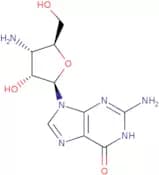
CAS:<p>terminates RNA strand synthesis catalyzed by RNA polymerase.</p>Fórmula:C10H14N6O4Pureza:Min. 95%Cor e Forma:Off-White PowderPeso molecular:282.3 g/molSapacitabine
CAS:<p>Sapacitabine is an oral prodrug that is converted to its active form, the cytotoxic agent 9-β-D-arabinofuranosyladenine (araA), by cellular enzymes. It has potent antitumor activity against solid tumours and has been shown to be effective in a variety of human cancer cell lines. Sapacitabine targets intracellular targets, including DNA methyltransferases and other enzymes involved in the synthesis of RNA and DNA. The drug has been shown to have synergistic effects when used with other cytotoxic agents such as 5-fluorouracil and gemcitabine, which are also inhibitors of DNA methyltransferase.</p>Fórmula:C26H42N4O5Pureza:Min. 95%Peso molecular:490.64 g/mol2’-C-Methylisocytidine
CAS:<p>2’-C-Methylisocytidine is a novel antiviral drug that is a deoxyribonucleoside. It is synthesized by the reaction of cytidine with 2’-chloroethylisocyanate to form a methylated derivative, which is converted to 2’-C-methylisocytidine via phosphorylation. This nucleoside has been shown to have anticancer properties and may be used as an activator for the synthesis of DNA or RNA.</p>Pureza:Min. 95%2'-O-(2-Methoxyethyl)adenosine
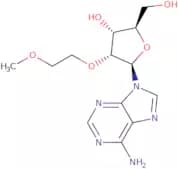
CAS:2'-O-(2-Methoxyethyl)adenosine is a nucleoside derivative that is produced by the methylation of 2'-deoxyadenosine. It is used in organic synthesis as a reagent for the alkylation of aromatic hydrocarbons and as an intermediate in the synthesis of purines. The product can be isolated with yields of 78% or greater, depending on reaction conditions and purification methods. Isomeric purity can be achieved with high purity (>99%) by recrystallization from water or ethanol. The compound has a number of physical properties that are similar to those of adenosine, including boiling point, melting point, density, and refractive index. The molecule also has two chiral centers at C2 and C4 that contribute to its isomeric nature. Adenosine is found in human connective tissue cells, where it plays a role in cell metabolism by regulating the production of RNA and DNA.Fórmula:C13H19N5O5Pureza:Min. 95%Cor e Forma:White Off-White PowderPeso molecular:325.32 g/mol2',3'-Dideoxyuridine-5'-triphosphate lithium - 100mM aqueous solution
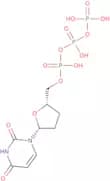
CAS:2',3'-Dideoxyuridine-5'-triphosphate can be used with uracil DNA glycosylase to minimize PCR carryover contamination and enables the kinetics of deoxyuridine 5′-triphosphate nucleotidohydrolases to be investiagated.Fórmula:C9H15N2O13P3•LixPureza:Min. 95%Cor e Forma:Clear LiquidPeso molecular:452.14 g/mol5'-O-Benzoyl-2,3'-anhydrothymidine
CAS:<p>5'-O-Benzoyl-2,3'-anhydrothymidine is a heterocycle that has been shown to have immunosuppressive properties. The compound binds to the immunodeficiency virus by covalent binding to an isomeric site on the viral envelope protein. It has been shown that 5'-O-Benzoyl-2,3'-anhydrothymidine can inhibit the growth of HIV in vitro with a 50% inhibitory concentration (IC50) of 0.8 μM. This compound also displays potent antiviral activity against herpes simplex virus type 1 (HSV-1) and herpes simplex virus type 2 (HSV-2).</p>Fórmula:C17H18N2O5Pureza:Min. 95%Cor e Forma:PowderPeso molecular:330.34 g/moldNTP pre-mixes - 25mM aqueous solution
CAS:<p>dATP, dTTP, dCTP and dGTP pre-mixed in a single vial</p>Pureza:Min. 95%7-(N-Acetylaminomethyl)-7-deazaguanosine
<p>7-(N-Acetylaminomethyl)-7-deazaguanosine is a nucleoside analog that is used to treat diseases such as hepatitis B and C. It is an antiviral, anticancer, and antibacterial agent. 7-(N-Acetylaminomethyl)-7-deazaguanosine inhibits viral replication by blocking the synthesis of DNA or RNA. The drug also inhibits cell growth through activation of apoptosis, which may be due to its ability to inhibit protein synthesis and DNA replication. This novel nucleoside analog has shown high purity levels in our lab and can be used for the treatment of various diseases.</p>Fórmula:C14H19N5O6Pureza:Min. 95%Cor e Forma:PowderPeso molecular:353.33 g/mol2',3'-Di-O-acetyl-5'-deoxy-5-nitro-N4-(pentyloxycarbonyl)cytidine
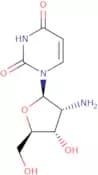
CAS:2',3'-Di-O-acetyl-5'-deoxy-5-nitro-N4-(pentyloxycarbonyl)cytidine is a nucleoside for use in research applicationsFórmula:C19H26N4O10Pureza:Min. 95%Cor e Forma:PowderPeso molecular:470.44 g/mol2'-Amino-2'-deoxyuridine
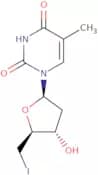
CAS:<p>2'-Amino-2'-deoxyuridine is a modified nucleoside based on uridine. The 2'-hydroxyl group on the sugar is replaced by an amino group. This compound can be used for research purposes</p>Fórmula:C9H13N3O5Pureza:Min. 98 Area-%Cor e Forma:PowderPeso molecular:243.22 g/mol5'-Deoxy-5'-iodothymidine
CAS:<p>5'-Deoxy-5'-iodothymidine is an antiviral nucleoside that inhibits viral replication by competing with the natural substrate, deoxyribonucleotide triphosphate, for incorporation in DNA. 5'-Deoxy-5'-iodothymidine has been shown to be a novel antiviral agent and an activator of host immune responses against virus infections. 5'-Deoxy-5'-iodothymidine is also used as an intermediate for the synthesis of phosphoramidites, which are used in the production of DNA.</p>Fórmula:C10H13IN2O4Pureza:Min. 95%Peso molecular:352.13 g/molThymidine-5'-diphosphate-b-L-fucose
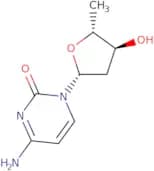
<p>Thymidine-5'-diphosphate-b-L-fucose is a ketone that can be used to catalyze the hydroxylation of an organic compound. It has been shown to modulate the activity of hydroxy group, orbital, and dehydrogenation in ketones. Thymidine-5'-diphosphate-b-L-fucose can be used to investigate radical elimination and hypothesized mechanisms of action. This ketone competes with amino groups for binding to the enzyme s-adenosylmethionine and hyperconjugation.</p>Pureza:Min. 95%2',5'-Dideoxycytidine
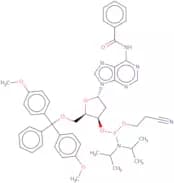
CAS:<p>2',5'-Dideoxycytidine is a nucleoside for use in a variety of applications</p>Fórmula:C9H13N3O3Pureza:Min. 95%Cor e Forma:White Off-White PowderPeso molecular:211.22 g/molN6-Benzoyl-2'-deoxy-5'-O-DMT-a-adenosine 3'-CE phosphoramidite
CAS:N6-Benzoyl-2'-deoxy-5'-O-DMT-a-adenosine 3'-CE phosphoramidite is a monophosphate nucleotide that is used as an activator in the synthesis of DNA. N6-Benzoyl-2'-deoxy-5'-O-DMT-a-adenosine 3'-CE phosphoramidite has been shown to have anticancer properties, and it also inhibits the replication of human immunodeficiency virus (HIV). N6-Benzoyl-2'-deoxy-5'-O-DMT-a adenosine 3'-CE phosphoramidite binds to the enzyme DNA polymerase and prevents the formation of a covalent bond with the deoxyribonucleoside triphosphate, thereby inhibiting DNA synthesis.Fórmula:C47H52N7O7PPureza:Min. 95%Cor e Forma:White SolidPeso molecular:857.93 g/mol5'-Deoxyadenosine
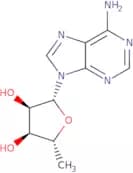
CAS:<p>5'-Deoxyadenosine is a nucleoside that is produced by the enzymatic reaction of glycolaldehyde and ATP. It is found in both DNA and RNA, where it plays an important role in the catalytic subunit of ribonucleotide reductase. 5'-Deoxyadenosine has been shown to be involved in hydrogen bonding with other molecules, such as ethanolamine. It also has a kinetic effect on the enzyme activity of ribonucleotide reductase by forming intramolecular hydrogen bonds with other adenine nucleotides. The analogs of 5'-deoxyadenosine have been shown to inhibit viral replication in cell culture studies using typhimurium virus.</p>Fórmula:C10H13N5O3Pureza:Min. 95%Cor e Forma:PowderPeso molecular:251.25 g/mol5-(Azidomethyl)uridine
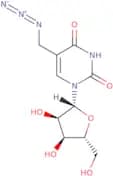
CAS:<p>5-(Azidomethyl)uridine (5-AZA-U) is a cytosolic nucleoside analog that inhibits the replication of herpes simplex virus type 1 (HSV-1). It is resistant to degradation by cellular nucleases and is fluorescent, making it a clickable substrate for microscopy. 5-AZA-U has been shown to inhibit the transcription of viral DNA and the synthesis of viral proteins in mammalian cells. This drug has also been shown to be effective against cancer and hepatitis B virus (HBV). 5-AZA-U can be used as an antiviral agent because of its ability to inhibit the posttranscriptional gene expression of HSV-1. 5-(Azidomethyl)uridine is also an analog of uridine, which can be used to study intracellular signaling pathways that regulate proliferation, differentiation, or apoptosis in mammalian cells.</p>Fórmula:C10H13N5O6Pureza:Min. 95%Cor e Forma:PowderPeso molecular:299.24 g/mol2'-O-Propargylguanosine
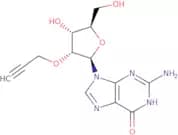
CAS:<p>2'-O-Propargylguanosine is a monophosphate nucleoside that is synthesized from Ribonucleosides. It has been shown to have antiviral and anticancer properties. 2'-O-Propargylguanosine has shown to be an activator of the transcription factor NF-κB and to induce apoptosis in various cancer cell lines. This drug inhibits viral replication by inhibiting DNA polymerase, thereby preventing RNA synthesis.</p>Fórmula:C13H15N5O5Pureza:Min. 95%Cor e Forma:PowderPeso molecular:321.29 g/mol