Nucleosídeos
Foram encontrados 3570 produtos de "Nucleosídeos"
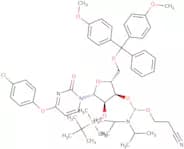
2'-O-tert-Butyldimethylsilyl-O4-(4-chlorophenyl)-5'-O-DMT-uridine 3'-CE-phosphoramidite
CAS:2'-O-tert-Butyldimethylsilyl-O4-(4-chlorophenyl)-5'-O-DMT-uridine 3'-CE-phosphoramidite is a nucleoside that is used in the synthesis of DNA. It is a novel synthetic nucleotide with antiviral and anticancer properties. The phosphoramidite has been modified to give it high purity, and the monophosphate form has been synthesized. This nucleotide is synthesized through the use of an Activator, which activates the 2' position of the sugar moiety on the 5' phosphate terminus. This product is of high quality due to its high purity and novel synthetic nature.Fórmula:C51H64CIN4O9PSPureza:Min. 95%Peso molecular:971.6 g/mol2'-O-tert-Butyldimethylsilyl-5-O-DMT-nebularine 3'-CE phosphoramidite
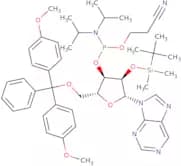
CAS:2'-O-tert-Butyldimethylsilyl-5-O-DMT-nebularine 3'-CE phosphoramidite is a monophosphate nucleoside analog. It has been shown to have anticancer and antiviral activity. This compound is synthesized by reacting 5'-O-DMT-nebularine with 2'-deoxyribonucleosides with an activator, such as pyridine. The resulting product can be used as a building block in the synthesis of DNA or RNA.Fórmula:C46H61N6O7PSiPureza:Min. 95 Area-%Cor e Forma:PowderPeso molecular:869.07 g/mol2'-TFA-NH-dA
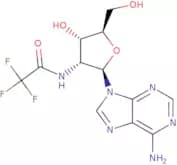
CAS:2'-TFA-NH-dA is a monophosphate nucleotide. It is a novel and modified ribonucleoside that can be used as an activator to promote the synthesis of diphosphate, deoxyribonucleosides, and phosphoramidites. 2'-TFA-NH-dA has been shown to have anticancer properties in vitro and antiviral properties in vivo. This compound is synthesized from 2'-deoxyadenosine 5'-phosphate (2'-DAP), which is obtained from the amino acid ATP.Fórmula:C12H13F3N6O4Pureza:Min. 95%Peso molecular:362.26 g/mol2,2'-Anhydro-5'-O-tert-butyldiphenylsilylthymidine
2,2'-Anhydro-5'-O-tert-butyldiphenylsilylthymidine is a novel monophosphate nucleoside analog that has antiviral activity against herpes simplex virus type 1 (HSV-1) and herpes simplex virus type 2 (HSV-2). This compound is chemically synthesized by the reaction between thymidine with bis-(2,6-diisopropylphenyl) disilazane in the presence of an activator. The synthesis of 2,2'-anhydro-5'-O-tert-butyldiphenylsilylthymidine is performed by reacting 5'-O-(4,4'-dimethoxytrityl)-thymidine with bis-(2,6-diisopropylphenyl) disilazane in the presence of tetrakis(triphenylphosphine)palladium(0Pureza:Min. 95%3',5'-Di-O-acetyl-2'-deoxyinosine
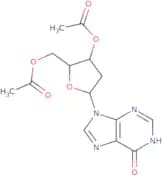
CAS:3',5'-Di-O-acetyl-2'-deoxyinosine is a dimer of 2'-deoxyinosine, which is an analog of inosine. It catalyzes the chlorination of aromatic substrates such as benzene or toluene with chlorine gas in the presence of FeCl3. The resulting product is a chlorinated aromatic compound. This reaction proceeds by electrophilic substitution at the C-2 position. 3',5'-Di-O-acetyl-2'-deoxyinosine has been shown to be more active than 2'-deoxyinosine in this reaction because it reacts faster and its reactive intermediate is more stable.Fórmula:C14H16N4O6Pureza:Min. 95%Peso molecular:336.3 g/mol3',5'-Di-O-Benzoyl-N4-benzoyl-2'-deoxy-2'-fluoroarabinocytidine
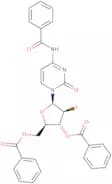
CAS:3',5'-Di-O-Benzoyl-N4-benzoyl-2'-deoxy-2'-fluoroarabinocytidine is a novel nucleoside analogue that has been synthesized to inhibit the activity of DNA polymerase. This compound is also an activator of diphosphate and ribonucleoside monophosphate. 3',5'-Di-O-Benzoyl-N4-benzoyl-2'-deoxy-2'-fluoroarabinocytidine has been shown to inhibit the replication of herpes simplex virus type 1 in cell culture and the replication of human cytomegalovirus in cell culture. 3',5'-Di-O-Benzoyl-N4-benzoyl-2'-deoxy-- 2'-fluoroarabinocytidine does not have any antiviral activity against HIV.Pureza:Min. 95%5-Methylcytidine-5'-triphosphate lithium salt - 100mM aqueous solution
5-Methylcytidine-5'-triphosphate lithium salt is a nucleotide analog that inhibits thrombin by binding to the active site and blocking the catalytic activity. This compound is useful for the study of cellular function and viral life. 5-Methylcytidine-5'-triphosphate lithium salt has been shown to inhibit intracellular levels of thrombin, which can be used for anticoagulation in vitro. In addition, this compound has been shown to have regenerative properties in vivo and may be used for tissue engineering purposes. 5-Methylcytidine-5'-triphosphate lithium salt has also been shown to inhibit viral replication in mammalian cells.Fórmula:C10H18N3O14P3·xLiPureza:Min. 95%Peso molecular:497.18 g/mol5-Aminoallylcytidine 5'-triphosphate lithium salt - 100mM aqueous solution
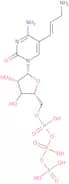
5-Aminoallylcytidine 5'-triphosphate lithium salt - 100mM aqueous solution is a DNA nucleoside analog that is used as an antiviral, anticancer and activator. It has the chemical formula C10H14N2O6P3Li. The CAS number is 182700-18-0. 5-Aminoallylcytidine 5'-triphosphate lithium salt - 100mM aqueous solution is also known by the following synonyms: (5-Amino)allylcytidinium chloride trihydrate; (5-Amino)allylcytidinium chloride, lithium salt; 5-(Amino)allyl cytidylic acid triphosphate lithium salt; 5-[(3-aminopropoxy)propyl]uracil triphosphate lithium salt; 5-[(3-aminopropoxyFórmula:C12H21N4O14P3·xLiPureza:Min. 95%Peso molecular:538.23 g/mol2'-Deoxy-5-iodo-3',5'-di-O-p-toluoyluridine
CAS:2'-Deoxy-5-iodo-3',5'-di-O-p-toluoyluridine is a nucleoside that has antiviral and anticancer effects. It can be used as an activator for phosphoramidites and as a precursor for the synthesis of other nucleosides. 2'-Deoxy-5-iodo-3',5'-di-O-p-toluoyluridine is synthesized from 2,4,6-triisopropylbenzenesulfonyl chloride and 5-(N,N-dimethylamino)valeronitrile in the presence of triethylamine and potassium carbonate in acetonitrile with subsequent purification by silica gel chromatography. The resulting compound is then converted to its diphosphate form by treatment with dithiothreitol in dimethylformamide. This product has been shown to inhibit DNA replication andFórmula:C25H23IN2O7Pureza:Min. 95%Peso molecular:590.36 g/mol2'-Deoxy-2'-iodo-adenosine-5'-[(beta,gamma)-imido]triphosphate sodium salt - 10mM aqueous solution
CAS:2'-Deoxy-2'-iodo-adenosine-5'-[(beta,gamma)-imido]triphosphate sodium salt - 10mM aqueous solution is a nucleoside that has antiviral activity. It is also used as an anticancer agent and can be used as a monophosphate, diphosphate or activator of deoxyribonucleosides. 2'-Deoxy-2'-iodo-adenosine-5'-[(beta,gamma)-imido]triphosphate sodium salt - 10mM aqueous solution has been modified for use in DNA synthesis. This nucleoside is used to produce phosphoramidites for the synthesis of oligonucleotides and other modified nucleic acid derivatives.
Fórmula:C10H16N6O11P3IPureza:Min. 95%Peso molecular:616.09 g/molN4-Benzoyl-5'-O-DMT-2'-ethylfluoro-5-methylcytidine
N4-Benzoyl-5'-O-DMT-2'-ethylfluoro-5-methylcytidine is a synthetic nucleoside that inhibits the enzyme ribonucleotide reductase. It has antiviral and anticancer activities.Pureza:Min. 95%2'-CMethylcytidine 5'-monophosphate
2'-CMethylcytidine 5'-monophosphate (2'-C-5MP) is a synthetic nucleoside that is chemically modified to inhibit viral replication. 2'-C-5MP inhibits the synthesis of DNA by binding to the polymerase enzyme of the virus and preventing it from synthesizing new DNA strands. This prevents the virus from replicating, which in turn prevents it from spreading through the body. The antiviral activity of 2'-C-5MP has been demonstrated in vitro against herpes simplex virus type 1 (HSV-1), herpes simplex virus type 2 (HSV-2), cytomegalovirus (CMV), respiratory syncytial virus (RSV), and human immunodeficiency virus type 1 (HIV-1). It also has anticancer activity and can be used as an alternative to chemotherapy for treating cancer cells. 2'-C-5MP is a novel compound with high purity and high quality, as evidencedPureza:Min. 95%2'-Deoxy-5'-O-DMT-uridine succinyl 3'-CPG
2'-Deoxy-5'-O-DMT-uridine succinyl 3'-CPG is a novel, synthetic, high purity, and high quality activator for oligonucleotide synthesis. It is a modified nucleoside with a 2' -deoxy-5'-O-dimethoxytrityl group attached to the sugar moiety. This product is used in monophosphate form and can be used as an anticancer agent. This product has antiviral activity, which may be due to its ability to inhibit viral DNA and RNA synthesis.Pureza:Min. 95%4-Amino-2-chloro-5-fluoropyrimidine
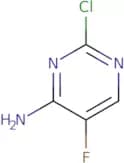
CAS:4-Amino-2-chloro-5-fluoropyrimidine is a chlorinating agent that is used in the synthesis of 4,5-dichloropyrimidine and 4,6-dichloropyrimidine. It is also used for the synthesis of oxychloride by reacting with phosphorus oxychloride or phosphorus.Pureza:Min. 95%3,5-Di-o-acetyl-5-fluoro-O4-(2,4,6-trimethylphenyl)-2-deoxyuridine
CAS:3,5-Di-o-acetyl-5-fluoro-O4-(2,4,6-trimethylphenyl)-2-deoxyuridine is a novel modified monophosphate nucleoside. It is an antiviral agent and has been shown to have anticancer activity. 3,5-Di-o-acetyl-5-fluoro-O4-(2,4,6-trimethylphenyl)-2-deoxyuridine is synthesized by the reaction of 5'-triphosphates with 2'-deoxyribonucleosides in the presence of a phosphoramidite. This nucleoside has been found to be cytotoxic in vitro and in vivo against cancer cell lines and can be used as a therapeutic agent for the treatment of leukemia.Fórmula:C22H25FN2O7Pureza:Min. 95%Peso molecular:448.40 g/molantisense
Antisense is a type of experimental therapy that uses a single-stranded RNA molecule to bind to complementary RNA molecules, blocking their function. Antisense rna is often used in gene regulation and chromatin remodeling. It also regulates the transcription of mRNA by binding to the messenger RNA molecule as it leaves the nucleus. The main output of antisense is an increase in the production of one type of protein or a decrease in another. Antisense has been shown to be effective in regulating gene expression and can be used to treat diseases such as cancer and autoimmune disorders.Pureza:Min. 95%3',5'-Di-o-acetyl-O6-phenyl-2'-deoxyinosine
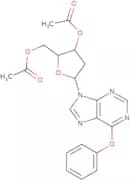
CAS:3',5'-Di-O-acetyl-O6-phenyl-2'-deoxyinosine is a nucleoside analog that has antiviral and anticancer activities. It is an activator of the enzyme ribonucleotide reductase and has been shown to be effective against herpes simplex virus type 1 and 2, cytomegalovirus, Epstein Barr virus, human immunodeficiency virus type 1, and Kaposi sarcoma cells. 3',5'-Di-O-acetyl-O6-phenyl-2'-deoxyinosine also inhibits the production of tumor necrosis factor alpha (TNFα), which can cause inflammatory reactions in the body. This compound is a modified nucleoside with high purity and quality. It has CAS number 133471-06-4.Fórmula:C20H20N4O6Pureza:Min. 95%Peso molecular:412.4 g/mol2-(Propylthio)pyrimidine-5-carbaldehyde
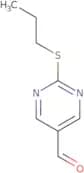
CAS:2-(Propylthio)pyrimidine-5-carbaldehyde (2-PSPCA) is a novel, modified ribonucleoside that has been shown to activate the DNA polymerase. 2-PSPCA has been used in the synthesis of deoxyribonucleosides and phosphoramidites for use in the research and development of antiviral agents and anticancer drugs. 2-PSPCA is a monophosphate with an IC50 of 0.6 mM against human leukemia cells.Fórmula:C8H10N2OSPureza:Min. 95%Peso molecular:182.24 g/mol2'-Deoxy-5'-O-DMT-guanosine-(iBu)-3'-succinyl CPG 2000 Å
2'-Deoxy-5'-O-DMT-guanosine-(iBu)-3'-succinyl CPG 2000 Å is a novel, high quality, and modified nucleoside that can be used in the synthesis of DNA and RNA. It is a phosphoramidite monophosphate that has antiviral and anticancer properties. It can also be used as an activator for the synthesis of oligonucleotides.
Pureza:Min. 95%2'-Deoxyuridine-5'-[(a,b)-methyleno]triphosphate sodium salt - 10 mM aqueous solution
CAS:2'-Deoxyuridine-5'-[(a,b)-methyleno]triphosphate sodium salt - 10 mM aqueous solution is an activator of nucleoside diphosphates. It is a novel and anticancer nucleoside analog with high purity, high quality and a CAS number of 170428-84-9. This activator has been shown to inhibit the growth of tumor cells by inhibiting DNA synthesis and ribonucleotide reductase activity. The 2'-deoxyuridine-5'-[(a,b)-methyleno]triphosphate sodium salt - 10 mM aqueous solution can be used in the synthesis of deoxyribonucleosides and phosphoramidites as well as modified DNA.Fórmula:C10H17N2O13P3Pureza:Min. 95%Cor e Forma:liquid.Peso molecular:466.17 g/mol2'-Deoxy-5'-O-DMT-N2-isobutyrylguanosine 3'-H phosphonate triethylammonium salt
CAS:2'-Deoxy-5'-O-DMT-N2-isobutyrylguanosine 3'-H phosphonate triethylammonium salt is a novel nucleoside analog. It has been shown to be cytotoxic to cancer cells in vitro and in vivo. 2'-Deoxy-5'-O-DMT-N2-isobutyrylguanosine 3'-H phosphonate triethylammonium salt inhibits viral replication, including herpes simplex virus type 1 (HSV1) and human immunodeficiency virus type 1 (HIV1), by inhibiting DNA synthesis.Fórmula:C35H37N5O9PPureza:Min. 95%Peso molecular:804.89 g/mol2'-Deoxyuridine-5'-[(a,b)-imido]triphosphate sodium salt - 10mM aqueous solution
CAS:2'-Deoxyuridine-5'-[(a,b)-imido]triphosphate sodium salt - 10mM aqueous solution is an antiviral nucleoside phosphoramidite that is used in the synthesis of deoxyribonucleosides. It has been shown to be effective against some DNA viruses and has anticancer activity. 2'-Deoxyuridine-5'-[(a,b)-imido]triphosphate sodium salt - 10mM aqueous solution is synthesized from 2',3',4',5',6-pentakis(2-hydroxypropyl)carbamate and 2-deoxyuridine 5'-monophosphate.Fórmula:C9H16N3O13P3Pureza:Min. 95%Cor e Forma:liquid.Peso molecular:467.16 g/molEthynyl 2-deoxy-5-O-DMT-ribosyl 3-CE phosphoramidite
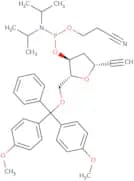
CAS:Ethynyl 2-deoxy-5-O-DMT-ribosyl 3-CE phosphoramidite is a monophosphate nucleoside analog. The ethynyl group is attached to the 2'-hydroxyl group of the ribose sugar. This nucleotide analogue inhibits DNA and RNA synthesis by inhibiting DNA polymerase and RNA polymerase. Ethynyl 2-deoxy-5-O-DMT-ribosyl 3-CE phosphoramidite has antiviral activity against Herpes simplex virus type 1 (HSV1) and type 2 (HSV2) in vitro, as well as cytotoxic activity against human leukemia cells in vitro.Fórmula:C37H45N2O6PPureza:Min. 95%Peso molecular:644.74 g/mol4,5-Dimethoxy-2-nitrobenzyl adenosine 3',5'-cyclic monophosphate
4,5-Dimethoxy-2-nitrobenzyl adenosine 3',5'-cyclic monophosphate is a synthetic nucleotide that can be activated to form an antiviral and anticancer agent. This compound has been shown to inhibit the proliferation of leukemia cells in culture. It also inhibits the synthesis of DNA and RNA, leading to cell death by inhibiting the production of proteins vital for cell division. 4,5-Dimethoxy-2-nitrobenzyl adenosine 3',5'-cyclic monophosphate is a novel nucleoside with high purity and CAS number: 57314-27-1.Fórmula:C19H21N6O10PPureza:Min. 95%Peso molecular:524.38 g/mol3'-O-Aminoacetoxy-2'-deoxyadenosine 5'-O-triphosphate triethylammonium salt
Please enquire for more information about 3'-O-Aminoacetoxy-2'-deoxyadenosine 5'-O-triphosphate triethylammonium salt including the price, delivery time and more detailed product information at the technical inquiry form on this page
Fórmula:C13H21N6P3O12•NaxPureza:Min. 98 Area-%Cor e Forma:PowderPeso molecular:546.26 g/mol6-Chloropurine riboside 5'-monophosphate disodium salt
CAS:6-Chloropurine riboside 5'-monophosphate disodium salt is a synthetic nucleoside that is used as an antiviral and anticancer agent. It is a DNA precursor that can be incorporated into DNA by the enzyme thymidylate synthase to form thymine and diphosphate. 6-Chloropurine riboside 5'-monophosphate disodium salt has been shown to inhibit the replication of some viruses, such as HIV, and also inhibits tumor growth in experimental models.Fórmula:C10H10ClN4Na2O7PH2OPureza:Min. 95%Peso molecular:428.63 g/molGuanosine 5'-triphosphate
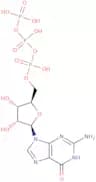
CAS:Guanosine 5'-triphosphate (GTP) is a nucleotide that is involved in many cellular processes including transcription, protein synthesis, and intracellular signaling. GTP binds to the enzyme guanine nucleotide-binding proteins and regulates the activity of certain enzymes. One such enzyme is adenylyl cyclase, which converts ATP into cAMP. GTP also activates other enzymes that are involved in signal transduction pathways, such as phospholipase C-β1 and phospholipase D. The antimicrobial agents can inhibit these enzymes, thereby preventing bacterial growth and replication.
Fórmula:C10H16N5O14P3Pureza:Min. 95%Peso molecular:523.18 g/mol4-Amino-6-methyl-8-(2'-deoxy-b-D-ribofuranosyl)-7-pteridone
CAS:4-Amino-6-methyl-8-(2'-deoxy-b-D-ribofuranosyl)-7-pteridone (4AMD) is an adenosine analog that is fluorescent. 4AMD is not hydrolyzed by adenosine deaminase and has a higher affinity for the A1 receptor than for the A2a receptor. This makes it a useful probe for the study of adenosine mediated, yields, and analogs. The fluorescence properties of 4AMD were studied in different solvents at various temperatures to monitor the interaction of 4AMD with catalysis. The monomeric form of 4AMD was used to measure its fluorescence properties.Fórmula:C12H15N5O4Pureza:Min. 95%Peso molecular:293.28 g/mol3'-Deoxy-N2-DMF-5'-O-DMT-guanosine
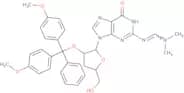
CAS:3'-Deoxy-N2-DMF-5'-O-DMT-guanosine is a modified nucleoside that is phosphorylated to the 3'-deoxyribonucleotide form. It has antiviral and anticancer activities, as well as being an activator of DNA and RNA synthesis. This compound has been shown to inhibit the growth of several cancer cell lines in vitro and in vivo. 3'-Deoxy-N2-DMF-5'-O-DMT-guanosine is also effective against herpes simplex virus type 1 (HSV1) and HSV type 2 in cell culture, although it does not have any effect on HSV type 1 replication in animal models.Fórmula:C34H36N6O6Pureza:Min. 95%Peso molecular:624.69 g/mol6-Pyrrolidino-7-deazapurine
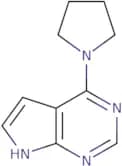
CAS:6-Pyrrolidino-7-deazapurine is a monophosphate nucleoside, which is a synthetic nucleotide. It has been shown to activate DNA synthesis and inhibit the growth of tumor cells. 6-Pyrrolidino-7-deazapurine has also been shown to be active against viruses, such as herpes, by inhibiting their replication. This product is stable at room temperature for up to one year and can be stored at -20°C for up to three years. The purity of this product is >98% with no detectable impurities.
Fórmula:C10H12N4Pureza:Min. 95%Peso molecular:188.23 g/mol4-Amino-1-(2',3',5'-tri-O-tert-butyldimethylsilyl-b-D-ribofuranosyl)-imidazo[4,5-c]pyridine
CAS:4-Amino-1-(2',3',5'-tri-O-tert-butyldimethylsilyl-b-D-ribofuranosyl)-imidazo[4,5-c]pyridine is a novel nucleoside analogue that has high purity and high quality. It is an activator of DNA synthesis, diphosphate and monophosphate of deoxyribonucleosides, ribonucleosides and analogues. 4-Amino-1-(2',3',5'-tri-O-tert-butyldimethylsilyl-b-D-ribofuranosyl)-imidazo[4,5-c]pyridine has been shown to have antiviral activities against herpes simplex virus type 1 (HSV1) in cell culture.Fórmula:C29H56N4O4Si3Pureza:Min. 95%Peso molecular:609.04 g/mol2'-Deoxy-5'-O-DMT-inosine 3'-succinyl CPG 1000Å
2'-Deoxy-5'-O-DMT-inosine 3'-succinyl CPG 1000Å is an antiviral and anticancer nucleoside. It is synthesized by the reaction of 2'-deoxy-5'-O-dimethoxytrityl-N4-benzoyladenosine with succinic anhydride. This product is a modified nucleoside that can be used in the synthesis of DNA or RNA, as well as to produce antiviral and anticancer compounds. The purity of this compound is typically greater than 99% and it has been shown to be stable for up to six months at room temperature.
2'-Deoxy-5'-O-DMT-inosine 3'-succinyl CPG 1000Å is also known by CAS number 57568-24-8.Pureza:Min. 95%2'-Deoxy-2'-fluoroadenosine-5'-triphosphate sodium salt - 100mM aqueous solution
2'-Deoxy-2'-fluoroadenosine-5'-triphosphate sodium salt - 100mM aqueous solution is a high purity synthetic compound that is used as an activator for the synthesis of DNA, RNA, and phosphoramidites. The product is in the form of a white to off-white solid and has high quality with purity of >99%. 2'-Deoxy-2'-fluoroadenosine-5'-triphosphate sodium salt - 100mM aqueous solution can be used in antiviral, anticancer, and antideoxyribonucleoside therapy. It inhibits viral replication by inhibiting reverse transcriptase activity in HIV and other retroviruses. It also inhibits tumor growth by interfering with DNA synthesis.Fórmula:C10H15FNO12P3·xNaPureza:Min. 95%Peso molecular:453.15 g/mol5'-O-DMT-4-thiouridine
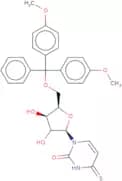
5'-O-DMT-4-thiouridine is a nucleoside analog that is used as a research tool in anticancer and antiviral studies. It is an activator of the phosphatase PP1 and has been shown to inhibit the growth of cultured human leukemia cells by inhibiting DNA synthesis. This compound has also been shown to be an inhibitor of HIV replication in vitro and in vivo, but it is not active against other viruses. 5'-O-DMT-4-thiouridine can be synthesized from uracil, 4-thiouracil, and DMT (dimethoxytrityl) using standard phosphoramidite chemistry. The purity of this compound is greater than 99%, and it can be obtained for use at a reasonable price.
Fórmula:C30H30N2O7SPureza:Min. 95%Peso molecular:562.64 g/mol2',3'-Dideoxy-3'-fluorocytidine
CAS:2',3'-Dideoxy-3'-fluorocytidine is a synthetic nucleoside analog that inhibits DNA synthesis by blocking the incorporation of deoxycytidine into DNA. It is used to treat lymphocytic leukemia, hepatitis, and virus infections. 2',3'-Dideoxy-3'-fluorocytidine has been shown to inhibit cell growth in solid tumours. The drug has also been shown to inhibit the production of immunodeficiency viruses such as human immunodeficiency virus type 1 (HIV-1) and human T-lymphotropic virus type I (HTLV-I), which causes acquired immune deficiency syndrome (AIDS). 2',3'-Dideoxy-3'-fluorocytidine inhibits viral replication by inhibiting the activity of the enzyme deaminase, which converts dATP to dTTP. This prevents DNA replication and transcription.Fórmula:C9H12FN3O3Pureza:Min. 95%Peso molecular:229.21 g/mol2'-Deoxyxanthosine ce-phosphoramidite (dx ce-phosphoramidite)
CAS:Please enquire for more information about 2'-Deoxyxanthosine ce-phosphoramidite (dx ce-phosphoramidite) including the price, delivery time and more detailed product information at the technical inquiry form on this page
Fórmula:C56H61N8O12PPureza:Min. 95%Peso molecular:1,069.1 g/mol7H-Pyrrolo[2,3d]pyrimidine
CAS:7H-Pyrrolo[2,3d]pyrimidine is a pyrimidine compound that has been shown to have potent antitumor activity. It inhibits the enzyme acyl-coenzyme A carboxylase (ACC) and blocks the production of malonyl-CoA, an intermediate in the metabolism of fatty acids. Malonyl-CoA is an allosteric activator of ACC, which is an important enzyme for regulating fatty acid synthesis. 7H-Pyrrolo[2,3d]pyrimidine also inhibits the expression of the gene encoding cb2 receptor, which is involved in inflammatory processes. The compound binds to a hydroxyl group on ACC to inhibit its activity. 7H-Pyrrolo[2,3d]pyrimidine has been shown to be effective against miapaca-2 cells and other cancer cell lines at concentrations as low as 1 nM. This compound also has aFórmula:C6H5N3Pureza:Min. 95%Peso molecular:119.12 g/molN6-Benzoyl-7-deaza-2'-deoxy-5'-O-tert-butyldimethylsilyl-7-iodoadenosine
CAS:N6-Benzoyl-7-deaza-2'-deoxy-5'-O-tert-butyldimethylsilyl-7-iodoadenosine is a novel nucleoside that has been shown to have anticancer and antiviral properties. It is a phosphoramidite of 7-iodoadenosine that has been modified to contain a benzoyl group at the 6 position. N6-Benzoyl-7-deaza-2'-deoxy-5'-O-tert-butyldimethylsilyl-(7)iodoadenosine can be used for the synthesis of oligonucleotides and DNA, as well as for the activation of latent HIV genes. This compound is also used in vitro to study the interactions between phosphoramidites and nucleosides.Fórmula:C24H31IN4O4SiPureza:Min. 95%Peso molecular:594.52 g/mol5'-O-DMT-inosine
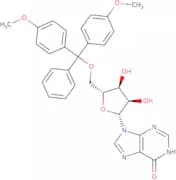
CAS:5'-O-DMT-inosine is a novel monophosphate nucleotide analogue. It is modified by the attachment of an aminooxy group to the 5' position of the pentose. This modification prevents ribonucleotide reductase from converting it into deoxyribonucleotides, which are then incorporated into DNA. 5'-O-DMT-inosine has been shown to be cytotoxic in human leukemia cells due to its ability to inhibit the synthesis of DNA and RNA.
Fórmula:C31H30N4O7Pureza:Min. 95%Peso molecular:570.59 g/mol8-Bromo-DA cep
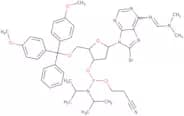
CAS:8-Bromo-2'-deoxyadenosine cep is a modified nucleoside that is used in the treatment of cancer. It has been shown to be effective in treating leukemia, lymphoma and myeloma. 8-Bromo-2'-deoxyadenosine cep inhibits the growth of cells by inhibiting DNA synthesis through inhibition of deoxynucleotide biosynthesis. This drug also has antiviral activity against herpes simplex virus type 1 (HSV1), herpes simplex virus type 2 (HSV2) and human immunodeficiency virus type 1 (HIV1). 8-Bromo-2'-deoxyadenosine cep is a synthetic nucleoside that is phosphoramidite that can be used to synthesize DNA or RNA.
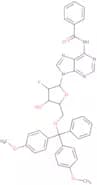
Fórmula:C43H52BrN8O6PPureza:Min. 95%Cor e Forma:PowderPeso molecular:887.8 g/molN6-Benzoyl-9-(2'-deoxy-5'-O-DMT-2'-fluoro-b-D-arabinofuranosyl)adenine
CAS:N6-Benzoyl-9-(2'-deoxy-5'-O-DMT-2'-fluoro-b-D-arabinofuranosyl)adenine is a synthetic nucleoside that has antiviral activity. It is activated by the enzyme ribonucleotide reductase and inhibits viral DNA synthesis. This agent also inhibits the production of deoxyribonucleosides, which are needed for DNA synthesis. In addition, this compound inhibits bacterial growth by inhibiting the enzyme DNA gyrase. N6-Benzoyl-9-(2'-deoxy-5'-O-DMT-2'-fluoro-b-D-arabinofuranosyl)adenine has novel properties in that it does not contain any ribose or phosphate groups. This product is available as a white powder with a purity of at least 98%.Fórmula:C38H34FN5O6Pureza:Min. 95%Peso molecular:675.71 g/mol2'-O-Acetyl-5'-O-benzoyl-3'-deoxy-5-methyluridine
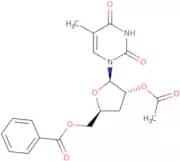
CAS:2'-O-Acetyl-5'-O-benzoyl-3'-deoxy-5-methyluridine (ABT-888) is a nucleoside analog that inhibits DNA synthesis and RNA transcription. It has been shown to induce apoptosis in human cancer cells, including leukemia, lymphoma and breast cancer cells. ABT-888 also has antiviral activity against herpes simplex virus type 1 and 2, vaccinia virus, and vesicular stomatitis virus.Fórmula:C19H20N2O7Pureza:Min. 95%Peso molecular:388.37 g/mol1-(a-D-Mannopyranosyl)thymine
CAS:1-(a-D-Mannopyranosyl)thymine is a phosphoramidite nucleoside with antiviral activity. It is an analog of thymine, in which the oxygen atom at the 5-position has been replaced by a mannose group and the hydroxyl group at the 4-position has been replaced by a methyl group. This compound has shown to have anticancer properties as well as inhibitory effects on HIV replication. Studies have also shown that 1-(a-D-mannopyranosyl)thymine inhibits proliferation and induces apoptosis in human cancer cell lines.Fórmula:C11H16N2O7Pureza:Min. 95%Cor e Forma:Light (Or Pale) Yellow SolidPeso molecular:288.75 g/mol2'-Deoxy-2'-fluorouridine-5'-triphosphate lithium salt - 100mM aqueous solution
2'-Deoxy-2'-fluorouridine-5'-triphosphate lithium salt is an antiviral drug that inhibits viral DNA replication by inhibiting viral polymerase. It is a novel nucleoside analogue with antiviral activity against RNA viruses, including influenza virus and HIV. 2'-Deoxy-2'-fluorouridine-5'-triphosphate lithium salt can be used as a precursor for the synthesis of modified monophosphate nucleosides, ribonucleosides and phosphoramidites. This product is supplied in high purity (98%) and high quality.Fórmula:C9H14N2O14P3F·xLiPureza:Min. 95%Peso molecular:486.13 g/molN4-Benzoyl-2'-deoxy-5-iodocytidine
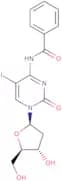
CAS:N4-Benzoyl-2'-deoxy-5-iodocytidine is a nucleoside that is used as an activator for RNA synthesis and in the synthesis of phosphoramidites. It has antiviral and anticancer properties and is novel for its potential use as a therapeutic agent.Fórmula:C16H18IN3O4Pureza:Min. 95%Peso molecular:443.24 g/molN4-Anisoyl-2'-deoxycytidine
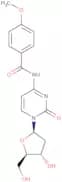
CAS:N4-Anisoyl-2'-deoxycytidine is a nucleoside that contains a long chain of four carbon atoms. It is the cyclic form of N4-anisoyl-2'-deoxyadenosine. This compound has been shown to be synthesized in yields of up to 71% using acid anhydrides and diamino compounds. N4-Anisoyl-2'-deoxycytidine is a bifunctional reagent that can be used as a starting material for the synthesis of oligodeoxyribonucleotides. The compound has also been shown to function as an effective inhibitor of DNA synthesis, which may lead to anti-cancer effects.Fórmula:C17H19N3O6Pureza:Min. 95%Cor e Forma:PowderPeso molecular:361.35 g/mol5-Ethynylpyrimidine
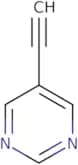
CAS:5-Ethynylpyrimidine is a supramolecular alkynyl group that has been shown to inhibit tyrosine kinase activity, cross-coupling, and the synthesis of proteins. It also exhibits luminescent properties and can be used in supramolecular chemistry. 5-Ethynylpyrimidine is a pyrimidine nucleoside, which is an organic compound that is a component of RNA. Pyrimidine nucleosides are important for protein synthesis and are used as luminophores or fluorescent resonance quenchers in biochemical assays for enzyme activity; they have also been shown to inhibit herpes simplex virus (HSV) replication. 5-Ethynylpyrimidine has been found to be able to bind terminal alkynes with high affinity.Fórmula:C6H4N2Pureza:Min. 95%Peso molecular:104.11 g/molAICAR 3',5'-cyclic phosphate
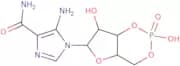
CAS:AICAR 3',5'-cyclic phosphate is an antiviral and anticancer agent that inhibits the production of DNA and RNA, which may be due to its ability to activate AMP-activated protein kinase. AICAR 3',5'-cyclic phosphate has been shown to inhibit the proliferation of human breast cancer cells in vitro. This drug also has anticancer activity against various types of cancers, including prostate cancer and melanoma. AICAR 3',5'-cyclic phosphate is a novel compound that can be used as a phosphoramidite reagent for the synthesis of oligonucleotides.
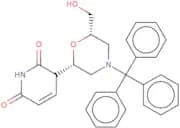
Fórmula:C9H13N4O7PPureza:Min. 95%Peso molecular:320.2 g/mol7’-OH-N-trityl morpholino uracil
CAS:Please enquire for more information about 7’-OH-N-trityl morpholino uracil including the price, delivery time and more detailed product information at the technical inquiry form on this page
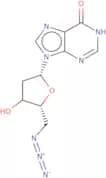
Fórmula:C28H27N3O4Peso molecular:469.53 g/mol5'-Azido-2',5'-dideoxyinosine
CAS:5'-Azido-2',5'-dideoxyinosine is a novel nucleoside which has been synthesized to investigate its anticancer and antiviral properties. 5'-Azido-2',5'-dideoxyinosine is an activator of ribonucleosides and deoxyribonucleosides, converting them into the corresponding monophosphate or diphosphate form. This product can be used as a building block for the synthesis of phosphoramidites and modified nucleosides. 5'-Azido-2',5'-dideoxyinosine has shown activity against cancer cells in vitro, in particular leukemia cell lines. It also has antiviral activity against HIV, herpes simplex virus type 1, and human cytomegalovirus (HCMV).Fórmula:C10H11N7O3Pureza:Min. 95%Peso molecular:277.24 g/mol




![2'-Deoxy-2'-iodo-adenosine-5'-[(beta,gamma)-imido]triphosphate sodium salt - 10mM aqueous solution](/_next/image/?url=https%3A%2Fstatic.cymitquimica.com%2Fproducts%2F3D%2Fthumb-webp%2FND166258.webp&w=3840&q=75)






![2'-Deoxyuridine-5'-[(a,b)-methyleno]triphosphate sodium salt - 10 mM aqueous solution](/_next/image/?url=https%3A%2Fstatic.cymitquimica.com%2Fproducts%2F3D%2Fthumb-webp%2FND45198.webp&w=3840&q=75)

![2'-Deoxyuridine-5'-[(a,b)-imido]triphosphate sodium salt - 10mM aqueous solution](/_next/image/?url=https%3A%2Fstatic.cymitquimica.com%2Fproducts%2F3D%2Fthumb-webp%2FND45196.webp&w=3840&q=75)



![4-Amino-1-(2',3',5'-tri-O-tert-butyldimethylsilyl-b-D-ribofuranosyl)-imidazo[4,5-c]pyridine](/_next/image/?url=https%3A%2Fstatic.cymitquimica.com%2Fproducts%2F3D%2Fthumb-webp%2FNA04493.webp&w=3840&q=75)


![7H-Pyrrolo[2,3d]pyrimidine](/_next/image/?url=https%3A%2Fstatic.cymitquimica.com%2Fproducts%2F3D%2Fthumb-webp%2FNP32608.webp&w=3840&q=75)