Bloqueadores Beta
Os bloqueadores beta, também conhecidos como agentes bloqueadores beta-adrenérgicos, são compostos que bloqueiam a ação da epinefrina (adrenalina) nos receptores beta, diminuindo a frequência cardíaca e reduzindo a pressão arterial. Eles são frequentemente usados para tratar condições como hipertensão, arritmias e insuficiência cardíaca. Na CymitQuimica, oferecemos uma variedade de bloqueadores beta para fins de pesquisa em estudos cardiovasculares e clínicos.
Subcategorias de "Bloqueadores Beta"
Foram encontrados 1520 produtos de "Bloqueadores Beta"
Ordenar por
Pureza (%)
0
100
|
0
|
50
|
90
|
95
|
100
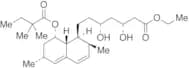
Simvastatin Hydroxy Acid Ethyl Ester
CAS:<p>Applications An impurity in Simvastatin (S485000).<br>References Sankar, D. et al.: Asian J. Chem., 21, 4294 (2009); Vuletic, M. et al.: J. Pharmac. Biomed. Anal., 37, 715 (2005);<br></p>Fórmula:C27H44O6Cor e Forma:Off-WhitePeso molecular:464.63N-[4-(4-Fluorophenyl)-5-hydroxymethyl-6-isopropylpyrimidin-2-yl]-N-methylmethanesulfonamide
CAS:Produto Controlado<p>Applications A Rosuvastatin (R700500) intermediate as HMG-CoA reductase inhibitor.<br>References Beck, et al.: J. Med. Chem., 33, 52 (1999),<br></p>Fórmula:C16H20FN3O3SCor e Forma:NeatPeso molecular:353.415-Oxo Rosuvastatin
CAS:Produto Controlado<p>Impurity Rosuvastatin EP Impurity C (Calcium Salt)<br>Stability Hygroscopic<br>Applications 5-Oxo Rosuvastatin (Rosuvastatin EP Impurity C (Calcium Salt)) is a Rosuvastatin (R700500) impurity.<br>References Endo, A., et al.: J. Antibiot., 32, 852 (1979), Beck, G., et al.: J. Med. Chem., 33, 52 (1990), Koga, T., et al.: Lipids, 30, 775 (1995),<br></p>Fórmula:C22H26FN3O6SCor e Forma:Light Yellow To Dark BeigePeso molecular:479.523-[4-(2-Methoxyethyl)phenoxy]-1,2-propanediol
CAS:<p>3-[4-(2-Methoxyethyl)phenoxy]-1,2-propanediol is a synthetic intermediate. It is metabolized from the drug product 3-[4-(2-Methoxyethyl)phenoxy]propionic acid and may be used as an impurity standard for this compound. This chemical is a high purity, pharmacopoeia grade material that is suitable for use in drug development and pharmaceutical research. 3-[4-(2-Methoxyethyl)phenoxy]-1,2-propanediol has a natural origin and can be produced synthetically or through biotransformation of other compounds.</p>Fórmula:C12H18O4Pureza:Min. 96 Area-%Cor e Forma:White Off-White PowderPeso molecular:226.27 g/mol4-(2-Methoxyethyl)phenol
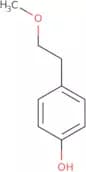
CAS:<p>4-(2-Methoxyethyl)phenol is a synthetic compound that is an antihypertensive agent. It is used to reduce high blood pressure, which may be due to its ability to block the action of angiotensin II, a potent vasoconstrictive hormone, by binding with its receptor. 4-(2-Methoxyethyl)phenol has been shown to be more potent than metoprolol succinate and less toxic than hydroxylated compounds such as propranolol in pharmacokinetic studies. In addition, 4-(2-Methoxyethyl)phenol has been found to have a low risk of congestive heart failure. The industrial process for this substance involves the reaction of hydrochloric acid with phenol in the presence of a catalyst such as aluminium chloride or zinc chloride.</p>Fórmula:C9H12O2Pureza:Min. 95%Cor e Forma:PowderPeso molecular:152.19 g/molrac-Diacetolol
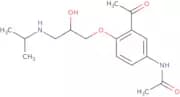
CAS:<p>Rac-Diacetolol is a racemic mixture of two isomers, (+) and (-), of acebutolol. Rac-Diacetolol is used to treat bowel disease, chronic oral inflammation and cardiac arrhythmias. It is also used as an experimental solubility probe in the study of the interactions between drugs and biological membranes. Rac-Diacetolol has been shown to have a low affinity for cytochrome P450 enzymes, which are responsible for metabolizing many drugs in the body. Rac-Diacetolol has been found to reduce plasma concentrations of PCSK9 antibody in patients with inflammatory bowel disease. The drug also has anti-inflammatory properties that may be due to its inhibition of prostaglandin synthesis.</p>Fórmula:C16H24N2O4Pureza:Min. 95%Cor e Forma:PowderPeso molecular:308.37 g/mol3-Hydroxy-4-(1-naphthyloxy)-butanenitrile
CAS:Produto Controlado<p>Applications 3-Hydroxy-4-(1-naphthyloxy)-butanenitrile is an intermediate in the synthesis of Nadoxolol (N201040), which is a beta-adrenergic receptor blocker.<br>References Kappor, M., et al.: Bioorg. Chem., 31, 259 (2003)<br></p>Fórmula:C14H13NO2Cor e Forma:NeatPeso molecular:227.26Esmolol hydrochloride
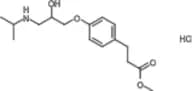
CAS:<p>Esmolol is a cardioselective beta-blocker used in parenteral forms in the treatment of arrhythmias and severe hypertension.</p>Fórmula:C16H25NO4·HClPureza:98.72% - 99.48%Cor e Forma:White SolidPeso molecular:331.15Penbutolol sulfate
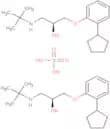
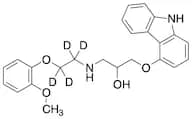
CAS:<p>Penbutolol sulfate ((-)-Terbuclomine) is able to bind to both β2-adrenergic receptor and β1-adrenergic receptor, thus making it a non-selective β blocker.</p>Fórmula:C18H29NO2H2O4SPureza:98.55%Cor e Forma:SolidPeso molecular:340.47(±)-Carvedilol-d4 (ethyl-d4)
CAS:Produto Controlado<p>Applications (±)-Carvedilol-d4 (ethyl-d4) (CAS# 1133705-56-2) is a useful isotopically labeled research compound.<br></p>Fórmula:C24H22D4N2O4Cor e Forma:NeatPeso molecular:410.51Atorvastatin Lactam Phenanthrene Calcium Salt Impurity (mixture of diastereomers)
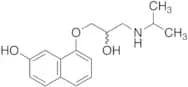
CAS:Produto Controlado<p>Impurity Atorvastatin lactam phenanthrene calcium salt impurity<br>Applications Atorvastatin (A791750) impurity. A stable Atorvastatin formulation.<br></p>Fórmula:C33H32FN2O6·CaCor e Forma:NeatPeso molecular:1183.31rac 7-Hydroxy Propranolol
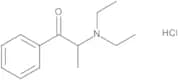
CAS:Produto Controlado<p>Applications A metabolite of Propranolol.<br>References Otton, S., et al.: Br. J. Clin. Pharmacol., 30, 751 (1990), Fujita, S., et al.: J. Pharmacol. Exp. Ther., 264, 226 (1993), Bichara, N., et al.: Drug Metab. Dispos., 24, 112 (1996), Tasaki, T., et al.: J. Biochem., 123, 162 (1998),<br></p>Fórmula:C16H21NO3Cor e Forma:NeatPeso molecular:275.34Amfepramone Hydrochloride (1 mg/ml in Acetonitrile)
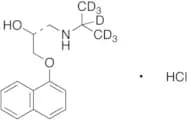
CAS:Produto ControladoFórmula:C13H19NO•HClCor e Forma:ColourlessPeso molecular:241.76(R)-Propranolol-d7 Hydrochloride
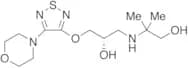
CAS:Produto Controlado<p>Applications The labelled R-enantiomer of Propranolol (P831800). β−Adrenergic blocker. Antihypertensive; antianginal; antiarrhythmic (class II).<br>References Bond, et al.: Nature, 213, 721 (1967), Hansteen, V., et al.: Br. Med. J., 284, 155 (1982), Diamond, S., et al.: J. Clin. Pharmacol., 28, 193 (1988),<br></p>Fórmula:C16H15D7ClNO2Cor e Forma:NeatPeso molecular:302.85(S)-Hydroxy Timolol
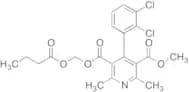
CAS:Produto Controlado<p>Applications (S)-(-)-Hydroxy Timolol is a metabolite of the non-selective beta-adrenergic receptor blocker, Timolol (T443710).<br>References Volotinen, M. et al.: Basic Clin. Pharmacol. Toxicol., 106, 302 (2010);<br></p>Fórmula:C13H24N4O4SCor e Forma:NeatPeso molecular:332.424-(2,3-Dichlorophenyl)-2,6-dimethyl-3,5-pyridinedicarboxylic Acid Methyl (1-oxobutoxy)methyl Ester
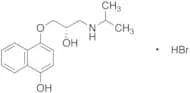
CAS:Produto ControladoFórmula:C21H21Cl2NO6Cor e Forma:NeatPeso molecular:454.3(S)-4-Hydroxy Propranolol Hydrobromide
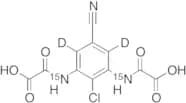
CAS:Produto Controlado<p>Applications (S)-4-Hydroxy Propranolol is the main metabolite of (S)-Propranolol (P831795).<br>References Shwed, J., et al.: Xenobiotica, 22, 973 (1992), Fujita, K., et al.: Biol. Pharm. Bull., 22, 446 (1999), Walle, U., et al.: Drug Metab. Dispos., 30, 564 (2002),<br></p>Fórmula:C16H21NO3·ClHCor e Forma:NeatPeso molecular:311.80Lodoxamide-15N2,d2
CAS:Produto Controlado<p>Applications Lodoxamide-15N2,d2 is the labelled form of Lodoxamide which is an antiallergic drug that acts as a mast cell stabilizer. It is effective in the treatment of allergic conjunctivitis and in decreasing vascular permeability.<br>References Ciprandi, G., et al.: Allergy, 51(12), 946-951 (1996); Bayer, Atilla., et al.: Ophthalmologica, 217(2), 119-123 (2003)<br></p>Fórmula:C11H4D2ClN15N2O6Cor e Forma:NeatPeso molecular:315.63Hydroxyatenolol-d7
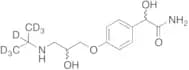
CAS:Produto Controlado<p>Applications Hydroxyatenolol-d7 is the isotope labelled analog of Hydroxyatenolol (H802480); a metabolite of Atenolol (A790075) which is a cardioselective β-adrenergic blocker, antihypertensive, antianginal, and antiarrhythmic (class II).<br>References Escher, B., et al.: Environ. Sci. Technol., 40, 7402 (2006); Caplar, V., et al.: Anal. Profiles Drug Subs., 13, 1 (1984)<br></p>Fórmula:C14H15D7N2O4Cor e Forma:NeatPeso molecular:289.38Nilvadipine
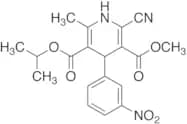
CAS:Produto Controlado<p>Applications Used as an antihypertensive and antianginal.<br>References Gross, G.J., et al.: Gen. Pharmacol., 14, 677 (1983), Molyvdas, P.A. and Sperelakis, N.: J. Cardiovasc. Pharmacol., 8, 449 (1986), Mizuno, K., et al.: Res. Comm. Chem. Pathol. Pharmacol., 52, 3 (1986)<br></p>Fórmula:C19H19N3O6Cor e Forma:NeatPeso molecular:385.37

![N-[4-(4-Fluorophenyl)-5-hydroxymethyl-6-isopropylpyrimidin-2-yl]-N-methylmethanesulfonamide](/_next/image/?url=https%3A%2Fstatic.cymitquimica.com%2Fproducts%2FTR%2Fthumb-webp%2FF595380.webp&w=3840&q=75)

![3-[4-(2-Methoxyethyl)phenoxy]-1,2-propanediol](/_next/image/?url=https%3A%2Fstatic.cymitquimica.com%2Fproducts%2F3D%2Fthumb-webp%2FIM63783.webp&w=3840&q=75)