Enzimas em Proteínas Recombinantes
As enzimas aceleram as reações químicas, atuando como catalisadores biológicos, atuando sobre os substratos e convertendo-os em diferentes moléculas chamadas produtos. Essas proteínas são indispensáveis em processos bioquímicos e aplicações industriais, facilitando reações em condições suaves com alta especificidade e eficiência. Na CymitQuimica, oferecemos uma ampla seleção de enzimas de alta qualidade para apoiar suas aplicações de pesquisa, industriais e clínicas.
Foram encontrados 3315 produtos de "Enzimas em Proteínas Recombinantes"
Ordenar por
Pureza (%)
0
100
|
0
|
50
|
90
|
95
|
100
Lyticase
CAS:<p>Lyticase is a lysing enzyme that is designed to lyse cells in a biological sample. It contains an optimized wild-type guanine nucleotide-binding protein and has been shown to have high enzyme activities. Lyticase has also been shown to be active against opportunistic fungal strains, such as Candida glabrata, by disrupting their cell membranes. Lyticase is classified as a signal peptide with nuclear DNA, which allows it to be used in wastewater treatment applications. The enzyme can also be used for the analysis of the Toll-like receptor (TLR) response of microbes due to its electrochemical impedance spectroscopy properties.</p>Pureza:Min. 95%Carnitine acetyltransferase
CAS:<p>From pigeon breast muscle - Carnitine acetyltransferase (EC 2.3.1.7, also Carnitine O-acetyltransferase) is an enzyme that catalyzes the following chemical reaction: acetyl-CoA + carnitine ⇌ CoA + acetylcarnitine</p>rec HIV-1 Protease (affinity purified) (expressed in E. coli)
<p>A proteolytic enzyme synthesized by the HIV cell as part of the GagPol polyprotein</p>Glyceraldehyde-3-phosphate dehydrogenase
CAS:<p>75u/mg - Glyceraldehyde 3-phosphate dehydrogenase (GAPDH; EC 1.2.1.12) is an enzyme that catalyzes the following reaction: glyceraldehyde 3-phosphate + NAD+ + Pi ⇌ glycerate 1,3-bisphosphate + NADH + H+ One unit of GAPDH will convert 1.0 μmole of glyceraldehyde 3-phosphate into glycerate 1,3-bisphosphate per minute at pH 8.5 and 37 °C in the presence of NAD+ and phosphate. NAD+ is available here.</p>Fórmula:C3H7O6PPureza:Min. 95%Peso molecular:170.06 g/molCocarboxylase hydrochloride
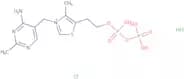
CAS:<p>Cocarboxylase hydrochloride is a coenzyme derivative, which is primarily sourced from thiamine (vitamin B1). It plays a crucial role in biochemical processes by facilitating the enzymatic decarboxylation of alpha-keto acids within the cellular environment. This action is fundamental in energy production as it aids in the conversion of pyruvate to acetyl-CoA, subsequently entering the citric acid cycle. Cocarboxylase hydrochloride’s involvement in carbohydrate metabolism is especially vital for tissues with high metabolic rates, such as the heart and brain.</p>Fórmula:C12H19N4O7P2S·ClHClPureza:Min. 95%Peso molecular:497.23 g/molSialic acid aldolase
<p>E. coli recombinant sialic acid aldolase (EC 4.1.3.3) from Pasteurella multocida. One unit is defined as the amount of enzyme that catalyses the formation of 1 umol Neu5Ac from ManNAc and Pyruvate per minute at 37 ℃.Activity: 9U/mg</p>Thioredoxin reductase from escherichia coli
CAS:<p>Thioredoxin reductase (TR, TrxR) (EC 1.8.1.9) is an enzyme that reduce thioredoxin using NADPH as a co-factor, and also contains FAD. One unit of thioredoxin reductase will raise increase light absorbance by 1.0 per minute at 412nm in the presence of thioredoxin and Ellman's reagent at pH 7.0 and 25 °C.</p>Pureza:Min. 95%Phosphodiesterase II from bovine spleen
CAS:<p>Phosphodiesterase II from bovine spleen is an enzyme derived from the spleen of cattle, which serves as a crucial biological catalyst for the hydrolysis of phosphodiester bonds in nucleotide sequences. This enzyme's mode of action involves cleaving the phosphodiester linkages within nucleic acids, facilitating the breakdown of these macromolecules into smaller nucleotide units.</p>Pureza:Min. 95%Oxalate Oxidase, freeze-dried, from Wheat
CAS:<p>Oxalate Oxidase, freeze-dried, is an enzymatic preparation that serves as a catalyst in biochemical reactions. This enzyme is derived from wheat, a common plant source, ensuring a naturally occurring origin. Its primary mode of action is the oxidation of oxalate into carbon dioxide and hydrogen peroxide. This biochemical activity is significant in various scientific applications, specifically in the breakdown of oxalate, which plays a crucial role in metabolic and environmental processes.</p>Cor e Forma:PowderGlycerol 3-phosphate oxidase, from pediococcus sp., 40-84U/mg
CAS:<p>Glycerol-3-phosphate oxidase (EC 1.1.3.21) is an enzyme that catalyzes the following reaction: glycerol-3-phosphate + O2 ⇌ dihydroxyacetone phosphate + H2O2 One unit of Glycerol-3-phosphate oxidase will generate 1.0 μmole H2O2 per min at 37°C, under the presence of O2 and the optimal pH. If required, you can remove the build-up of hydrogen peroxide using catalase.</p>Pureza:Min. 95%Sulfatase, from helix pomatia ≥10,000 units/g solid
CAS:<p>Sulfatase from Helix pomatia is a highly potent enzyme that is capable of hydrolyzing sulfated compounds and sulfate esters. It has been widely used in various applications such as glucosinolate analysis, genistein extraction preparation, and regiospecificity studies. With a concentration of ≥10,000 units per gram of solid, this sulfatase offers exceptional enzymatic activity for sulfatase assays. It effectively catalyzes the hydrolysis of sulfated substrates, including p-nitrocatechol sulfate, naphthyl sulfate and phenyl sulfates.The enzyme can be incubated with the desired sample to facilitate the release of sulfate groups from sulfated compounds. Sulfatase from Helix pomatia is a valuable tool for researchers and scientists working in diverse fields requiring efficient and reliable enzymatic hydrolysis capabilities. Additionally the enzyme has been found to have industrial applications, such as in the bioconversion of industrial chemicals, where it can be used as a catalyst.</p>Cor e Forma:PowderTriose phosphate isomerase
CAS:<p>Triose-phosphate isomerase (TPI, TIM; EC 5.3.1.1) is an enzyme that catalyzes the reversible isomerisation of dihydroxyacetone phosphate and D-glyceraldehyde 3-phosphate: DHAP ⇌ GADP The reaction mechanism involves the formation of an enediol intermediate. One unit of Triose-phosphate isomerase will convert 1.0 μmole glyceraldehyde 3-phosphate to dihydroxyacetone phosphate per min at pH 7.6 and 25 °C.</p>Pureza:Min. 95%Cholesterol oxidase from microorganisms
CAS:<p>Cholesterol oxidase (EC 1.1.3.6) is an enzyme that catalyzes the following reaction: cholesterol + O2 ⇌ cholest-4-en-3-one + H2O2One unit of cholesterol oxidase will convert 1.0 μmole of cholesterol into cholest-4-en-3-one per min at pH 7.5 and 25 °C. You can remove the build-up of hydrogen peroxide using catalase.</p>Pureza:Min. 95%Glycerokinase, cellulomonas species
CAS:<p>Glycerokinase (glycerol kinase, GP, ATP-glycerol 3-phosphotransferase; EC 2.7.1.30) is an enzyme that catalyzes the following reaction: ATP + glycerol ⇌ ADP + glycerol 3-phosphate One unit of Glycerokinase will convert 1.0 μmole of glycerol and ATP to glycerol 3-phosphate and ADP per min at pH 9.8 and 25 °C.</p>Cor e Forma:PowderPoly(ethylene terephthalate) hydrolase
<p>Poly(ethylene terephthalate) hydrolase is an enzyme involved in the breakdown of Polyethylene terephthalate which is present in many plastics Polyethylene terephthalate hydrolytic enzymes may be useful in biotechnology, for use in waste treatment, biocatalysis and biorecycling</p>Pureza:Min. 95%Sarcosine oxidase from bacillus sp., >15 units/mg solid, lyophilized powder
CAS:<p>Sarcosine oxidase (Monomeric sarcosine oxidase, MSOX, EC 1.5.3.1) is an enzyme that catalyzes the oxidative demethylation of sarcosine to yield glycine, H2O2 and formaldehyde in the following reaction: CH3-NH2+-CH2-COO- + H2O + O2 → NH3+-CH2-COO- + H2O2 + CH2O or sarcosine + water + oxygen → glycine + hydrogen peroxyde + formaldehydeOne unit of Sarcosine oxidase will form 1.0 micromole of formaldehyde from sarcosine per minute at pH 8.3 and 37 °C. You can remove the build-up of hydrogen peroxide using catalase.</p>Fórmula:C10H12N8O3Pureza:Min. 95%Cor e Forma:PowderPeso molecular:292.25 g/molKRAS Protein, Human, Recombinant (G12S, GST)
<p>Expression system: E. coli<br>Length: 1-169, Partial<br>Activity: BLI</p>Cor e Forma:Odour Lyophilized PowderCarboxypeptidase Q Protein, Human, Recombinant (His)
<p>Expression system: HEK297 Cells<br>Length: 21-472, Full Length of Mature Protein<br>Activity: Not Tested</p>Cor e Forma:Lyophilized PowderPeso molecular:49.72 kDa (Predicted)GUCY2C Protein, Canine, Recombinant (His)
<p>GUCY2C Protein, Canine, Recombinant (His) is expressed in HEK293 mammalian cells with His tag.</p>Cor e Forma:Lyophilized PowderPeso molecular:47.9 kDa (predicted); 84.32 kDa (reducing conditions)Ref: TM-TMPY-06518
Produto descontinuadoPKC iota Protein, Human, Recombinant (GST)
<p>Protein kinase C iota type, also known as Atypical protein kinase C-lambda/iota, aPKC-lambda/iota and PRKCI, is a cytoplasm, membrane and nucleus protein which</p>Cor e Forma:Lyophilized PowderPeso molecular:93.5 kDa (predicted); 100 kDa (reducing conditions)