Enzimas em Proteínas Recombinantes
Foram encontrados 3319 produtos de "Enzimas em Proteínas Recombinantes"
Neuron-specific enolase human
CAS:Neuron-specific enolase human (ENO2, Enolase 2, Neural enolase, Gamma-enolase, Phosphopyruvate hydratase, 2-phospho-D-glycerate hydro-lyase; EC 4.2.1.11) is the enzyme that is catalyzes the following reaction: 2-phospho-D-glycerate ⇌ phosphoenolpyruvate + H2O One unit of enolase will convert 1.0 μmole of 2-phosphoglycerate to phosphoenolpyruvate per min.
Ubiquitin thiolesterase UCHL1
CAS:Ubiquitin thiolesterase UCHL1 (Ubiquitin carboxy-terminal hydrolase L1; EC 3.1.2.15) is an enzyme that hydrolyses small C-terminal ubiquitin adducts to regenerate ubiquitin.
Superoxide dismutase PEG
Superoxide dismutase coupled to polyethylene glycol. Superoxide dismutase (EC 1.15.1.1) is an enzyme that catalyzes the following reaction: 2 H+ + 2 O2− → O2 + H2O2 thus converting an extremely reactive and cytotoxic superoxide radical into oxygen and (significantly less reactive) hydrogen peroxide.
Butyrylcholinesterase
Butyrylcholinesterase (BCHE, BuChE, PCHE, pseudocholinesterase, plasma cholinesterase, Acylcholine acyl-hydrolase, Choline esterase; EC 3.1.1.8, CAS No [9001-08-5]) is an enzyme that made in the liver and found mainly in blood plasma. It catalyzes the following reaction: Acylcholine + H2O → choline + carboxylic acidOne unit of Butyrylcholinesterase will change absorbance by 0.2 milliunits (mA) per minute at optimal buffer conditions and 37 ̊C. Equine serum butyrylcholinesterase is supplied as white to pale grey-green powder with activity of ≥50U/mg and specific activity of ≥300U/mg protein. It can be dissolved at 5 mg/mL concentration in 50 mM Tris-HCl pH 7.3 - 7.5, giving colorless to slightly green solution. Equine serum butyrylcholinesterase is activated by Ca2+, optimum pH 7-8, KM=18 µM (butyrylthiocholine at 25°C). Store at -20°C on arrival.Chitinase
CAS:Chitinase (systematic name (1→4)-2-acetamido-2-deoxy-β-D-glucan glycanohydrolase, EC 3.2.1.14) is a hydrolase that breaks down glycosidic bonds in chitin. One unit of chitinase will yield 1.0 mg of N-acetyl-D-glucosamine from chitin per hour at pH 6.0 and 25 °C.Fórmula:C17H16N8ZnPureza:Min. 95%Peso molecular:397.74 g/molLactase - >300U/mg
CAS:beta-Galactosidase (EC 3.2.1.23, shortly beta-Gal, also know as lactase) catalyses the hydrolysis of beta-d-galactoside in the presence of water to galactose and alcohol, or lactose into glucose and galactose. beta-Gal has a molecular weight of 540,000 and is composed of four identical subunits of MW 135,000, each with an independent active site. The enzyme has divalent metals as cofactors, with chelated Mg2+ ions required to maintain active site conformation. The molecule contains numerous sulfhydryl groups and is glycosylated.Aminopeptidase, Aeromonas proteolytica
CAS:One unit of Aminopeptidase (3.4.11.10) will hydrolyze 1.0 μmole of L-leucine p-nitroanilide to p-nitroaniline and L-leucine per min at pH 8.0 and 25 °C.Lipase Kit, 25 unique EUCODIS® lipases, recombinant - EL Kit
Lipases belong to the family of esterases and naturally act on triglycerides at lipid-water interfaces. Lipases/esterases can be used as versatile tools in hydrolytic reactions, esterifications and transesterification reactions in industrial and food applications. The Lipase kit contains 25 lipases with different pH and temperature optima and substrate specificity properties.
β-1,4-Galactosyltransferase 1
β-1,4-Galactosyltransferase 1 is an enzyme that catalyzes the synthesis of the glycosaminoglycan-protein linkage in proteoglycans.Ribonuclease T1 from aspergillus oryzae
CAS:Ribonuclease T1 is an endonuclease enzyme, which is derived from the fungus Aspergillus oryzae. It specifically cleaves single-stranded RNA at the 3' end of guanosine residues, which involves hydrolyzing the phosphodiester bond to produce 3′-phosphomononucleotides and 5′-hydroxylated oligonucleotides. This enzyme’s high specificity and catalytic efficiency make it valuable for various applications.Pureza:Min. 95%Ribonuclease A
CAS:Ribonuclease A (RNase A) is widely used to break down RNA in DNA purification. RNase A catalyzes the endonucleolytic cleavage of phosphodiester bonds of RNA.Alcohol dehydrogenase, from yeast
CAS:Alcohol dehydrogenase (EC 1.1.1.1) is the enzyme that catalyzes interconversion between alcohols and aldehydes or ketones, using NAD+/NADH as a cofactor in the following reaction: CH3CH2OH + NAD+ ⇔ CH3CHO + NADH + H+ One unit of alcohol dehydrogenase will convert 1.0 µmol of ethanol to acetaldehyde per minute at pH 8.8 and 25 °C.
EUCODIS® CalB02 ICE, engineered variant of Candida antarctica Lipase B, covalent immobilization on hydrophobic carrier - ELCB02ICE
Lipases belong to the family of esterases and naturally act on triglycerides at lipid-water interfaces. Lipases/esterases can be used as versatile tools in hydrolytic reactions, esterifications and transesterification reactions in industrial and food applications. The CalB02 ICE lipase has been immobilized on a hydrophobic carrier by a covalent linkage. The immobilized CalB02 lipase has a temperature optimum in the 40 - 50 °C range and pH optimum between pH 5 and 8.
Protease from Streptomyces griseus
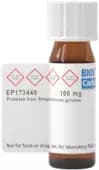
CAS:Protease enzymes break down proteins and are essential for many biological processes, including digestion, cellular regulation and blood clotting. They are also used in many industrial and biotechnological applications for example in food processing and in detergents.
Pureza:Min. 95%Cor e Forma:PowderGlutathione peroxidase
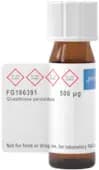
CAS:Glutathione peroxidase (EC 1.11.1.9) is an enzyme that reduces peroxides to limit oxidative damage, by catalyzing the following reaction: 2 GSH + H2O2 → GS–SG + 2 H2O One unit of glutathione peroxidase will catalyze the conversion of 1.0 µmole of H2O2 per minute at pH 7.0 and 25 °C in the presence of reduced glutathione. Reduced glutahione is available here.Pureza:Min. 95%Peso molecular:84,500 g/molCytochrome C oxidase
CAS:Cytochrome C oxidase (originally assigned EC 1.9.3.1, now re-assigned EC 7.1.1.9) is an enzyme that catalyzes the following reaction: 4 Fe2+ – cytochrome c + 4 H+ + O2 → 4 Fe3+ – cytochrome c + 2 H2O
Lipase 077, acidic lipase - recombinant
Lipase 77 recombinantly expressed in P. pastoris comes in a spray-dried formulation. It has its pH optimum at 4-5. Lipases belong to the family of esterases and naturally act on triglycerides at lipid-water interfaces catalyzing hydrolytic reactions, esterifications and transesterification reactions in industrial and food applications. Lipase 77 was shown to hydrolyze p-Nitrophenyl esters of butyrate and triglycerides.
Protein phosphatase 2C
CAS:Protein phosphatase 2C is a key enzyme, which is a serine/threonine-specific phosphatase, derived from various organisms including humans, plants, and bacteria. This enzyme plays a pivotal role in cellular signaling by removing phosphate groups from serine and threonine residues on target proteins, a process known as dephosphorylation. This action is crucial for the regulation of diverse cellular functions, including stress responses, cell division, and apoptosis.C. rugosa Lipase 02, CRL 2 from Candida rugosa - ELCR02
Lipases belong to the family of esterases and naturally act on triglycerides at lipid-water interfaces. Lipases/esterases can be used as versatile tools in hydrolytic reactions, esterifications and transesterification reactions in industrial and food applications. The Lipase 02 from the yeast Candida rugosa has a temperature optimum in the 30 - 50 °C range and pH optimum between pH 7 and 8.