Outros
Foram encontrados 6275 produtos de "Outros"
Ordenar por
Pureza (%)
0
100
|
0
|
50
|
90
|
95
|
100
2-Methyl-4-nitrophenyl b-D-galactopyranoside
<p>2-Methyl-4-nitrophenyl b-D-galactopyranoside is a chemiluminescent substrate that is used in various applications. It is a ligand that binds to the enzyme beta-galactosidase and is used in diagnostics for detecting the presence of the enzyme. 2-Methyl-4-nitrophenyl b-D-galactopyranoside has been shown to be an appropriate substrate for chemiluminescence reactions, such as those used in diagnostic or research applications. The product also has been tested for potential toxicity and found not to be toxic at concentrations up to 100mg/mL. This product can be used in a variety of applications, including food testing, bacterial culture media, and environmental testing.</p>Pureza:Min. 95%Peso molecular:315.28 g/molN-(4-Nitrophenyl)-D-glucopyranosylamine
<p>N-(4-Nitrophenyl)-D-glucopyranosylamine is a conjugate that is used in food testing, environmental testing, and diagnostics. It is a fluorogenic substrate that reacts with the enzyme glucose oxidase to produce a yellow color. This product has high purity and quality and CAS No. 553-03-6. It also has bioluminescence properties.</p>Pureza:Min. 95%4-Nitrophenyl trimethylacetate
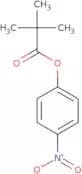
CAS:<p>4-Nitrophenyl trimethylacetate is a cytosolic proteinase inhibitor. It binds to the active site of trypsin and other enzymes that hydrolyze peptide bonds, thereby inhibiting the activity of these enzymes. 4-Nitrophenyl trimethylacetate has been shown to inhibit soybean trypsin, which has led to its use as a model system for studying enzyme inhibition. The binding site on 4-Nitrophenyl trimethylacetate is competitive with respect to substrate binding but not with respect to the enzyme's catalytic triad. This inhibitor also has a high buffer capacity and can be used in low pH systems.</p>Pureza:Min. 95%Peso molecular:223.23 g/molAldol® 515 β-D-xylopyranoside, Biosynth Patent: EP 2427431 and US 8940909
CAS:<p>Aldol® 515 beta-D-xylopyranoside is a chromogenic substrate that is used in food testing. It is an alternative to the more common glucose and sucrose, which are not suitable for some types of assays. Aldol® 515 beta-D-xylopyranoside is also used in diagnostics as a ligand for fluorescent antibody staining and chemiluminescence assays. It has been shown to increase the sensitivity of these tests by up to 10 times. The substrate has been tested extensively and is safe for use with a wide range of bacteria including E. coli, S. typhimurium, M. tuberculosis, and C. albicans at concentrations up to 100 mM without any inhibitory effects on growth or viability.<br>END>.</p>Fórmula:C28H34N2O6Pureza:Min. 95.0 Area-%Peso molecular:494.59 g/mol5-Bromo-6-chloro-3-indoxyl nonanoate
CAS:<p>5-Bromo-6-chloro-3-indoxyl nonanoate is a chemical compound that is used in the detection of bioluminescence. It is a substrate for enzymes, such as luciferase, and can be used to measure the amount of light emitted during the reaction. The CAS number for this molecule is 682802-80-8.</p>Pureza:Min. 95%Peso molecular:386.71 g/mol5-Bromo-4-chloro-3-indoxyl nonanoate
CAS:<p>5-Bromo-4-chloro-3-indoxyl nonanoate (5BCNI) is a chromogenic substrate for the detection of alkaline phosphatase. It is soluble in most organic solvents and is stable at room temperature for up to 30 days. 5BCNI has been shown to be a high quality, sensitive and specific substrate for the detection of alkaline phosphatase in culture media, diagnostics, conjugates, environmental testing and chemiluminescence. It has also been used as an enzyme substrate in bioluminescence studies. The CAS number for 5BCNI is 133950-77-3.</p>Fórmula:C17H21BrClNO2Peso molecular:386.72 g/mol4-Nitrophenyl b-D-cellopentaoside hexadecaacetate
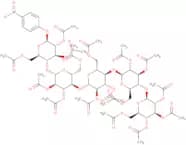
CAS:<p>4-Nitrophenyl b-D-cellopentaoside hexadecaacetate is a fluorogenic substrate that is used to study the activity of various enzymes. It reacts with hydrolytic enzymes in the presence of hydrogen peroxide to produce light, and it can be used for food testing, environmental testing, and diagnostics. 4-Nitrophenyl b-D-cellopentaoside hexadecaacetate is a conjugate of 4-nitrophenol and cellobiose pentaacetate that has a high purity and high quality. The CAS number for this compound is 129411-66-1.</p>Pureza:Min. 95%Peso molecular:1,622.4 g/mol4-Nitrophenyl 2-acetamido-4-O-(2-acetamido-3,4,6-tri-O-acetyl-2-deoxy-b-D-glucopyranosyl)-3,6-di-O-acetyl-2-deoxy-b-D-glucopyranosid e
CAS:<p>4-Nitrophenyl 2-acetamido-4-O-(2-acetamido-3,4,6-tri-O-acetyl-2-deoxy-b-D-glucopyranosyl)-3,6-di-O -acetyl2 deoxy b D glucopyranosid e is a chemiluminescence substrate that reacts with hydrogen peroxide to produce light. It is used in diagnostics for the detection of bacterial and fungal cultures. The reaction between 4NPAA and hydrogen peroxide generates light at 540 nm. This product has been tested for purity and quality using various methods including culture media, environmental testing, bioluminescence, staining, fluorogenic substrate, enzyme substrate, food testing and conjugate.</p>Pureza:Min. 95%Peso molecular:755.68 g/mol4-Nitrophenyl phosphate bis(tris) salt
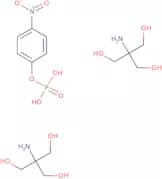
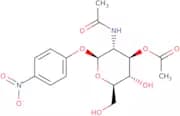
CAS:<p>Substrate for alkaline phosphatase</p>Fórmula:C6H6NO6P•(C4H11NO3)2Pureza:(%) Min. 99%Cor e Forma:PowderPeso molecular:461.36 g/mol4-Nitrophenyl 2-acetamido-3-O-acetyl-2-deoxy-b-D-glucopyranoside
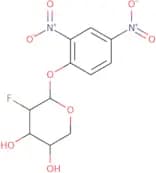
CAS:<p>4-Nitrophenyl 2-acetamido-3-O-acetyl-2-deoxy-b-D-glucopyranoside is a fluorogenic substrate for the enzyme acetylcholinesterase. It can be used in food testing, environmental testing and diagnostics. 4NP2A2DGBG is a high purity, high quality product with a CAS number of 23262-57-9.</p>Pureza:Min. 95%Peso molecular:384.34 g/mol2,4-Dinitrophenyl 2-deoxy-2-fluoro-b-D-xylopyranoside
CAS:<p>2,4-Dinitrophenyl 2-deoxy-2-fluoro-b-D-xylopyranoside (DNFX) is a transglycosylation reagent that can be used to inactivate enzymes that catalyze the synthesis of xylosides. DNFX undergoes a covalent reaction with these enzymes and inhibits them by binding to the active site. DNFX catalyses the reaction between xylose and nucleophiles such as hydroxide ions, thiols, or amines. DNFX also has a catalytic effect on electrospray ionization and can be used for the detection of nucleophile activity.</p>Pureza:Min. 95%Cor e Forma:White PowderPeso molecular:318.21 g/molN-Acetyl-L-glutamine p-nitroanilide
CAS:<p>N-Acetyl-L-glutamine p-nitroanilide is a fluorogenic substrate that can be used in the diagnosis of bacterial infections. It is a ligand that can bind to enzymes involved in the production of bioluminescence, such as luciferase, and can be used for the detection of bacteria. It is also used for food testing, environmental testing, and diagnostics. N-Acetyl-L-glutamine p-nitroanilide has high purity and high quality, which makes it suitable for conjugation with other molecules.</p>Fórmula:C13H15N3O6Pureza:Min. 95%Cor e Forma:PowderPeso molecular:309.27 g/mol4-Nitrophenyl 2-acetamido-2-deoxy-4-O-[2-O-(a-L-fucopyranosyl)-b-D-galactopyranosyl]-b-D-glucopyranoside
CAS:<p>The 4-Nitrophenyl 2-acetamido-2-deoxy-4-O-[2-O-(a-L-fucopyranosyl)-b-D-galactopyranosyl]-b-D-glucopyranoside is a specialized pNP enzyme substrate designed to study fucosyl-galactose-dependent enzymes. This chromogenic substrate is valuable for researchers investigating glycosyltransferase activity, structure-function relationships of glycan-binding proteins, and regulation of cellular signaling pathways involving fucose modifications. Its high specificity and sensitivity ensure accurate measurements in diverse experimental setups, and its chromogenic detection system facilitates rapid and reliable analysis.</p>Pureza:Min. 95%Peso molecular:650.58 g/mol6-Chloro-4-(2-chlorophenyl)-2-quinazolinecarboxylic acid
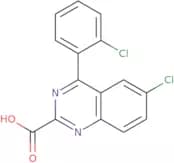
CAS:<p>6-Chloro-4-(2-chlorophenyl)-2-quinazolinecarboxylic acid (CA) is an impurity found in the drug lorazepam. It is a chemical intermediate that is not active as a pharmaceutical agent, but has been studied for use in treating epilepsy and other neurological disorders. CA is an excipient used to manufacture other drugs such as salicylic acid and the surfactant sodium lauryl sulfate. It has been shown to have acidic properties and can be used as a surfactant, which is helpful in chromatographic methods to separate molecules by size. CA also binds to chloride ions, which are necessary for the proper functioning of many cellular processes. CA's molecular weight is 322 daltons and it exhibits no pharmacological activity.</p>Fórmula:C15H8Cl2N2O2Pureza:Min. 95%Cor e Forma:White PowderPeso molecular:319.14 g/mol1-Naphthyl 2-acetamido-2-deoxy-b-D-glucopyranoside
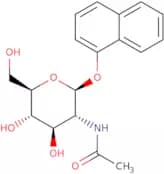
CAS:<p>1-Naphthyl 2-acetamido-2-deoxy-b-D-glucopyranoside is a chromogenic substrate commonly used to assay the activity of enzymes that cleave N-acetyl-beta-D-glucosaminide, such as beta-N-acetylglucosaminidase. Upon cleavage by the enzyme of interest, the substrate releases a yellow-colored 1-naphthylamine, which can be measured spectrophotometrically. This substrate is widely used in biomedical research and drug discovery for studying lysosomal storage disorders, bacterial infections, and neurological diseases.</p>Pureza:Min. 95%Peso molecular:347.36 g/mol4-Nitrophenyl 2-acetamido-3,4,6-tri-O-acetyl-2-deoxy-a-D-glucopyranoside
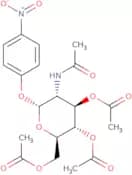
CAS:<p>4-Nitrophenyl 2-acetamido-3,4,6-tri-O-acetyl-2-deoxy-a-D-glucopyranoside is a synthetic compound with the ability to inhibit the enzyme glutamicum. It is a radionuclide that can be used as a focusing agent for gamma cameras and has been shown to be effective against corynebacterium glutamicum and other organisms. 4NP2AG was synthesized by reacting nitrophenol with acetamide in the presence of an acid catalyst and hydrogenating the product. The synthesis employs precession chemistry, which involves rotating a molecule around its axis at high speed to increase its concentration in one area. This treatment leads to a higher yield of desired product. 4NP2AG contains two acetamido groups on the glucopyranoside moiety, which are esterified with nitrophenol and acetic acid respectively. These moieties are</p>Pureza:Min. 95%Peso molecular:468.41 g/mol4-Nitrophenyl 2-O-(b-L-fucopyranosyl)-b-D-galactopyranoside
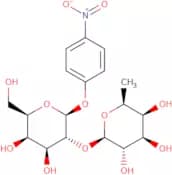
CAS:<p>4-Nitrophenyl 2-O-(b-L-fucopyranosyl)-b-D-galactopyranoside is a high-quality chromogenic substrate with excellent sensitivity specifically designed for enzymes' activity detection. This pNP substrate enables rapid, accurate, and measurable colorimetric visualization of enzymatic hydrolysis reactions. Researchers can easily and effectively monitor the release of 4-nitrophenol as a yellow product under laboratory conditions, allowing for convenient comparative analysis and identification of enzyme levels in various samples.</p>Pureza:Min. 95%Cor e Forma:White SolidPeso molecular:447.39 g/mol4-Methyl-2-nitrophenyl b-D-galactopyranoside
<p>4-Methyl-2-nitrophenyl b-D-galactopyranoside is a fluorogenic substrate for β-galactosidase. It has a high purity and is of high quality. 4-Methyl-2-nitrophenyl b-D-galactopyranoside is used as an enzyme substrate in diagnostics, as a chromogenic substrate in staining, and as a conjugate in chemiluminescence. It can be used for the detection of β-galactosidase in culture media and for the detection of β-galactosidase in environmental testing. This chemical also has bioluminescent properties that make it useful for food testing.</p>Pureza:Min. 95%Peso molecular:315.28 g/molNaphthol AS-BI b-D-glucopyranoside
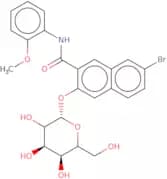
CAS:<p>Naphthol AS-BI b-D-glucopyranoside is a substrate for enzymes such as β-glucosidase and β-glycosidase. It has been used in diagnostic tests to detect the presence of amylase, lipase, α-amylase, or maltase in urine and feces. In biochemistry, naphthol AS-BI b-D-glucopyranoside is often used as a chromogenic or fluorogenic substrate for the detection of β-galactosidases and other glycosidases. This product has also been used in the detection of bacteria in culture media. Naphthol AS-BI b-D-glucopyranoside is a high quality reagent that can be used for chemiluminescence experiments, food testing, and environmental testing.</p>Pureza:Min. 95%Peso molecular:534.35 g/molAldol® 470 N-tosyl-L-alanine ester, Biosynth Patent: EP 2427431 and US 8940909
CAS:Produto Controlado<p>The Aldol® 470 N-tosyl-L-alanine ester is a high purity, high quality fluorogenic substrate for the enzyme alkaline phosphatase. It is a conjugate of the tosyl group with L-alanine and has been used as a fluorogenic substrate in various food testing applications. The Aldol® 470 N-tosyl-L-alanine ester also has several other uses including in diagnostic methods, culture media, and enzyme substrates.</p>Fórmula:C33H30N2O7SPureza:Min. 95%Cor e Forma:PowderPeso molecular:598.67 g/mol






![4-Nitrophenyl 2-acetamido-2-deoxy-4-O-[2-O-(a-L-fucopyranosyl)-b-D-galactopyranosyl]-b-D-glucopyra…](/_next/image/?url=https%3A%2Fstatic.cymitquimica.com%2Fproducts%2F3D%2Fthumb-webp%2FEN04931.webp&w=3840&q=75)