Monossacáridos
Monossacarídeos são a forma mais simples de carboidratos e servem como building blocks fundamentais para açúcares mais complexos e polissacarídeos. Essas moléculas de açúcar único desempenham papéis críticos no metabolismo energético, na comunicação celular e nos componentes estruturais das células. Nesta seção, você encontrará uma ampla variedade de monossacarídeos essenciais para pesquisas em bioquímica, biologia molecular e glicociência. Esses compostos são cruciais para estudar vias metabólicas, processos de glicosilação e desenvolvimento de agentes terapêuticos. Na CymitQuimica, oferecemos monossacarídeos de alta qualidade para apoiar suas necessidades de pesquisa, garantindo precisão e confiabilidade em suas investigações científicas.
Subcategorias de "Monossacáridos"
- Aloses(11 produtos)
- Arabinoses(21 produtos)
- Eritroses(11 produtos)
- Frutoses(9 produtos)
- Fucoses(36 produtos)
- Galactosamina(41 produtos)
- Galactoses(260 produtos)
- Glucoses(365 produtos)
- Ácidos Glucurónicos(51 produtos)
- Glico-substratos para enzimas(77 produtos)
- Guloses(6 produtos)
- Idoses(4 produtos)
- Inositóis(15 produtos)
- Lixoses(4 produtos)
- Mannoses(65 produtos)
- O-Glicanos(48 produtos)
- Psicoses(3 produtos)
- Ramnoses(10 produtos)
- Riboses(61 produtos)
- Ácidos siálicos(100 produtos)
- Sorboses(4 produtos)
- Açúcares(173 produtos)
- Tagatoses(4 produtos)
- Taloses(8 produtos)
- Xiloses(20 produtos)
Exibir 17 mais subcategorias
Foram encontrados 6088 produtos de "Monossacáridos"
Ordenar por
Pureza (%)
0
100
|
0
|
50
|
90
|
95
|
100
N-Acetyl-L-neuraminic acid
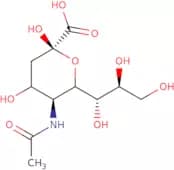
CAS:<p>N-Acetyl-L-neuraminic acid is a glycosylation compound that is an important component of the cell wall of Gram negative bacteria. It is used in the synthesis of polysaccharides and in the formation of complex carbohydrates. N-Acetyl-L-neuraminic acid has been studied for its potential use as a drug delivery agent due to its ability to inhibit the activity of enzymes such as α-mannosidase, which can lead to tumor metastasis. This compound can be synthesized using methylation, fluorination, and click chemistry, or custom synthesized by ordering specific monosaccharides. N-Acetyl-L-neuraminic acid can also be modified with acetate groups to create an acetylated form for use in chemical analysis or as a substrate for enzymatic reactions.</p>Fórmula:C11H19NO9Pureza:Min. 95%Peso molecular:309.27 g/mola-D-Glucuronic acid-1-phosphate
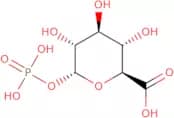
CAS:<p>a-D-Glucuronic acid-1-phosphate is a substrate for alkaline phosphatase. It hydrolyzes phosphate esters and modifies inorganic phosphate, including pyrophosphate. It also catalyzes the hydrolysis of nucleotide monophosphates such as NADPH and UDPglucose to their respective diphosphates. This enzyme is not inhibited by inorganic phosphate, phosphatase, NADP+, or UDP-.</p>Fórmula:C6H11O10PPureza:Min. 95%Cor e Forma:PowderPeso molecular:274.12 g/mol2,5-Deoxyfructosazine
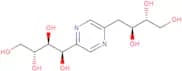
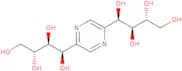
CAS:<p>2,5-Deoxyfructosazine is a physiological agent that inhibits the growth of bacteria and fungi. 2,5-Deoxyfructosazine is active against Gram-positive and Gram-negative bacteria, as well as Candida albicans and other yeasts. This drug is effective in inhibiting water vapor loss in the lungs and has been shown to be an effective antimicrobial agent for the treatment of acute lung infections. 2,5-Deoxyfructosazine has been shown to reduce the development of antibiotic resistance in bacteria by preventing cell wall synthesis. The mechanism of action is thought to involve a matrix effect with cationic compounds, which are deposited on the surface of bacterial cells and destroy them by osmotic lysis. 2,5-Deoxyfructosazine also has antidiabetic effects due to its ability to inhibit glucose uptake into cells by binding to glucose transporters on the cell membrane. A reaction mechanism for this process involves hydrogen</p>Fórmula:C12H20N2O7Pureza:Min. 98 Area-%Cor e Forma:PowderPeso molecular:304.3 g/molb-D-Glucose - 95%
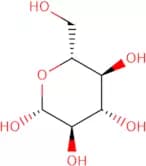
CAS:<p>B-D-glucose is a monosaccharide with the molecular formula C6H12O6. It is the major form of glucose in plants, and is one of the simplest carbohydrates. B-D-glucose is synthesized by photosynthesis in plants and used as an energy source for cellular respiration. The hydroxyl group of b-D-glucose reacts with p-hydroxybenzoic acid to form a new compound called glucopyranosiduronic acid. The hydroxyl group also reacts with sodium citrate to form sodium hydrogen citrate. This reaction can be used to measure the concentration of b-D-glucose in an unknown solution using high performance liquid chromatography (HPLC). B-D-glucose has been shown to have antidiabetic activity, as it improves insulin sensitivity, reduces blood glucose levels, and decrease body mass index (BMI) in animal models. A model system</p>Fórmula:C6H12O6Pureza:Min. 95 Area-%Cor e Forma:PowderPeso molecular:180.16 g/molAstragalus polysaccharide
CAS:<p>The chemical structure of Astragalus polysaccharide is complex and consists of an α-D-(1,4)-Glc and (1,6)-α-D-Glcp backbone, and a branch point at O-6. The molecular weight is approximately 3.01 × 10⁵ Da from Mongolian Astragalus using low concentration of ethanol for precipitation and gel chromatography for purification. Spectral analysis results of 1H NMR and 13C NMR showed that the polysaccharide backbone has a 1,3-linked β-D-Gal residue and the branched portion has β-Glc, 1,6-linked α-Gal; 1,5-linked β-Xyl; 1,4-linked β-Gal; β-D-Gal, 1,2-linked α-Rha; and 1,2,4-linked α-Rha residues.</p>Fórmula:C10H7ClN2O2SPureza:Min. 95%Cor e Forma:Brown PowderPeso molecular:254.69 g/molFructosazine
CAS:<p>Fructosazine is a natural compound that is found in the bark of the fructus quinquefoliae tree. It has been shown to have antimicrobial properties when it reacts with hydrochloric acid. Fructosazine inhibits the growth of bacteria by reacting with their cell walls and interfering with their metabolism. Fructosazine may also have physiological effects, such as reducing blood pressure and body weight gain, which are not fully understood. The reaction mechanism for fructosazine is not yet known, but it may be due to its reactive nature. More research needs to be done on this compound before we can understand its full potential.</p>Fórmula:C12H20N2O8Pureza:Min. 96 Area-%Cor e Forma:PowderPeso molecular:320.3 g/molBenzyl β-D-glucopyranosiduronic acid
CAS:<p>Benzyl b-D-glucopyranosiduronic acid is a synthetic monosaccharide that is used for the synthesis of oligosaccharides, polysaccharides, and saccharides. It has been shown to be a substrate for methylation reactions and can be modified with fluorination or click chemistry. The CAS number for this compound is 5285-02-9.</p>Fórmula:C13H16O7Pureza:Min. 95%Cor e Forma:Off-White PowderPeso molecular:284.26 g/molGlycerone phosphate dilithium salt
CAS:<p>Glycerone phosphate dilithium salt is a cross-linking agent that has been used in clinical trials as a dietary supplement. It has been shown to reduce the levels of ATP, adenine nucleotides, and 6-phosphate. Glycerone phosphate dilithium salt is not metabolized by cellular enzymes and can be used as an alternate energy source for cells that are low in ATP or have high rates of glycolysis. When glycerone phosphate dilithium salt is added to fat cells in culture, it increases the rate of lipid synthesis.</p>Fórmula:C3H5Li2O6PPureza:Min. 93%Cor e Forma:PowderPeso molecular:181.92 g/molAlkylsophorolipids
<p>Alkylsophorolipids are custom-synthesized complex carbohydrates. They are composed of an oligosaccharide and methylated saccharides, which have been modified with fluorine at the C3 position. This modification increases the hydrophobicity of the molecule, which makes it more soluble in organic solvents such as chloroform. Alkylsophorolipids have a CAS number of 1269-61-6.</p>Pureza:Min. 95%1-Deoxy-D-psicose
<p>1-deoxy-D-psicose is a deoxy sugar that can be used as a reagent for the conversion of 1-deoxy-d-fructose to d-psicose. It is useful in the synthesis of rhamnose, which is a precursor to pharmaceuticals and agrochemicals. 1-Deoxy-D-psicose can be used in the synthesis of l-rhamnose from d-psicose or vice versa. This process of converting one epimer to another isomerization is very efficient, with an 88% yield.</p>Pureza:Min. 95%3-C-Methyl-allonolactone
<p>3-C-Methyl-allonolactone is an oligosaccharide that is modified by methylation, glycosylation, and polysaccharide. It is a custom synthesis and has a high purity. 3-C-Methyl-allonolactone may be used as a precursor to 3-carbon sugars.</p>Pureza:Min. 95%4-Aminophenyl b-D-lactopyranoside
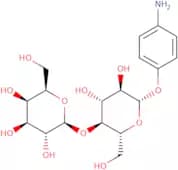
CAS:<p>4-Aminophenyl b-D-lactopyranoside is a chemical compound that has been used to optimize the production of human immunoglobulin. It has been shown to have diagnostic value for several viruses, including Epstein-Barr virus and cytomegalovirus. Electron microscopic studies have revealed organisms agglutinated by 4-aminophenyl b-D-lactopyranoside. The receptor binding properties and antigen concentration of this compound have been determined using agglutinin and lectin techniques. This molecule also has inhibitory potency on the synthesis of polypeptides, which are essential for the growth of certain organisms.</p>Fórmula:C18H27NO11Pureza:Min. 95%Cor e Forma:Off-White PowderPeso molecular:433.41 g/mol6'-O-Acetylpaniculoside II
<p>6'-O-Acetylpaniculoside II is an oligosaccharide that contains a methylated saccharide. It has CAS No. 836-50-4 and Click modification, which is a chemical reaction between the glycone of a saccharide and an electrophile. 6'-O-Acetylpaniculoside II is also a glycosylation product of a polysaccharide and it can be custom synthesized to produce high purity carbohydrates. This compound is fluorinated for complex carbohydrate chemistry.</p>Pureza:Min. 95%6-Cyclohexylhexyl-4-O-(a-D-glucopyranosyl)-b-D-glucopyranoside
CAS:<p>The 6-cyclohexylhexyl-4-O-(a-D-glucopyranosyl)-b-D-glucopyranoside is a monoclonal antibody that targets acetylcholine. It binds to nicotinic acetylcholine receptors in the nervous system, preventing the binding of acetylcholine and thereby inhibiting the transmission of nerve impulses. The antibody has been shown to inhibit multidrug resistance in cell culture. This may be due to its ability to bind hydroxyl groups on molecules that are known inhibitors of multidrug resistance. This drug also has an amphipathic nature, which allows it to penetrate lipid bilayers and membranes.</p>Fórmula:C24H44O11Peso molecular:508.60 g/molRef: 3D-W-201950
1gA consultar5gA consultar10gA consultar500mgA consultar2500mgA consultar-Unit-ggA consultar1-Epi-adenophorine
<p>1-Epi-adenophorine is a synthetic molecule that can inhibit the activity of enzymes. It is an epoxide that forms from the 1,2-epoxidation of cinnamic acid and has been shown to have many effects on various enzymes, including inhibiting enzyme activities. This drug has been used in the synthesis of miglustat, a macrocyclic molecule that inhibits a number of enzymes involved in protein folding and cell proliferation. 1-Epi-adenophorine is also effective as a cancer therapeutic agent by inhibiting glycosidases and cellular glycosylation.</p>Pureza:Min. 95%1-Deoxy-D-sorbofuranose
<p>1-Deoxy-D-sorbofuranose is a custom synthesis that is an oligosaccharide with a complex carbohydrate structure. It has a molecular weight of 399.54, and CAS No. of 1092-19-3. 1DDS is modified with methylation, glycosylation, click modification and fluorination. 1DDS is also an Oligosaccharide and Polysaccharide with high purity (99.5%), Mw of 399.54 g/mol, MWt of 603.2 g/mol, Mz of 1204.8 g/mol, Purity of 99%.</p>Pureza:Min. 95%1,4-Dideoxy-1,4-imino-L-altritol
<p>The compound 1,4-dideoxy-1,4-imino-L-altritol is a synthetic carbohydrate that is made of a monosaccharide and an oligosaccharide. The monosaccharide is a simple sugar with the chemical formula C5H10O5. The oligosaccharide has the chemical formula C2n+1(C3H3O3)n. The monosaccharide has four carbons and one oxygen molecule. The oligosaccharide also has five carbon atoms, but it also has three oxygen molecules. The two sugars are linked by a glycosidic linkage. <br>The compound was created to be used in the synthesis of complex carbohydrates. It can be modified to have fluorine atoms added to it, methyl groups added to it, or both. It can also be modified to make it into an ester or an amide. It is soluble in water and alcohol</p>Pureza:Min. 95%3-Amino-3-deoxy-D-glucose HCl
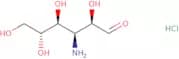
CAS:<p>3-Amino-3-deoxy-D-glucose HCl is a synthetic compound that inhibits the efflux of glucose from cells. It has been shown to inhibit growth in Saccharomyces cerevisiae, which may be due to its ability to inhibit the function of an efflux pump. 3-Amino-3-deoxy-D-glucose HCl has also shown antifungal activity against Candida albicans and Aspergillus fumigatus.</p>Fórmula:C6H13NO5·HClPureza:Min. 98 Area-%Cor e Forma:Slightly Yellow PowderPeso molecular:215.63 g/mol2,5-Anhydro- 3- deoxy-D- ribo- hexonic acid
<p>2,5-Anhydro-3-deoxy-D-ribohexonic acid is a fluorinated monosaccharide. It is synthesized by the modification of 2,5-anhydro-3-deoxyglucose with N-(2'-fluoroethyl)trimethoxysilane (FETS). This synthetic compound can be used as a glycosylation or polysaccharide building block in the synthesis of complex carbohydrates. The FETS modification allows for the introduction of various functional groups on C1 and C2 while maintaining the high purity.</p>Pureza:Min. 95%Chloramphenicol-β-D-galactopyranoside
CAS:<p>Chloramphenicol-beta-D-galactopyranoside is a carbohydrate that can be used in the synthesis of various carbohydrates. This product is fluorinated at the beta-position and has a saccharide modification. It is also an oligosaccharide with a high purity, methylated, glycosylated, and click modified.</p>Fórmula:C17H22Cl2N2O10Peso molecular:485.27 g/mol