Monossacáridos
Subcategorias de "Monossacáridos"
- Aloses(11 produtos)
- Arabinoses(21 produtos)
- Eritroses(11 produtos)
- Frutoses(9 produtos)
- Fucoses(36 produtos)
- Galactosamina(41 produtos)
- Galactoses(261 produtos)
- Glucoses(365 produtos)
- Ácidos Glucurónicos(52 produtos)
- Glico-substratos para enzimas(78 produtos)
- Guloses(6 produtos)
- Idoses(4 produtos)
- Inositóis(15 produtos)
- Lixoses(4 produtos)
- Mannoses(65 produtos)
- O-Glicanos(48 produtos)
- Psicoses(3 produtos)
- Ramnoses(10 produtos)
- Riboses(61 produtos)
- Ácidos siálicos(100 produtos)
- Sorboses(4 produtos)
- Açúcares(173 produtos)
- Tagatoses(4 produtos)
- Taloses(8 produtos)
- Xiloses(20 produtos)
Foram encontrados 6088 produtos de "Monossacáridos"
β,β-Trehalose
CAS:β,β-Trehalose is a carbohydrate that is synthesized by the expression of a trehalose synthase enzyme from the yeast Saccharomyces cerevisiae. β,β-Trehalose is an acidic sugar with two glucose subunits. It has been shown to have an enzymatic mechanism similar to that of glucose. β,β-Trehalose has been found to increase the solubility and stability of proteins in acidic phs (pHs) by binding to hydroxyl groups on protein surfaces. β,β-Trehalose also binds to alcohols such as ethanol and methanol, which may be due to its ability to form hydrogen bonds between oxygen atoms. This sugar also forms hexamers in solution, which may contribute to its effectiveness as a stabilizer for proteins and other molecules. The optimum ph for β,β-trehalose synthesis is around 5.5-6.0 and it can be used at higher phFórmula:C12H22O11Pureza:Min. 99 Area-%Cor e Forma:White Off-White PowderPeso molecular:342.3 g/mol2,3,4,6-Tetra-O-acetyl-α-D-glucopyranosyl chloride
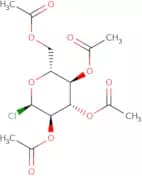
CAS:2,3,4,6-Tetra-O-acetyl-a-D-glucopyranosyl chloride (TAOC) is a nuclear magnetic resonance (NMR) probe that has been used to study the structure of nuclei. It is synthesised by reacting acetyl chloride with sucrose in a reaction catalyzed by sodium hydroxide. The compound can be detected in quadrupole and resonance spectroscopy due to its high sensitivity to nuclear magnetic resonance. This NMR probe is typically used to study the structures of nuclei or for the analysis of polysaccharides.
Fórmula:C14H19ClO9Pureza:Min. 95%Cor e Forma:PowderPeso molecular:366.8 g/mol1,2,3,4,6-Penta-O-acetyl-D-mannopyranose
CAS:1,2,3,4,6-Penta-O-acetyl-D-mannopyranose is an organic chemical compound that belongs to the group of sugars. It is a synthetic compound that can be used as an analytical reagent in hepg2 cells and chloride. 1,2,3,4,6-Penta-O-acetyl-D-mannopyranose has been shown to have a protective effect against adenosine receptors and phosphotungstic acid in brain cells. This sugar also has a strong affinity for lectins and can be used to study the binding of sugars to proteins by titration calorimetry.Fórmula:C16H22O11Pureza:Min. 98 Area-%Cor e Forma:White PowderPeso molecular:390.34 g/molD-Xylose-5-phosphate disodium
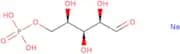
CAS:D-Xylose-5-phosphate disodium salt is a Custom synthesis that has been fluorinated, methylated, and modified with a click reaction. D-Xylose-5-phosphate disodium salt is also an oligosaccharide and polysaccharide. The CAS No. for this compound is 1083083-57-1.Fórmula:C5H11O8P•Na2Pureza:(%) Min. 80%Cor e Forma:White/Off-White SolidPeso molecular:276.09 g/molD-Glucose-13C6
CAS:D-Glucose-13C6 is a complex carbohydrate, which is composed of a glucose molecule with one carbon atom labeled as C6. It is used to study the structure of carbohydrates and their interactions with proteins. D-Glucose-13C6 also has applications in the study of diseases such as Alzheimer's disease, Parkinson's disease, diabetes mellitus type 2, and cancer. In addition, this molecule can be used to measure plasma glucose concentrations in humans or animals. D-Glucose-13C6 is not active against bacteria such as Pseudomonas aeruginosa or Escherichia coli. The synthesis of D-glucose-13C6 requires anhydrous dextrose and unlabeled glucose.Fórmula:C6H12O6Pureza:Min. 98 Area-%Cor e Forma:White PowderPeso molecular:186.11 g/mol2,3,4,6-Tetra-O-pivaloyl-D-glucopyranosyl amine
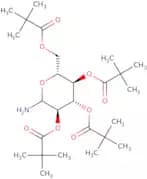
CAS:2,3,4,6-Tetra-O-pivaloyl-D-glucopyranosyl amine is a monosaccharide that is custom synthesized and modified with fluorination. It also has saccharide properties such as methylation and glycosylation. This product can be used in the synthesis of complex carbohydrates or polysaccharides. It is a high purity compound with CAS No. 888963-33-5.Fórmula:C26H45NO9Pureza:Min. 95%Peso molecular:515.64 g/molE-Retinyl b-glucuronide
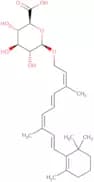
CAS:E-Retinyl b-glucuronide is a metabolite of vitamin A that is formed in the liver by glucuronidation of retinol. It has been shown to have immunomodulatory effects and can be used to activate various immune cells, such as T lymphocytes, monocytes, and natural killer cells. E-Retinyl b-glucuronide binds to cell surface antigens and induces the expression of surface markers on mononuclear cells. In vitro studies have shown that this metabolite has growth-promoting activity for certain types of cancerous cells including colon carcinoma, breast carcinoma, and thyroid carcinoma. E-Retinyl b-glucuronide is also known to inhibit the binding of 13-cis retinoic acid to its receptor, thereby preventing the activation of genes in target tissues.Fórmula:C26H38O7Pureza:Min. 95%Peso molecular:462.58 g/mol2-Deoxy-D-glucose-6-phosphate sodium salt
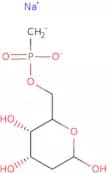
CAS:Glucose 6-phosphatase substrate
Fórmula:C6H12NaO8PPureza:Min. 98 Area-%Cor e Forma:White PowderPeso molecular:266.12 g/mol2-Chloroethyl-b-D-fructopyranoside
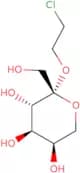
CAS:2-Chloroethyl-b-D-fructopyranoside is a stable reagent that is used to prepare 2,4-dichloroacetophenone (2,4-DAAP), which can be used as a crosslinking agent. This reagent is reactive and should be handled with care. It forms a hemoglobin adduct by reacting with the amino groups of hemoglobin. The reaction can be catalyzed by dialdehydes. Affinities for tissue proteins are created through stepwise reactions involving ring-opening reactions or methemoglobin formation. 2-Chloroethyl-b-D-fructopyranoside can be used to synthesize a polymerized affinity column by using the ring opening reaction in an affinity chromatography process.Fórmula:C8H15ClO6Pureza:Min. 95%Cor e Forma:PowderPeso molecular:242.65 g/molOsmaronin
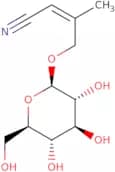
CAS:Leucine-âderived gamma-hydroxynitrile glucoside
Fórmula:C11H17NO6Pureza:Min. 95%Peso molecular:259.26 g/molMethyl β-D-maltopyranoside
CAS:Methyl β-D-maltopyranoside is a disaccharide that is an aglycon of maltosides. It has been shown to bind to the active site of alpha-d-glucopyranosidases, which are enzymes that hydrolyze alpha-d-glucopyranosides. Methyl β-D-maltopyranoside has also been shown to interact with dihedral angles and hydroxyl groups in the enzyme binding region, which may be due to conformational changes in the enzyme's active site. The kinetic constants for methyl β-D-maltopyranoside have been calculated by using an algorithm.Fórmula:C13H24O11Pureza:(%) Min. 98%Cor e Forma:PowderPeso molecular:356.32 g/mol4,6-O-Benzylidene-D-glucal
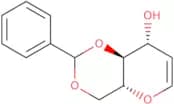
CAS:Glucal is a carbohydrate that is used as a synthon in organic synthesis. It has been shown to be anomeric and can be synthesized by acetylation of the corresponding aldose, or by the glycosidic bond reaction with borohydride reduction. Glucal is not stable at high pH and can undergo ring-opening reactions with nucleophiles such as sodium borohydride. Glucal also reacts with glycoconjugates to form new molecules, which are called glycosidic products.
Fórmula:C13H14O4Pureza:Min. 95%Cor e Forma:White PowderPeso molecular:234.25 g/mol3-Aminopropyl α-D-glucopyranoside
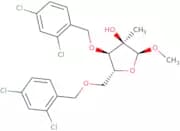
CAS:3-Aminopropyl α-D-glucopyranoside is a monomer that can be used to produce polymers. It has been shown to be effective in methylation, saccharide and oligosaccharide modifications. 3-Aminopropyl α-D-glucopyranoside is an alpha glucosidase inhibitor. The compound also inhibits the action of other enzymes, such as glycosidases, which are responsible for breaking down glycogen and starch. 3-Aminopropyl α-D-glucopyranoside is a white powder with a melting point of about 150°C and boiling point of about 300°C.Fórmula:C9H19NO6Pureza:Min. 95%Cor e Forma:PowderPeso molecular:237.35 g/molMethyl 3,5-di-O-(2,4-dichlorobenzyl)-2-C-methyl-α-D-ribofuranoside
CAS:Building block for the synthesis of 2'-âC-âmethyl substituted nucleosidesFórmula:C21H22Cl4O5Pureza:Min. 95%Cor e Forma:Yellow PowderPeso molecular:496.21 g/mol2,3,4,6-Tetra-O-benzyl-D-galactopyranose
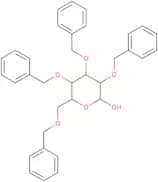
CAS:2,3,4,6-Tetra-O-benzyl-D-galactopyranose is a building block which can be used as both a galactosyl donor and acceptor in the synthesis of saccharides. The benzyl protecting groups can be readily and selectively cleaved but are stable to a variety of reaction conditions allowing chemical manipulations to be carried out on the rest of the saccharide. 2,3,4,6-Tetra-O-benzyl-D-galactopyranose has been used in the synthesis of potential cholera toxin inhibitors, analogues of α-galactosyl ceramide (iNKT agonist) and more recently in the synthesis of Scleropentaside A.Fórmula:C34H36O6Pureza:Min. 98 Area-%Cor e Forma:White PowderPeso molecular:540.65 g/mol4-Methoxyphenyl 2,3:4,6-di-O-benzylidene-β-D-mannopyranoside
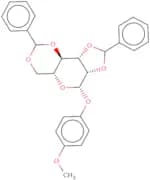
The product is a Modification, Oligosaccharide, Carbohydrate, complex carbohydrate. It is Custom synthesis, Synthetic, High purity, CAS No., Monosaccharide, Methylation, Glycosylation, Polysaccharide. The product has Fluorination and saccharide.Pureza:Min. 95%Methyl 3-O-benzyl-D-glucopyranoside
CAS:Methyl 3-O-benzyl-D-glucopyranoside is a custom synthesis. It is a complex carbohydrate that is an oligosaccharide, polysaccharide, and modified saccharide. Methyl 3-O-benzyl-D-glucopyranoside can be synthesized from glucose with the use of methylation, glycosylation, or carbonylation reactions. The product has been fluorinated to yield a high purity product. This product can be used for click modifications or sugar chemistry experiments.Pureza:Min. 95%Phenyl α-D-thiomannopyranoside
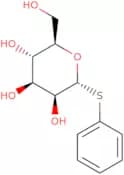
CAS:Phenyl α-D-thiomannopyranoside is a saccharide that can be modified to produce various derivatives. Phenyl α-D-thiomannopyranoside is a high purity, custom synthesis carbohydrate. This product is synthesized by the methylation and glycosylation of phenyl α-D-mannopyranoside. The carbohydrate has been fluorinated for the production of fluorinated derivatives. Phenyl α-D-thiomannopyranoside is an oligosaccharide and sugar that belongs to the class of carbohydrates. It can be used in protein modification and complex carbohydrate synthesis.Fórmula:C12H16O5SPureza:Min. 95%Cor e Forma:White PowderPeso molecular:272.32 g/molN-Acetyl-D-glucosamine
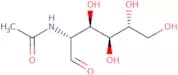
CAS:N-acetyl D-glucosamine (GlcNAc) is an aldohexose (2-acetamido-2-deoxyglucose) in which the hydroxyl group at position 2 is replaced by NHAc (Collins, 2006). N-acetyl D-glucosamine forms the exoskeletons of molluscs and insects as the building block of the polysaccharide chitin (Rudrapatnam, 2003). N-acetyl D-glucosamine is a key component of N- and O-linked glycans, present in glycolipids and the glycosaminoglycan hyaluronic acid (Fallacara, 2018). A recent study has suggested that N-acetyl D-glucosamine may have therapeutic potential for COVID-19 as it affects the spike protein-ACE2 receptor interaction during the infection with SARS-CoV-2 virus (Baysal, 2021).Fórmula:C8H15NO6Pureza:Min. 98 Area-%Cor e Forma:PowderPeso molecular:221.21 g/molUDP-3-O-(R-3-hydroxydecanoyl)-GlcNAc sodium salt
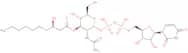
CAS:Substrate for UDP-3-O-acyl-GlcNAc deacetylase
Fórmula:C27H43N3O19P2·xNaPureza:Min. 90 Area-%Cor e Forma:White Off-White Solidified MassPeso molecular:777.6 g/mol