Monossacáridos
Monossacarídeos são a forma mais simples de carboidratos e servem como building blocks fundamentais para açúcares mais complexos e polissacarídeos. Essas moléculas de açúcar único desempenham papéis críticos no metabolismo energético, na comunicação celular e nos componentes estruturais das células. Nesta seção, você encontrará uma ampla variedade de monossacarídeos essenciais para pesquisas em bioquímica, biologia molecular e glicociência. Esses compostos são cruciais para estudar vias metabólicas, processos de glicosilação e desenvolvimento de agentes terapêuticos. Na CymitQuimica, oferecemos monossacarídeos de alta qualidade para apoiar suas necessidades de pesquisa, garantindo precisão e confiabilidade em suas investigações científicas.
Subcategorias de "Monossacáridos"
- Aloses(11 produtos)
- Arabinoses(21 produtos)
- Eritroses(11 produtos)
- Frutoses(9 produtos)
- Fucoses(36 produtos)
- Galactosamina(41 produtos)
- Galactoses(261 produtos)
- Glucoses(365 produtos)
- Ácidos Glucurónicos(51 produtos)
- Glico-substratos para enzimas(77 produtos)
- Guloses(6 produtos)
- Idoses(4 produtos)
- Inositóis(15 produtos)
- Lixoses(4 produtos)
- Mannoses(65 produtos)
- O-Glicanos(48 produtos)
- Psicoses(3 produtos)
- Ramnoses(10 produtos)
- Riboses(61 produtos)
- Ácidos siálicos(100 produtos)
- Sorboses(4 produtos)
- Açúcares(173 produtos)
- Tagatoses(4 produtos)
- Taloses(8 produtos)
- Xiloses(20 produtos)
Exibir 17 mais subcategorias
Foram encontrados 6090 produtos de "Monossacáridos"
Ordenar por
Pureza (%)
0
100
|
0
|
50
|
90
|
95
|
100
Phenyl 2-azido-3-O-benzyl-4,6-O-benzylidene-2-deoxy-b-D-thioglucopyranoside
<p>Phenyl 2-azido-3-O-benzyl-4,6-O-benzylidene-2-deoxy-b-D-thioglucopyranoside is a synthetically modified carbohydrate. It is a saccharide with an Oligosaccharide structure and has been fluorinated. The CAS No. for this compound is 104984-61-5. Phenyl 2-azido-3,6,2″′′′′′′′'-O-(benzylidene)-b-[D]thioglucopyranoside is a methylated glycoside which has been click modified.</p>Pureza:Min. 95%(3aR,3bS,6aR,7aR)-2,2-Dimethylhexahydrofuro[2',3':4,5]furo[2,3-d][1,3]dioxol-5-ol
CAS:<p>(3aR,3bS,6aR,7aR)-2,2-Dimethylhexahydrofuro[2',3':4,5]furo[2,3-d][1,3]dioxol-5-ol is a novel compound that induces the expression of an inducible gene. This compound has been shown to activate guanine and guanosine receptors and modulate the activity of guanosine triphosphatase. It has been shown to be effective in cancer cells and may have diagnostic applications. The mechanism of action for this drug is not fully understood but it has been suggested that it may act as a neuromodulator.</p>Pureza:Min. 95%6-O-Benzoyl-3-O-tert-butyldiphenylsilyl-D-glucal
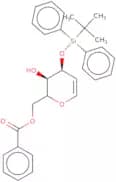
<p>6-O-Benzoyl-3-O-tert-butyldiphenylsilyl-D-glucal is a modification of the oligosaccharide, 6-O-(benzoyloxy)hexyl glucal. The product is used as a synthetic intermediate in the synthesis of complex carbohydrates. It is also used in the production of high purity monosaccharides and polysaccharides. This product has been shown to be effective in methylation reactions, glycosylation reactions, and fluorination reactions.</p>Pureza:Min. 95%2-Acetamido-1,2-dideoxynojirimycin hydrochloride
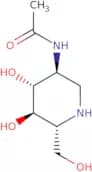
CAS:<p>2-Acetamido-1,2-dideoxynojirimycin hydrochloride is used in the treatment of human ovarian carcinoma. It has been shown to inhibit glycosidase enzymes with binding constants in the micromolar range. 2-Acetamido-1,2-dideoxynojirimycin hydrochloride has been shown to be a potential inhibitor of mammalian cell transport involving complex oligosaccharides. This drug also inhibits the enzymatic degradation of glycoproteins and other proteins by glycosidases. 2-Acetamido-1,2-dideoxynojirimycin hydrochloride is a synthetic analog of nijirimycin, which is a naturally occurring antibiotic obtained from cultures of Streptomyces nijirimensis. The clinical significance of this drug is that it can be used as an antiangiogenic agent and chemo sensitizing</p>Fórmula:C8H16N2O4·HClPureza:(%) Min. 97%Cor e Forma:White PowderPeso molecular:204.22 g/molMethyl 1-(6-tert-butylmethylsilyl-4'-hydroxyraloxifene)-2,3,4,-tri-O-acetyl-b-D-glycopyranuronate
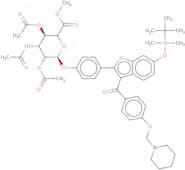
CAS:<p>This is a complex carbohydrate, which is a modification of an oligosaccharide. The structure of this carbohydrate is based on the sugar methyl 1-(6-tert-butylmethylsilyl-4'-hydroxyraloxifene)-2,3,4,-tri-O-acetyl-b-D-glycopyranuronate. This modification has been shown to be useful for glycosylation and polysaccharide synthesis. This compound can be synthesized by click chemistry and has high purity with little or no impurities.</p>Fórmula:C46H55NO13SSiPureza:Min. 95%Peso molecular:890.08 g/mol2-Acetamido-2-deoxy-b-D-galactopyranosyl serine
<p>2-Acetamido-2-deoxy-b-D-galactopyranosyl serine is a glycosylation agent that can be used as a sugar donor in glycoprotein synthesis. This product is available as custom synthesis and has been modified with fluorination, saccharide, and modification. It also has CAS number: 3897-78-5. 2 Acetamido-2 deoxy b D galactopyranosyl serine is a monosaccharide that is synthesized from D galactose and L serine. It can be used to produce complex carbohydrates for Methylations, Click modifications, Polysaccharides, or Fluorinations.</p>Pureza:Min. 95%Dimethylthexylsilyl 2,3,6-tri-O-benzyl-b-D-galactopyranoside
<p>Dimethylthexylsilyl 2,3,6-tri-O-benzyl-b-D-galactopyranoside is a synthetic oligosaccharide with a fluorinated benzene ring. It is an important intermediate for glycosylation and can be modified with methyl groups or click chemistry. This product is of high purity and has been custom synthesized. Dimethylthexylsilyl 2,3,6-tri-O-benzyl-b-D-galactopyranoside has CAS number 69422-24-2.</p>Pureza:Min. 95%1-O-tert-Butyldimethylsilyl-2-azido-2-deoxy-b-D-glucopyranoside
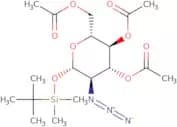
CAS:<p>1-O-tert-Butyldimethylsilyl-2-azido-2-deoxy-b-D-glucopyranoside is a Carbohydrate, Modification, saccharide, Oligosaccharide, sugar that has been fluorinated and methylated. It is a custom synthesis. The CAS No. 99049-65-7 is 9904965.</p>Fórmula:C12H25N3O5SiPureza:Min. 95%Peso molecular:319.43 g/molVanillic acid 4-β-D-glucoside
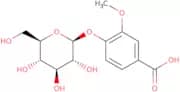
CAS:Vanillic acid 4-beta-D-glucoside is a Custom synthesis that is used as an Oligosaccharide. It is Polysaccharide and Modification of the natural product vanillin. Vanillic acid 4-beta-D-glucoside has CAS No. 32142-31-7, Methylation, Glycosylation, Carbohydrate, Click modification, saccharide, sugar, High purity and Fluorination. It is also Synthetic.Fórmula:C14H18O9Pureza:Min. 95%Peso molecular:330.29 g/molBenzyl 2-(acetylamino)-2-deoxy-3-o-[3,4,6-tri-o-acetyl-2-(acetylamino)-2-deoxy-β-D-glucopyranosyl]-α-D-galactopyranoside 4,6-diaceta te
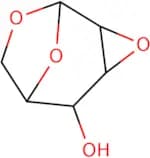
CAS:<p>Please enquire for more information about Benzyl 2-(acetylamino)-2-deoxy-3-o-[3,4,6-tri-o-acetyl-2-(acetylamino)-2-deoxy-β-D-glucopyranosyl]-α-D-galactopyranoside 4,6-diaceta te including the price, delivery time and more detailed product information at the technical inquiry form on this page</p>Fórmula:C33H44N2O16Pureza:Min. 95%Peso molecular:724.7 g/mol1,6, 2,3-Dianhydro-beta-D-talopyranose
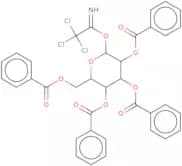
CAS:<p>1,6, 2,3-Dianhydro-beta-D-talopyranose is a fluorinated sugar that is an intermediate in the synthesis of complex carbohydrates. It has been used as a monosaccharide building block and can also be used to synthesize oligosaccharides and polysaccharides. 1,6, 2,3-Dianhydro-beta-D-talopyranose can be modified with methylation or click chemistry to alter its properties. This product is a carbohydrate that has been modified for research purposes.</p>Fórmula:C6H8O4Pureza:Min. 95%Peso molecular:144.12 g/mol2,3,4,6-Tetra-O-benzoyl-D-galactopyranosyl trichloroacetimidate
CAS:<p>2,3,4,6-Tetra-O-benzoyl-D-galactopyranosyl trichloroacetimidate is a fluorinated carbohydrate that can be used for synthesis of complex carbohydrates. It is a monosaccharide with an O-benzoyl group at the 2 position and a glycosylation at the 4 position. The chemical structure has been modified by a reaction with trichloroacetimidate to form an acetal linker. This product is available in both custom synthesis and high purity.</p>Fórmula:C36H28Cl3NO10Pureza:Min. 95%Cor e Forma:White To Yellow SolidPeso molecular:740.97 g/molHeptamaloxyloglucan
CAS:Heptamaloxyloglucan is an analog of marbofloxacin that has been shown to inhibit tumor growth and induce apoptosis in cancer cells. This compound acts as a kinase inhibitor, blocking the activity of enzymes involved in cell division and proliferation. Heptamaloxyloglucan has also been found to have anticancer properties, inhibiting the growth of cancer cells and inducing apoptosis through various mechanisms. In addition, this compound has been shown to be effective in treating urinary tract infections caused by gram-negative bacteria such as Escherichia coli and Proteus mirabilis. Heptamaloxyloglucan may also have potential therapeutic applications for other diseases such as hypertension, as it has been found to be a potent inhibitor of ACE (angiotensin-converting enzyme) activity.Fórmula:C40H70O33Pureza:75%MinPeso molecular:1,079 g/mol6-o-Benzyl D-mannose
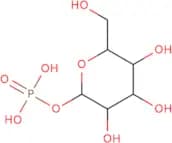
CAS:Please enquire for more information about 6-o-Benzyl D-mannose including the price, delivery time and more detailed product information at the technical inquiry form on this pageFórmula:C12H16O6Pureza:Min. 95%Peso molecular:256.25 g/molα-D-Mannose 1-phosphate
CAS:<p>α-D-Mannose 1-phosphate is a complex carbohydrate that is modified with methylation, glycosylation and fluorination. This product has been custom synthesized to order. It is an oligosaccharide that can be modified with glycosylation and carbonylation. Methylation of α-D-mannose 1-phosphate leads to the formation of a fluorinated sugar called α-D-mannose 1,6-diphosphate. The modification process can be done in several ways, including Click chemistry. This product is of high purity and has been synthesized from natural materials.</p>Fórmula:C6H13O9PPureza:Min. 95%Peso molecular:260.14 g/molD-Allose-13C
CAS:<p>Please enquire for more information about D-Allose-13C including the price, delivery time and more detailed product information at the technical inquiry form on this page</p>Fórmula:C6H12O6Pureza:Min. 95%Peso molecular:181.15 g/molD-Arabinose-1-D
CAS:D-Arabinose-1-D is a potent inhibitor of human kinases, which are enzymes that play a crucial role in the regulation of cell growth and division. This analog has been shown to be effective in inhibiting tumor growth and inducing apoptosis in cancer cells. D-Arabinose-1-D is commonly used as a medicinal compound for its anticancer properties. It has also been found in human urine and Chinese medicinal herbs. As an inhibitor of protein kinases, D-Arabinose-1-D can block the activity of these enzymes, which are often overexpressed in cancer cells. The inhibition of these kinases can lead to the suppression of tumor growth and increase the efficacy of other anticancer drugs.Fórmula:C5H10O5Pureza:Min. 95%Peso molecular:151.14 g/mol3,6-Di-O-triisopropylsilyl-D-glucal
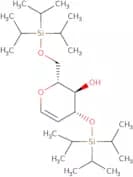
CAS:<p>3,6-Di-O-triisopropylsilyl-D-glucal is a synthetic monosaccharide. It has a molecular weight of 368.76 g/mol and chemical formula C14H22O8Si. 3,6-Di-O-triisopropylsilyl-D-glucal is soluble in water and ethanol.<br>It is used for the synthesis of oligosaccharides and polysaccharides, as well as for modification of sugar moieties on glycoproteins and glycolipids. 3,6-Di-O-triisopropylsilyl-D-glucal can be used for the preparation of complex carbohydrate structures by glycosylation or polysaccharide structures by methylation. 3,6-Di-O-triisopropylsilyl--D--glucal can also be used to synthesize sugar mo</p>Fórmula:C24H50O4Si2Pureza:Min. 95%Peso molecular:458.82 g/molCalcium α-D-isosaccharinate
CAS:<p>Please enquire for more information about Calcium α-D-isosaccharinate including the price, delivery time and more detailed product information at the technical inquiry form on this page</p>Fórmula:C12H24O12•CaPureza:Min. 95%Peso molecular:400.39 g/molMethyl 2-deoxy-4,6-o-(phenylmethylene)-α-D-ribo-hexopyranoside benzoate
CAS:Please enquire for more information about Methyl 2-deoxy-4,6-o-(phenylmethylene)-α-D-ribo-hexopyranoside benzoate including the price, delivery time and more detailed product information at the technical inquiry form on this pageFórmula:C21H22O6Pureza:Min. 95%Peso molecular:370.4 g/mol

![(3aR,3bS,6aR,7aR)-2,2-Dimethylhexahydrofuro[2',3':4,5]furo[2,3-d][1,3]dioxol-5-ol](/_next/image/?url=https%3A%2Fstatic.cymitquimica.com%2Fproducts%2F3D%2Fthumb-webp%2FMD45372.webp&w=3840&q=75)


![Benzyl 2-(acetylamino)-2-deoxy-3-o-[3,4,6-tri-o-acetyl-2-(acetylamino)-2-deoxy-β-D-glucopyranosyl]…](/_next/image/?url=https%3A%2Fstatic.cymitquimica.com%2Fproducts%2F3D%2Fthumb-webp%2FKDA05428.webp&w=3840&q=75)