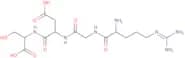
Peptídeos
Os peptídeos são cadeias curtas de aminoácidos ligados por ligações peptídicas, desempenhando papéis importantes como moléculas biológicas em processos celulares. Eles funcionam como hormônios, neurotransmissores e moléculas de sinalização, sendo amplamente utilizados em aplicações terapêuticas e diagnósticas. Os peptídeos também são cruciais na pesquisa para estudar interações proteicas, atividades enzimáticas e vias de sinalização celular. Na CymitQuimica, oferecemos uma ampla seleção de peptídeos de alta qualidade para apoiar suas necessidades de pesquisa e desenvolvimento em biotecnologia e farmacêutica.
Subcategorias de "Peptídeos"
Foram encontrados 30159 produtos de "Peptídeos"
Ordenar por
Pureza (%)
0
100
|
0
|
50
|
90
|
95
|
100
RNASEH2A Blocking Peptide
<p>A synthetic peptide for use as a blocking control in assays to test for specificity of RNASEH2A antibody, catalog no. 70R-1626</p>Pureza:Min. 95%Arf4 Blocking Peptide
<p>A synthetic peptide for use as a blocking control in assays to test for specificity of Arf4 antibody, catalog no. 70R-9371</p>Pureza:Min. 95%Lys-Ala-AMC
CAS:<p>Lys-Ala-AMC is an activator of ion channels and a ligand for receptors. It is used in research as a tool to study protein interactions, receptor pharmacology, and ion channel pharmacology. Lys-Ala-AMC binds to the α-subunit of voltage gated calcium channels and can activate these channels by increasing the rate of opening. This peptide also inhibits receptor binding by competing with the natural ligand. It has been shown to be an antagonist at the NMDA receptor and can inhibit the binding of glycine to this receptor.</p>Fórmula:C19H26N4O4Pureza:Min. 95%Peso molecular:374.43 g/molPeptide YY (canine, mouse, porcine, rat)
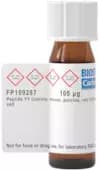
CAS:<p>Peptide YY (PYY) is a peptide hormone that inhibits gastric emptying and increases intestinal transit time. This peptide can be given as an intubation, perfusion, or intravenous infusion to increase the absorption of nutrients. It also has the potential to reduce body weight in obese people. PYY is a potent activator of protein synthesis and it has been shown to stimulate lipolysis in adipocytes. PYY is found in the ileum and colon, where it may have its effects on appetite suppression and regulation of gastrointestinal motility.</p>Fórmula:C190H288N54O57Pureza:Min. 95%Cor e Forma:PowderPeso molecular:4,240.65 g/molRef: 3D-FP109287
Produto descontinuadoGSG1 Blocking Peptide
<p>A synthetic peptide for use as a blocking control in assays to test for specificity of GSG1 antibody, catalog no. 70R-7537</p>Pureza:Min. 95%LRFN3 Blocking Peptide
<p>A synthetic peptide for use as a blocking control in assays to test for specificity of LRFN3 antibody, catalog no. 70R-7159</p>Pureza:Min. 95%KHDRBS1 Blocking Peptide
<p>A synthetic peptide for use as a blocking control in assays to test for specificity of KHDRBS1 antibody, catalog no. 20R-1132</p>Pureza:Min. 95%Magainin 2
<p>Custom research peptide; min purity 95%.</p>Fórmula:C114H180N30O29SPureza:Min. 95%Peso molecular:2,466.95 g/molRef: 3D-PM17037
Produto descontinuadoBis-dPEG®29-Acid
CAS:<p>Bis-dPEG®29-Acid is a PEG polymer categorised as homobifunctional PEG (X-PEG X). Used as a linker, bis-dPEG®29-Acid is used to attached PEG to proteins, peptides, oligonucleotides, nanoparticles and small molecules via pegylation, a bioconjugation technique.</p>Fórmula:C30H49N5O11S3Pureza:Min. 95%Peso molecular:751.94 g/molMelanocyte Protein PMEL 17 (256-264) (human, bovine, mouse)
<p>Custom research peptide; min purity 95%.</p>Fórmula:C44H67N9O14Pureza:Min. 95%Peso molecular:946.08 g/molRef: 3D-PM17049
Produto descontinuadoHNRPDL Blocking Peptide
<p>A synthetic peptide for use as a blocking control in assays to test for specificity of HNRPDL antibody, catalog no. 70R-1322</p>Pureza:Min. 95%Methionine-Enkephalin (Human, Porcine, Bovine, Rat, Mouse)
CAS:<p>Methionine-Enkephalin (ME) is a peptide that has been shown to bind to the opioid receptor and inhibit the production of pro-inflammatory cytokines. ME has been shown to have an inhibitory effect on human liver cells, as well as on cultured human epidermal cells. ME may also have a role in epidermal growth factor receptors, which could be related to its anti-inflammatory effects.</p>Fórmula:C27H35N5O7S•H2OPureza:Min. 95%Peso molecular:591.68 g/molTMEM138 Blocking Peptide
<p>A synthetic peptide for use as a blocking control in assays to test for specificity of TMEM138 antibody, catalog no. 70R-6431</p>Pureza:Min. 95%SFPQ Blocking Peptide
<p>A synthetic peptide for use as a blocking control in assays to test for specificity of SFPQ antibody, catalog no. 70R-1422</p>Pureza:Min. 95%IL 1 α Human
<p>IL-1α is a cytokine protein that has been shown to be involved in the immune system. IL-1α is an activator of the receptor and is also a ligand for it. The protein has been shown to activate ion channels, which are proteins that allow ions to pass through either by diffusion or by facilitated transport. This activation causes cells to produce more hydrogen ions, which leads to an increase in the acidity of the cell. IL-1α has also been shown to inhibit cell proliferation and induce apoptosis.</p>Pureza:Min. 95%LYVE1 Blocking Peptide
<p>A synthetic peptide for use as a blocking control in assays to test for specificity of LYVE1 antibody, catalog no. 70R-6181</p>Pureza:Min. 95%ANP (Rat, 3-28)
CAS:<p>ANP (Rat, 3-28) is a peptide that is a potent inhibitor of protein interactions. This peptide binds to the ligand-binding domain of the receptor and blocks the binding of the ligand. ANP (Rat, 3-28) also has high purity and can be used as a research tool or an antibody in life science studies.</p>Fórmula:C119H189N43O36S2Pureza:Min. 95%Peso molecular:2,862.2 g/molFibronectin Active Fragment (RGDS)
CAS:<p>Fibronectin is an extracellular matrix protein that plays a critical role in cell adhesion, migration, and differentiation. Fibronectin subunits are composed of repeating units of three types of modules: type I, type II, and type III. The active fragment of fibronectin refers to a small peptide sequence within the type III modules of fibronectin that has been shown to have potent biological activity.<br>The fibronectin active fragment, also known as the cell-binding domain or RGD domain, is a short peptide sequence consisting of the amino acid sequence Arg-Gly-Asp (RGD). This peptide sequence interacts with cell surface receptors known as integrins, which are important for mediating cell adhesion, migration, and signaling.<br>The fibronectin active fragment has been extensively studied as a research tool to investigate the mechanisms of cell adhesion and migration. It has also been used in tissue engineering applications to promote cell attachment and proliferation on synthetic biomaterials.</p>Fórmula:C15H27N7O8CH3COOH•2H2OPureza:Min. 95%Peso molecular:499.48 g/mol