Peptídeos
Subcategorias de "Peptídeos"
Foram encontrados 29608 produtos de "Peptídeos"
Osteogenic Growth Peptide (OGP)
Osteogenic Growth Peptide (OGP) is derived from the C-terminal sequence ALKRQGRTLYGFGG of Histone H4. This 14-aa peptide is produced from alternative translation of Histone H4 mRNA.Cor e Forma:PowderPeso molecular:1,522.8 g/molACT1
α-connexin carboxyl terminal peptide that specifically targets and maintains Cx43 at gap junction sites between cell-cell membrane borders of breast cancer cell.- Thus it augments gap junction activity and impairs proliferation and survival of breast cancer cells with no effect on non-transformed cells.
Peso molecular:3,255.8 g/molHeart-homing peptide
The pathology of cardiovascular disease (CVD) is linked to the health of endothelial cells in the heart.- However, the specific characteristics of the cardiovascular endothelial cells are still being uncovered. The heart homing peptide specifically binds to a receptor on cardiovascular endothelial cells. This peptide can be used as a conjugate to deliver molecules specifically to the heart. This can be a crucial tool in therapeutic drug delivery for CVD, angiogenesis, and thrombosis.
Peso molecular:627.3 g/molGhrelin (Human)
CAS:Ghrelin is a peptide hormone that regulates appetite, energy balance, meal initiation and nutrient sensing. Ghrelin is produced in the stomach, but is also found in the blood, brain, and other tissues.. It influences bodily functions through associating with growth hormone secretagogue receptors (GHS-R) through its unique N-octanoyl group which is linked to its serine 3 residue covalently. It wider functions are in the regulation of insulin resistance, diabetes and obesity. On top of this Ghrelin is also found to be involved with glucose homeostasis, energy homeostasis, cardio-protective effects, bone metabolism and is a potential target for cancer. Therefore it can be used to develop therapies for a whole spectrum of diseases. This molecule is used as a research tool for studying cell biology and pharmacology. This product is available in the salt form: Trifluoroacetate.Fórmula:C149H249N47O42Pureza:Min. 95%Peso molecular:3,370.87 g/mol(Z-Asp-Glu-Val-Asp)2-Rh110
CAS:This is a synthetic peptide that can be used as an enzyme substrate for the study of caspase activity. It is a peptide that has been designed to mimic the sequence of amino acids in the active site of caspase-7 and caspase-3. This peptide is useful for biochemical research, especially in the study of apoptosis.Fórmula:C56H66N10O23Pureza:Min. 95%Peso molecular:1,247.19 g/molTAPI-0
CAS:A hydroxamate-based inhibitor of collagenase, gelatinase, and TACE. TACE stands for Tumor Necrosis Factor-α Converting Enzyme. It is also known as ADAM17 (A Disintegrin and Metalloproteinase 17)Fórmula:C24H32N4O5Pureza:Min. 95%Peso molecular:456.54 g/molBoc-D-Asp(OcHex)-OH
CAS:Boc-D-Asp(OcHex)-OH is a peptide that belongs to the group of activators. It binds to the receptor and induces a conformational change in the receptor protein, which leads to activation of an ion channel. Boc-D-Asp(OcHex)-OH is also known as orexin A, which is a peptide that regulates appetite and sleep. This compound has been shown to stimulate the release of histamine from mast cells and inhibit tumor necrosis factor production. It has been used as a research tool for studying protein interactions and ligand binding. Boc-D-Asp(OcHex)-OH has been shown to be an inhibitor of calcium channels, potassium channels, and sodium channels in vitro at low concentrations (10 μM).
Fórmula:C15H25NO6Pureza:Min. 95%Peso molecular:315.37 g/molH-FIIPQIVK^-OH
Peptide H-FIIPQIVK^-OH is a Research Peptide with significant interest within the field academic and medical research. This peptide is available for purchase at Cymit Quimica in multiple sizes and with a specification of your choice.Histone H3 (1-20)-GG-[Lys(5-FAM)]
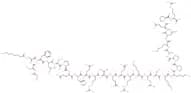
Histone H3 (1-20)-GG-[Lys(5-FAM)] is derived from Histone 3 (H3) which is one of the four core histones (H2A, H2B, H3 and H4) fundamental in compacting eukaryotic DNA into the nucleosome. The nucleosome arises when 147 base pairs of DNA wrap around a H3-H4 tetramer and two H2A-H2B dimers, forming the histone octamer core. Both H4 and H3 are highly conserved and perform roles in binding to segments of DNA which enter and leave the nucleosome and in chromatin formation. Similar to the other core histone, H3 has a globular domain and a flexible N-terminal domain, 'histone tail' which can undergo modifications such as acetylation, methylation, phosphorylation and ubiquitination. Due to histones containing a large number of lysine and arginine residues they have a positive net charge which interacts in an electrostatic manner with the negatively charged phosphate groups in DNA. The transcriptional activation or silencing of the chromatin is controlled by ATP-dependent chromatin remodelling factors and histone modifying enzymes which target histone proteins. Both processes function to alter the positioning of the nucleosome, allowing the DNA it to be either available or inaccessible to the transcription machinery.Histone H3 (1-20)-GG-[Lys(5-FAM)] has a C-terminal GKK linker labelled with 5-Carboxyfluorescein (5-FAM), a widely used green fluorescent tag. This peptide also has an uncharged C-terminal amide.
Peso molecular:2,781.5 g/molCyclic L27-11
Cyclic L27-11 is a peptidomimetic compound that targets the outer membrane protein LptD. LptD is part of a complex that functions to transport lipopolysaccharides to the cell surface through the C-terminal β-barrel domain lumen, embedded within the outer membrane. Cyclic L27-11 can bind LptD and prevent translocation of lipopolysaccharides across the periplasm, even nanomolar doses were effective. This interaction gives cyclic L27-11 a potent antimicrobial activity particularly against the human pathogen Pseudomonas aeruginosa.Modifications of cyclic L27-11 are under research to improve its stability for drug delivery. The peptide provided here has a D-proline substitution, characterised as have no antimicrobial activity against Pseudomonas aeruginosa.Peso molecular:1,234.5 g/molFluor-RRGG-OH
Peptide Fluor-RRGG-OH is a Research Peptide with significant interest within the field academic and medical research. This peptide is available for purchase at Cymit Quimica in multiple sizes and with a specification of your choice.LCBiot-KKWKMRRNQFWVKVQRG-OH
Peptide LCBiot-KKWKMRRNQFWVKVQRG-OH is a Research Peptide with significant interest within the field academic and medical research. This peptide is available for purchase at Cymit Quimica in multiple sizes and with a specification of your choice.H-DHIGTR^-OH
Peptide H-DHIGTR^-OH is a Research Peptide with significant interest within the field academic and medical research. This peptide is available for purchase at Cymit Quimica in multiple sizes and with a specification of your choice.
6-Azido-Hexanoic Acid
CAS:6-Azido-Hexanoic Acid is a lysine derivative that is used for Click Chemistry, which involves the use of reactive nitrenes, such as azides, to create stable covalent bonds with other molecules. This product is also used in diagnostic agents and has shown anticancer activity against prostate cancer cells. 6-Azido-Hexanoic Acid can be synthesized using Click Chemistry and x-ray crystal structures have been determined. The structure consists of a cyclic peptide that contains an amide bond between two lysine residues. The compound has a neutral pH and can be detected by gravimetric analysis.Fórmula:C6H11N3O2Pureza:Min. 95%Peso molecular:157.17 g/molHLA leader peptide LVL
Fragment of the signal peptide from endogenous HLA Class I molecules which is also found in viral glycoproteins, for example human Cytomegalovirus (hCMV) protein UL40. When presented on a cell surface via HLA-E molecules, the HLA- VMAPRTLVL complex binds NKG2A receptors on Natural Killer (NK) cells and some CD8⁺ cytotoxic T cells to reduce their cytotoxic activity. Blocking this interaction is an attractive opportunity for immune checkpoint (IC) approach therapies. This is relevant in both cancer therapies, and viral infections, where endogenous HLA Class I peptide presentation is exploited to escape immune attack.In one study, VMAPRTLVL UL4015-23 was found in 18% congenital cytomegalovirus (cCMV) strains.FEFEFKFK
The ionic-complementary octapeptide, FEFEFKFK, can self-assemble into antiparallel β-sheet rich fibres and forms very stable hydrogels when at a concentration of more than 20 mg/mL (in water).These peptide hydrogels are naturally biocompatible and biodegradable and can be metabolised by the body. Such hydrogels have been shown to mimic the structure of the extracellular matrix, thus offering cells a niche to undertake their physiological functions. These properties mean that these hydrogels have the potential for use in medical applications.FEFEFKFK hydrogels are able to support the culture of cells such as mesenchymal stem cells in three dimensions with sustained cell viability. They can also support the differentiation into osteoblasts and promote mineralisation upon addition of osteogenic stimulation. They therefore have potential for use in the regeneration of hard tissues such as alveolar bone following injury or degeneration.
Peso molecular:1,120.6 g/molSIVmac239 - 101
Custom research peptide; min purity 95%. For different specs please use the Peptide Quote Tool
Peso molecular:1,812.1 g/molAc-LRLRGG-CHO
Peptide Ac-LRLRGG-CHO is a Research Peptide with significant interest within the field academic and medical research. This peptide is available for purchase at Cymit Quimica in multiple sizes and with a specification of your choice.Fmoc-Ile-OH
CAS:Fmoc-Ile-OH is a sodium salt that is used in the synthesis of peptides. It provides the hydroxyl group to the peptide chain, and can be used in solid-phase synthesis. The protonated form of Fmoc-Ile-OH is useful for acetonitrile solvents. Fmoc-Ile-OH has shown antibacterial activity against gram-positive bacteria such as Staphylococcus aureus and Streptococcus pneumoniae. Clinical development of this drug has been successful in treating infections caused by multidrug resistant bacteria, such as MRSA, Acinetobacter baumannii, and Pseudomonas aeruginosa.
Fórmula:C21H23NO4Pureza:Min. 98.0 Area-%Peso molecular:353.42 g/mol



![Histone H3 (1-20)-GG-[Lys(5-FAM)]](/_next/image/?url=https%3A%2Fstatic.cymitquimica.com%2Fproducts%2F3D%2Fthumb-webp%2FCRB1101260.webp&w=3840&q=75)