Peptídeos
Subcategorias de "Peptídeos"
Foram encontrados 29639 produtos de "Peptídeos"
β-Amyloid (37-43)
Custom research peptide; min purity 95%. For different specs please use the Peptide Quote ToolFórmula:C27H49N7O9Peso molecular:615.73 g/molAc-QGGEVYCCSTCPYVFCKSC-NH2
Peptide Ac-QGGEVYCCSTCPYVFCKSC-NH2 is a Research Peptide with significant interest within the field academic and medical research. This peptide is available for purchase at Cymit Quimica in multiple sizes and with a specification of your choice.Osteogenic Growth Peptide (OGP)
Osteogenic Growth Peptide (OGP) is derived from the C-terminal sequence ALKRQGRTLYGFGG of Histone H4. This 14-aa peptide is produced from alternative translation of Histone H4 mRNA.Cor e Forma:PowderPeso molecular:1,522.8 g/molH-ELTR-NH2
Peptide H-ELTR-NH2 is a Research Peptide with significant interest within the field academic and medical research. This peptide is available for purchase at Cymit Quimica in multiple sizes and with a specification of your choice.H-ITPTDSR^-OH
Peptide H-ITPTDSR^-OH is a Research Peptide with significant interest within the field academic and medical research. This peptide is available for purchase at Cymit Quimica in multiple sizes and with a specification of your choice.
H-ENATVAHL^VGALR-OH
Peptide H-ENATVAHL^VGALR-OH is a Research Peptide with significant interest within the field academic and medical research. This peptide is available for purchase at Cymit Quimica in multiple sizes and with a specification of your choice.
H-IIDNKPSIDSYSK^-OH
Peptide H-IIDNKPSIDSYSK^-OH is a Research Peptide with significant interest within the field academic and medical research. This peptide is available for purchase at Cymit Quimica in multiple sizes and with a specification of your choice.
H-NWGLSVYADKPETTK^-OH
Peptide H-NWGLSVYADKPETTK^-OH is a Research Peptide with significant interest within the field academic and medical research. This peptide is available for purchase at Cymit Quimica in multiple sizes and with a specification of your choice.IGRP Catalytic Subunit-related Protein (206-214)
Peptide corresponding to residues 206-214 of murine islet-specific glucose-6-phosphatase catalytic subunit-related protein (IGRP), the autoantigen targeted by pathogenic CD8+ T cells in non obese diabetic (NOD) mice. Cells that recognize IGRP(206-214) are present in the earliest islet infiltrates of NOD mice and undergo avidity maturation as islet inflammation progresses to overt disease.Peso molecular:1,094.6 g/molH-ENEGFTVTAEGK^-OH
Peptide H-ENEGFTVTAEGK^-OH is a Research Peptide with significant interest within the field academic and medical research. This peptide is available for purchase at Cymit Quimica in multiple sizes and with a specification of your choice.
H-GLHGPLTLNSPLTPEK^-OH
Peptide H-GLHGPLTLNSPLTPEK^-OH is a Research Peptide with significant interest within the field academic and medical research. This peptide is available for purchase at Cymit Quimica in multiple sizes and with a specification of your choice.
H-DVSQSSISFQIEK^-OH
Peptide H-DVSQSSISFQIEK^-OH is a Research Peptide with significant interest within the field academic and medical research. This peptide is available for purchase at Cymit Quimica in multiple sizes and with a specification of your choice.Ac-LVLRLR-NH2
Peptide Ac-LVLRLR-NH2 is a Research Peptide with significant interest within the field academic and medical research. This peptide is available for purchase at Cymit Quimica in multiple sizes and with a specification of your choice.Ile-Pro-Leu
Custom research peptide; min purity 95%. For different specs please use the Peptide Quote ToolFórmula:C17H31N3O4Peso molecular:341.45 g/molSuc-Ala-Pro-Ala-pNA
CAS:Suc-Ala-Pro-Ala-pNA is a synthetic substrate that inhibits serine proteases. It has been shown to inhibit thrombin, trypsin, and chymotrypsin at low concentrations. Suc-Ala-Pro-Ala-pNA is used as an anticoagulant in rat neutrophils and it has also been found to have chemotactic activity for neutrophils at high concentrations. The substrate was also found to be an efficient method of detecting the presence of protease activity in plant physiology experiments. In addition to its use as a proteinase inhibitor, Suc-Ala-Pro-Ala-pNA can also be used as an antiplatelet agent.Fórmula:C21H27N5O8Pureza:Min. 95%Peso molecular:477.47 g/molEglin c (41-49)
CAS:Eglin C (41-49) is a synthetic peptide that has been shown to inhibit the function of human leukocytes. It has been used in analytical high-performance liquid chromatography (HPLC) for the separation of peptides with different functional groups. The sequence of this peptide is CPGGKTYCYC, and it is synthesized by cleaving a larger protein at the point where the amino acid sequence begins with the letter "E". Eglin C (41-49) has also been shown to be potently inhibitory against porcine pancreatic elastase and human leukocyte elastase.Fórmula:C48H78N12O15Pureza:Min. 95%Cor e Forma:PowderPeso molecular:1,063.2 g/molGalanin (2-13)-Biotin
Galanin is a widely distributed neuropeptide in the central nervous system, peripheral regions and endocrine system. Galanin has a role in energy homeostasis. Central injections of galanin to the amygdala led to food intake in rats. Galanin also acts in the CNS to inhibit neurotransmitter release, such as acetylcholine. Galanin has been implicated in numerous neurological conditions, including Alzheimer's disease, depression, and epilepsy.Galanin interacts with 3 receptor subtypes, GalR1-3 which are G protein-coupled receptors inserted into the plasma membrane. GalR1 is believed to activate a Gβγ pathway to regulate MAPK activation. GalR2 can also activate the MAPK pathway, but unlike GalR1, there is detectable inositol phosphate production. GalR3 is associated with the Galphai/o pathway. Activation of the receptor leads to a cellular influx of potassium ions.The galanin active fragment (1-16) has been identified as a highly potent agonist for the galanin receptors. These have become a basis for galanin-based peptides, which are neuroactive. These are being investigated as a potential source for anticonvulsant neuropeptides as a therapeutic for conditions such as epilepsy. A library of galanin fragments has allowed screening of their properties to be assessed and used to generate chimeric peptides. Galanin fragments have different affinities for GalR receptors- however, the N-terminal (1-16) have been shown to have a conserved affinity for the receptors.The galanin fragment (2-13) provided here have a C-terminal biotin label for easy detection and purification. Cymit Quimica Laboratories Ltd is a custom peptide provider. If you desire an alternate tag, please contact us to request a custom synthesis.
Cor e Forma:PowderPeso molecular:1,558.8 g/molH-LNIPTDVLK^-OH
Peptide H-LNIPTDVLK^-OH is a Research Peptide with significant interest within the field academic and medical research. This peptide is available for purchase at Cymit Quimica in multiple sizes and with a specification of your choice.
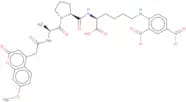
Mca-Ala-Pro-Lys(Dnp)-OH trifluoroacetate salt
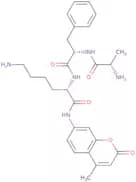
CAS:Mca-Ala-Pro-Lys(Dnp)-OH trifluoroacetate salt is a high quality, versatile, and speciality chemical that is used as an intermediate in the synthesis of complex compounds. Mca-Ala-Pro-Lys(Dnp)-OH trifluoroacetate salt is also a useful scaffold for building block molecules and a versatile building block for peptide synthesis. This compound can be utilized in the manufacture of research chemicals and speciality chemicals.Pureza:Min. 98 Area-%Cor e Forma:PowderPeso molecular:696.66 g/molH-Ala-Phe-Lys-AMC trifluoroacetate salt
CAS:H-Ala-Phe-Lys-AMC trifluoroacetate salt is a chemical compound that can be used as an intermediate in the synthesis of peptides, peptidomimetics, and other organic compounds. This reagent is a high quality, versatile building block that can be used in the synthesis of complex compounds. H-Ala-Phe-Lys-AMC trifluoroacetate salt is a fine chemical that has been assigned CAS No. 120928-02-1. It is a useful scaffold for the synthesis of novel compounds with potential pharmaceutical value.
Fórmula:C28H35N5O5•C2HF3O2Pureza:Min. 95 Area-%Cor e Forma:PowderPeso molecular:635.63 g/mol