Peptídeos
Subcategorias de "Peptídeos"
Foram encontrados 29874 produtos de "Peptídeos"
H-[Lys-Leu-Ala-Lys-Leu-Ala-Lys]2-Gly-Phe-Leu-Gly-(Cys-Gln-Thr-Pro-Tyr-Tyr-Met-Asn-Thr-Cys)-OH
This peptide is a cell-penetrating peptide (CPP) that is derived from the amino acid sequence of the human protein, integrin alpha 4. It binds to the α4β1 integrin receptor on the surface of cancer cells and causes apoptosis. This CPP can also be used as a target for various other biochemicals, such as chemotherapeutic agents, radionuclides, and antibodies, which can then bind to this target and induce apoptosis in cancer cells.
Fórmula:C142H234N36O35S3Pureza:Min. 95%Peso molecular:3,101.86 g/molH-Leu-2-ClTrt-Resin (200-400 mesh) 1% DVB
H-Leu-2-ClTrt-Resin (200-400 mesh) 1% DVB is a building block for the synthesis of peptides. It may be used in the synthesis of amines, thiols, alcohols, and resin. This product can also be used as a tool for peptide synthesis.
Pureza:Min. 95%Marfey's reagent
CAS:Marfey's reagent is a mixture of l-tartaric acid, hydrochloric acid and trifluoroacetic acid. It is used to determine the presence of β-amino acids in urine samples by reacting with the amide group on the β-amino acid. The reaction produces a white precipitate that can be filtered and analyzed using a UV spectrophotometer or LC/MS/MS. Marfey's reagent has significant cytotoxicity and should not be used in cell culture experiments.Fórmula:C9H9FN4O5Pureza:Min. 95%Peso molecular:272.19 g/molH-dPEG®4-Glu[dPEG®4(Cyclo(Arg-Gly-Asp-d-Phe-Lys))]2
H-dPEG®4-Glu[dPEG®4(Cyclo(Arg-Gly-Asp-d-Phe-Lys))]2 is a peptide containing polyethylene glycol (PEG) as spacer to alter their pharmacokinetic properties and pharmodynamics.Fórmula:C92H150N22O31Pureza:Min. 95%Peso molecular:2,060.35 g/molGM CSF Human
GM CSF Human is a protein that belongs to the GM-CSF family. GM-CSF proteins are cytokines that activate neutrophils and macrophages, which play an important role in the immune system. This protein is a potent activator of receptor and peptides, as well as ion channels. It has been shown to inhibit ligand binding to receptors and inhibit the function of antibodies. The antibody can be used as a research tool for Cell Biology or to study the effects of drugs on ion channels. The CAS number for this protein is 57722-07-1.Pureza:Min. 95%IL 4 Human
IL 4 is a cytokine that is responsible for the proliferation and activation of B cells, T cells, macrophages and other immune cells. IL 4 binds to the high affinity receptor IL-4Rα. It also activates the membrane bound IL-4Rβ. The IL-4Rα is a heterodimer consisting of an alpha chain, which is shared by all members of the type II cytokine receptor family, and the common beta chain shared by all type I cytokines receptors. IL-4 has been shown to be effective in inhibiting tumor growth in vivo and in vitro.
Pureza:>98% By Sds-Page And Rp-Hplc.H-LEAEIATYR^-OH
Peptide H-LEAEIATYR^-OH is a Research Peptide with significant interest within the field academic and medical research. This peptide is available for purchase at Cymit Quimica in multiple sizes and with a specification of your choice.
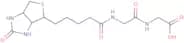
Biotinyl-Gly-Gly-OH
CAS:Please enquire for more information about Biotinyl-Gly-Gly-OH including the price, delivery time and more detailed product information at the technical inquiry form on this page
Fórmula:C14H22N4O5SPureza:Min. 95%Peso molecular:358.41 g/molH-LVTDLTK^-OH
Peptide H-LVTDLTK^-OH is a Research Peptide with significant interest within the field academic and medical research. This peptide is available for purchase at Cymit Quimica in multiple sizes and with a specification of your choice.Bz-Arg-His-D-Asp-CH2Cl trifluoroacetate
CAS:Bz-Arg-His-D-Asp-CH2Cl is a research tool that can be used as an activator or ligand in cell biology and pharmacology. This product is also a receptor, which is a protein that binds to one or more specific substances (ligands) and triggers a change in the activity of cells. Receptors are often located on the surface of cells, such as those in the brain, heart and muscles. Bz-Arg-His-D-Asp-CH2Cl can be used to inhibit ion channels and has been shown to block receptors for acetylcholine, histamine and serotonin. Bz-Arg-His-D-Asp-CH2Cl also blocks calcium channels and potassium channels. This product has been shown to inhibit the activity of phospholipase A2, which helps break down fats into fatty acids. It also inhibits the activity of aminopeptidases, which breaks down proteins intoFórmula:C24H31ClN8O6•(C2HF3O2)xPureza:Min. 95%Peso molecular:563.01 g/molH-Glu[Cyclo(Arg-Ala-Asp-D-Phe-Lys)]2
H-Glu[Cyclo(Arg-Ala-Asp-D-Phe-Lys)]2 is a peptide macrocycle with a cyclic structure. It belongs to the group of biologically active peptides and biochemicals. The peptide macrocycle has an RGD sequence that binds to integrin receptors on cells, which are involved in cell adhesion, migration, and proliferation. This peptide can be used as an agent for cancer research or as a drug to treat cardiovascular diseases.Fórmula:C61H91N19O16Pureza:Min. 95%Peso molecular:1,346.52 g/molBoc-Val-Leu-Lys-AMC
CAS:Boc-Val-Leu-Lys-AMC is a research tool that has been shown to activate ion channels and increase the permeability of cell membranes. This compound also binds to receptors on cells, which may be due to its ability to bind with antibodies. Boc-Val-Leu-Lys-AMC has been used as an inhibitor in protein interactions and pharmacology studies, as well as for the study of ion channels in cell biology.Fórmula:C32H49N5O7Pureza:Min. 95%Peso molecular:615.76 g/molm-dPEG®8-Azide (Azido-m-dPEG®8)
CAS:m-dPEG®8-Azide (Azido-m-dPEG®8) is a PEG compound with two different functional groups (also known as heterobifunctional). Unlike homobifunctional PEG compounds (same functional group on both ends), this type of compounds are more versatile as have two different anchor points. m-dPEG®8-Azide (Azido-m-dPEG®8) is used as a linker and spacer to add a PEG moiety, via pegylation (a bioconjugation technique) to proteins, peptides, oligonucleotides, small molecules and nanoparticles.Pureza:Min. 95%Peso molecular:409.48 g/molH-Ser-Phe-Asn-Gly-Gly-Pro-NH2
CAS:H-Ser-Phe-Asn-Gly-Gly-Pro-NH2 is a peptide that activates Protease Activated Receptor 1 (PAR1) and Protease Activated Receptor 3 (PAR3). It also has been shown to decrease blood pressure in mice, inhibit coagulation, and increase the breakdown of fibrin clots. This product is a ligand for PAR1 and PAR3. It has been shown to activate these receptors by binding to them through its amino acid sequence. HSPNP binds to proteases that cleave the peptide from the receptor, which leads to activation of the receptor. HSPNP can also bind to PAR3 and PAR4.Fórmula:C25H36N8O8Pureza:Min. 95%Peso molecular:576.61 g/molUrotensin II (Human) Antiserum
Urotensin II (Human) Antiserum is a research tool for the study of ion channels and receptors. Urotensin II is a peptide that interacts with the G-protein coupled receptor, UTA1. The purified antibody can be used to detect the presence of this peptide in a sample by Western blotting or ELISA. This product is supplied in high purity and has not been shown to react with any other protein.
Pureza:Min. 95%H-Arg-Arg-Leu-Ile-Glu-Asp-Ala-Glu-Tyr-Ala-Ala-Arg-Gly-NH2
CAS:This peptide hormone is a member of the lipid-binding proteins. It is a basic protein that has been found to be expressed in human leukemia cells and may have an important function in cellular transformation. The hl-60 cells, treated with this agent, show changes in cell shape and motility. Epidermal growth factor (EGF) receptors are activated by this fatty acid, which leads to an increase in the production of EGF by the cells. This peptide hormone has been shown to bind to the epidermal growth factor receptor and stimulate the production of EGF. Monoclonal antibodies can be used to identify this peptide hormone. The binding sites for this peptide hormone are dinucleotide phosphate or cytosolic proteins. This peptide hormone has been associated with autoimmune diseases such as rheumatoid arthritis and psoriatic arthritis.Fórmula:C64H106N22O21Pureza:Min. 95%Peso molecular:1,519.69 g/molAc-RLIEDICLPRWGCLWEDD-NH2
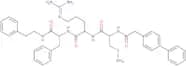
Peptide Ac-RLIEDICLPRWGCLWEDD-NH2 is a Research Peptide with significant interest within the field academic and medical research. This peptide is available for purchase at Cymit Quimica in multiple sizes and with a specification of your choice.N-(4-Biphenylacetyl)-Cys(Me)-D-Arg-Phe-N-Phenylethylamide
CAS:N-(4-Biphenylacetyl)-Cys(Me)-D-Arg-Phe-N-Phenylethylamide is an inhibitor of serine proteases. It prevents the breakdown of proteins, which may result in a number of pathologies. N-(4-Biphenylacetyl)-Cys(Me)-D-Arg-Phe-N-Phenylethylamide has been shown to prevent reperfusion injury and proteinuria in mice by inhibiting renal inflammation and oxidative stress. This compound has also been shown to be effective in preventing the development of cancer, for example prostate cancer, by inhibiting angiogenesis, leading to reduced vascularization.Fórmula:C41H49N7O4SPureza:Min. 95%Peso molecular:735.96 g/molH-GTYLTDETHR^-OH
Peptide H-GTYLTDETHR^-OH is a Research Peptide with significant interest within the field academic and medical research. This peptide is available for purchase at Cymit Quimica in multiple sizes and with a specification of your choice.H-SYPSNATCPR^-OH
Peptide H-SYPSNATCPR^-OH is a Research Peptide with significant interest within the field academic and medical research. This peptide is available for purchase at Cymit Quimica in multiple sizes and with a specification of your choice.
![H-[Lys-Leu-Ala-Lys-Leu-Ala-Lys]2-Gly-Phe-Leu-Gly-(Cys-Gln-Thr-Pro-Tyr-Tyr-Met-Asn-Thr-Cys)-OH](/_next/image/?url=https%3A%2Fstatic.cymitquimica.com%2Fproducts%2F3D%2Fthumb-webp%2FCAN-3505-PI.webp&w=3840&q=75)


![H-dPEG®4-Glu[dPEG®4(Cyclo(Arg-Gly-Asp-d-Phe-Lys))]2](/_next/image/?url=https%3A%2Fstatic.cymitquimica.com%2Fproducts%2F3D%2Fthumb-webp%2FRGD-3750-PI.webp&w=3840&q=75)



![H-Glu[Cyclo(Arg-Ala-Asp-D-Phe-Lys)]2](/_next/image/?url=https%3A%2Fstatic.cymitquimica.com%2Fproducts%2F3D%2Fthumb-webp%2FPCI-3979-PI.webp&w=3840&q=75)