


Peptídeos
Os peptídeos são cadeias curtas de aminoácidos ligados por ligações peptídicas, desempenhando papéis importantes como moléculas biológicas em processos celulares. Eles funcionam como hormônios, neurotransmissores e moléculas de sinalização, sendo amplamente utilizados em aplicações terapêuticas e diagnósticas. Os peptídeos também são cruciais na pesquisa para estudar interações proteicas, atividades enzimáticas e vias de sinalização celular. Na CymitQuimica, oferecemos uma ampla seleção de peptídeos de alta qualidade para apoiar suas necessidades de pesquisa e desenvolvimento em biotecnologia e farmacêutica.
Subcategorias de "Peptídeos"
Foram encontrados 30311 produtos de "Peptídeos"
Ordenar por
Pureza (%)
0
100
|
0
|
50
|
90
|
95
|
100
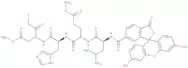
Fluorescein-6-carbonyl-Leu-Glu(OMe)-His-DL-Asp(OMe)-fluoromethylketone
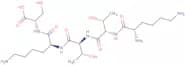
CAS:<p>Please enquire for more information about Fluorescein-6-carbonyl-Leu-Glu(OMe)-His-DL-Asp(OMe)-fluoromethylketone including the price, delivery time and more detailed product information at the technical inquiry form on this page</p>Fórmula:C45H47FN6O14Pureza:Min. 95%Peso molecular:914.89 g/molProcollagen Type I (212-216) H-Lys-Thr-Thr-Lys-Ser-OH
CAS:<p>Procollagen type I (212-216) H-Lys-Thr-Thr-Lys-Ser-OH is a tetrapeptide that is the most abundant component of human skin. It has been shown to have biological properties and can be synthesized in vitro. Procollagen type I (212-216) H-Lys-Thr-Thr-Lys-Ser-OH has an absorption maximum at 265 nm, which makes it suitable for use in uv protection creams. It also has a high chemical stability and can be stored for up to two years without degradation. Procollagen type I (212-216) H-Lys-Thr-Thr-Lys-Ser-OH is used as a substrate in cell culture to study protein synthesis and transcription, or polymerase chain reaction, technique. This peptide also inhibits the activity of proteases such as trypsin and chymotrypsin, making</p>Fórmula:C23H45N7O9Pureza:Min. 95%Cor e Forma:White Off-White PowderPeso molecular:563.65 g/mol1,4-Diazabicyclo[2.2.2]octane bis(sulfur dioxide) adduct
CAS:1,4-Diazabicyclo[2.2.2]octane bis(sulfur dioxide) adduct is a catalyst that can be used for the reduction of various functional groups. It is typically used to synthesize aziridines from amines and diazo compounds, or from halides and organometallic reagents. 1,4-Diazabicyclo[2.2.2]octane bis(sulfur dioxide) adduct has been shown to inhibit the production of sulfoxides by sulfide-reducing bacteria such as Desulfovibrio desulfuricans and Desulfobulbus propionicus.Fórmula:C6H12N2O4S2Pureza:Min. 95%Peso molecular:240.3 g/molAmyloid β-Protein (35-25) trifluoroacetate salt
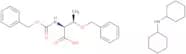
CAS:Please enquire for more information about Amyloid beta-Protein (35-25) trifluoroacetate salt including the price, delivery time and more detailed product information at the technical inquiry form on this pageFórmula:C45H81N13O14SPureza:Min. 95%Cor e Forma:PowderPeso molecular:1,060.27 g/molZ-Thr(Bzl)-OH·DCHA
CAS:Produto ControladoPlease enquire for more information about Z-Thr(Bzl)-OH·DCHA including the price, delivery time and more detailed product information at the technical inquiry form on this pageFórmula:C19H21NO5·C12H23NPureza:Min. 95%Peso molecular:524.69 g/molACTH (4-11)
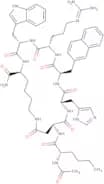
<p>Catalogue peptide; min. 95% purity</p>Fórmula:C50H71N15O11SPeso molecular:1,090.28 g/molN-Acetyl-L-norleucyl-L-a-aspartyl-L-histidyl-3-(2-naphthalenyl)-D-alanyl-L-arginyl-L-tryptophyl-L-lysinamide-(2,7) -lactam
CAS:Please enquire for more information about N-Acetyl-L-norleucyl-L-a-aspartyl-L-histidyl-3-(2-naphthalenyl)-D-alanyl-L-arginyl-L-tryptophyl-L-lysinamide-(2,7) -lactam including the price, delivery time and more detailed product information at the technical inquiry form on this pageFórmula:C54H71N15O9Pureza:Min. 95%Peso molecular:1,074.24 g/molFmoc-Phe-Wang resin (100-200 mesh)
<p>Please enquire for more information about Fmoc-Phe-Wang resin (100-200 mesh) including the price, delivery time and more detailed product information at the technical inquiry form on this page</p>Pureza:Min. 95%Disulfide biotin azide
CAS:<p>Extraordinary strength of the streptavidin-biotin interaction allows for efficient capturing of even highly dilute targets; however, it makes recovery of proteins from affinity resins challenging. Conventional methods to elute biotinylated proteins from immobilized avidin include the following: (i) denaturation of streptavidin by boiling the resin in a denaturing buffer that may include high concentrations of chaotropic salts, (ii) trypsin digestion of proteins while they are bound to the resin, or (iii) elution of proteins with excess free biotin. These protocols can co-elute contaminant proteins by releasing nonspecifically bound proteins and/or naturally biotinylated proteins concurrently with labeled proteins. In addition, some of these methods can cause elution of high levels of resin-based peptides along with the proteins of interest, resulting in further sample contamination.<br>Disulfide Biotin Azide probe eliminates a major limitation of the streptavidin-biotin affinity purification. This reagent contains a biotin moiety linked to an azide moiety through a spacer arm containing a cleavable disulfide linker. Captured biomolecules can be efficiently released under mild conditions (50 mM dithiothreitol, 10 mM 2-mercaptoethanol or 1% sodium borohydride) and the small molecular fragment (188.25 Da) left on the labeled protein following cleavage. These features make the cleavable probe especially attractive for use in biomolecular labeling and proteomic studies.</p>Fórmula:C27H48N8O7S3Pureza:Min 95%Peso molecular:692.92 g/mol[Gln144]-PLP (139-151), Q144-PLP(139-151)
<p>Catalogue peptide; min. 95% purity</p>Fórmula:C66H102N20O18Peso molecular:1,463.67 g/molIL34 Human, His
<p>IL34 Human Recombinant produced in E.Coli is a single, non-glycosylated polypeptide chain containing 260 amino acids (21-242 a.a) and having a molecular mass of 29.6kDa. IL34 is fused to a 38 amino acid His-tag at N-terminus & purified by proprietary chromatographic techniques.</p>Pureza:Min 85% By Sds-Page.Human Growth Hormone (1-43)
<p>Catalogue peptide; min. 95% purity</p>Fórmula:C240H358N62O67SPeso molecular:5,215.97 g/molGhrelin-[Cys(AF647)] Human
<p>Ghrelin is a peptide hormone mainly produced in the stomach. Ghrelin is involved in several physiological processes, including feeding, lipid accumulation, stress response- anxiety- cardiac performance- immunity and inflammation, taste sensation, reward-seeking behaviour, glucose metabolism and thermogenesis, memory, motivation and learning.Ghrelin exerts its actions by binding the growth hormone secretagogue receptor (GHSR), mainly found in the hypothalamic and mesolimbic brain regions and peripheral organs (adipose tissue, adrenals, and stomach).Ghrelin is produced by the cleavage of the precursor peptide preproghrelin. The attachment of a fatty acid to its serine 3 residue makes a form capable of activating GHSR.Ghrelin is a valuable target for treating conditions such as anorexia, cachexia, sarcopenia, cardiopathy, neurodegenerative disorders, renal and pulmonary disease, gastrointestinal disorders, inflammatory disorders and metabolic syndrome.This ghrelin has a C-terminal AF647, a structural analog to Alexa Fluor 647, a widely used far-red fluorescent dye. Its excitation is ideally suited to 594nm or 633nm. This dye is suited for low abundance targets as it has high initial brightness and a high photostability allowing detection of low abundance peptides.</p>Pureza:Min. 95%Peso molecular:4,326.9 g/molNeurogranin (28-43)
<p>Catalogue peptide; min. 95% purity</p>Fórmula:C78H134N28O19SPeso molecular:1,800.18 g/molBNP (1-21), Pro (Human)
<p>Catalogue peptide; min. 95% purity</p>Fórmula:C89H144N28O35Peso molecular:2,166.31 g/molbeta-Amyloid (16-23)
<p>Catalogue peptide; min. 95% purity</p>Fórmula:C47H69N9O13Peso molecular:968.13 g/mol[Ala8]-Humanin, [Ala8]-HN, Shna
<p>Catalogue peptide; min. 95% purity</p>Fórmula:C119H204N34O32SPeso molecular:2,655.23 g/mol[Ile12, Val15] MUC5AC Analog 3
<p>Catalogue peptide; min. 95% purity</p>Fórmula:C67H112N16O25Peso molecular:1,541.73 g/mol[D-Ala2]-beta-Casomorphin (1-6), bovine
<p>Catalogue peptide; min. 95% purity</p>Fórmula:C33H42N6O8Peso molecular:650.7 g/molGlycoprotein Hormone a (32-46) amide
<p>Catalogue peptide; min. 95% purity</p>Fórmula:C78H128N24O20SPeso molecular:1,754.09 g/mol

![1,4-Diazabicyclo[2.2.2]octane bis(sulfur dioxide) adduct](/_next/image/?url=https%3A%2Fstatic.cymitquimica.com%2Fproducts%2F3D%2Fthumb-webp%2FFD111193.webp&w=3840&q=75)


![[Gln144]-PLP (139-151), Q144-PLP(139-151)](/_next/image/?url=https%3A%2Fstatic.cymitquimica.com%2Fproducts%2F3D%2Fthumb-webp%2FVAC-00496.webp&w=3840&q=75)


![Ghrelin-[Cys(AF647)] Human](/_next/image/?url=https%3A%2Fstatic.cymitquimica.com%2Fproducts%2F3D%2Fthumb-webp%2FCRB1110382.webp&w=3840&q=75)


![[Ala8]-Humanin, [Ala8]-HN, Shna](/_next/image/?url=https%3A%2Fstatic.cymitquimica.com%2Fproducts%2F3D%2Fthumb-webp%2FVAC-00593.webp&w=3840&q=75)
![[Ile12, Val15] MUC5AC Analog 3](/_next/image/?url=https%3A%2Fstatic.cymitquimica.com%2Fproducts%2F3D%2Fthumb-webp%2FVAC-00456.webp&w=3840&q=75)
![[D-Ala2]-beta-Casomorphin (1-6), bovine](/_next/image/?url=https%3A%2Fstatic.cymitquimica.com%2Fproducts%2F3D%2Fthumb-webp%2FVAC-00830.webp&w=3840&q=75)
