Substratos enzimáticos
Subcategorias de "Substratos enzimáticos"
Foram encontrados 1527 produtos de "Substratos enzimáticos"
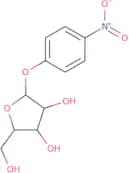
4-Nitrophenyl b-L-arabinofuranoside
CAS:Chromogenic substrate targeting alpha-L-arabinofuranosidase
Pureza:Min. 95%Cor e Forma:White/Off-White SolidPeso molecular:271.22 g/mol4-Nitrophenyl-α-D-maltopyranoside
CAS:Chromogenic α-maltosidase substrate yielding a yellow solution upon cleavage.Fórmula:C18H25NO13Pureza:Min. 98.0 Area-%Peso molecular:463.40 g/mol6-Chloro-3-indoxyl caprylate
CAS:6-Chloro-3-indoxyl caprylate is a high quality, enzyme substrate, chromogenic substrate, bioluminescence, chemiluminescence ligand, staining and diagnostics reagent. It has CAS No. 159954-35-5 and is used in food testing, culture media and environmental testing. 6-Chloro-3-indoxyl caprylate is also a fluorogenic substrate that is used for high purity applications such as conjugation with other molecules.
Fórmula:C16H20ClNO2Peso molecular:293.80 g/mol4-Nitrophenyl-beta-D-xylopyranoside
CAS:Chromogenic β-xylosidase substrate yielding a yellow solution upon cleavage.Fórmula:C11H13NO7Pureza:Min. 99 Area-%Peso molecular:271.23 g/mol5-Bromo-4-chloro-3-indolyl palmitate
CAS:5-Bromo-4-chloro-3-indolyl palmitate is a chromogenic substrate used to detect the specific enzymatic activity of lipase. After cleavage, 5-bromo-4-chloro-indoxyl is released, resulting in a blue to blue-green color change in bacterial colonies or media. 5-Bromo-4-chloro-3-indolyl palmitate is used in lipase activity assays or cystic fibrosis diagnostics.Fórmula:C24H35BrClNO2Pureza:Min. 95%Cor e Forma:PowderPeso molecular:484.9 g/molFLsharp™ - Phosphate, disodium salt
FLsharp™ - Phosphate, disodium salt is a fluorogenic water-soluble substrate for phosphatase enzymes. Its chemical name is 6-Chloro-2-[5-chloro-2-(phosphonooxy)phenyl]-4(1H)-quinazolinone disodium salt and was developed by Molecular Probes in the 1990s. After cleavage of the substrate by phosphatase activity, an insoluble product is formed that is highly fluorescent in the solid state. Upon UV irradiation this very stable fluorophore emits green light in the 530 nm range for an extended period of time. FLsharp™ is a unique substrate - optimized for the detection of phosphatase activity in solid matrices such as agar media, tissue sections or microscopic preparations. FLsharp™ - Phosphate, disodium salt is used in microbiology as a substrate for bacterial phosphatases.
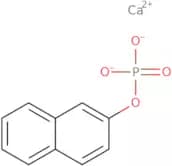
Pureza:Min. 95%Calcium 2-naphthylphosphate
CAS:Calcium 2-naphthylphosphate, which is the calcim salt of 2-naphthylphosphate, is a chromogenic substrate to measure alkaline phosphatase activity. After enzymatic cleavage, the product yielded (2-naphthol) generates a red-colored complex upon reaction with a diazonium salt like Fast Blue RR or Fast Garnet GBC.
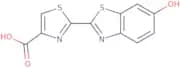
Pureza:(%) Min. 95%Cor e Forma:PowderPeso molecular:282.24 g/molDehydroluciferin
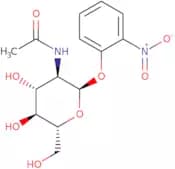
CAS:Dehydroluciferin is a bioluminescence probe that is a potent inhibitor of the firefly luciferase reaction. It is a byproduct of the oxidation of luciferin, the substrate for firefly luciferase, which catalyzes the bioluminescence reaction. It can also form during the synthesis or storage of luciferin. Its presence can potentially lead to issues in bioluminescent assays.Fórmula:C11H6N2O3S2Pureza:Min. 97 Area-%Cor e Forma:PowderPeso molecular:278.31 g/mol2-Nitrophenyl 2-acetamido-2-deoxy-a-D-glucopyranoside
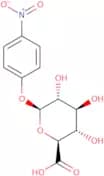
CAS:2-Nitrophenyl 2-acetamido-2-deoxy-alpha-D-glucopyranoside is a chromogenic substrate used to assay the activity of enzymes that cleave N-acetyl-alpha-D-glucosaminide, such as chitinases and lysozymes. Upon cleavage by the enzyme of interest, the substrate releases a yellow-colored 2-nitrophenol that can be measured spectrophotometrically. This substrate is widely used in the food industry to monitor the activity of lysozyme in cheese, as well as in biomedical research for studying cellular and molecular mechanisms involved in conditions such as inflammation and cancer.Pureza:Min. 95%Cor e Forma:PowderPeso molecular:342.3 g/mol4-Nitrophenyl-beta-D-glucuronic acid
CAS:Chromogenic β-glucuronidase substrate yielding a yellow solution upon cleavage. Used to detect E. coli contamination in food and drinking water due to their β-glucuronidase activity.Fórmula:C12H13NO9Pureza:Min. 98.0 Area-%Peso molecular:315.24 g/molLuc-coliforms Na
CAS:Luc-coliforms Na is a high quality, chromogenic substrate for the detection of coliforms. It is used widely in the food industry to detect whether coliforms are present in milk, cheese, and other dairy products. Luc-coliforms Na provides a color change from yellow to blue when it reacts with coliforms and has a high pH range of 4.0-8.0. Luc-coliforms Na has a CAS number of 93824-43-4.Pureza:Min. 95%4-Methylumbelliferyl palmitate
CAS:Fluorogenic substrate for esterase yielding a blue fluorescent solution upon cleavage.Fórmula:C26H38O4Pureza:Min. 99 Area-%Peso molecular:414.59 g/molRef: 3D-M-5750
-Unit-ggA consultar1gA consultar5gA consultar250mgA consultar500mgA consultar2500mgA consultar5-Nitro-3-indoxyl-β-D-galactopyranoside
For the detection of beta-galactosidase activityFórmula:C14H16N2O8Peso molecular:340.29 g/molL-Alanine-7-amido-4-methylcoumarin hydrochloride
CAS:L-Alanine-7-amido-4-methylcoumarin hydrochloride is a synthetic peptide substrate used as a fluorogenic substrate for alanine aminopeptidase.Fórmula:C13H14N2O3·HClPureza:Min. 90%Cor e Forma:PowderPeso molecular:282.72 g/mol2-Naphthyl caprylate
CAS:Chromogenic substrate for carboxylesterase and lipase. 2-naphthol is released upon hydrolyzation. By simultaneous coupling with a diazonium salt, the corresponding azo-dye is formed. Naphthols can also be detected by fluorescence analysis. Used in an colorimetric assay for the extracellular lipase of Pseudomonas fluorescens B52.
Fórmula:C18H22O2Pureza:Min. 98.0 Area-%Peso molecular:270.37 g/molRef: 3D-N-2220
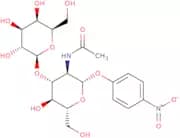
-Unit-ggA consultar1gA consultar5gA consultar250mgA consultar500mgA consultar2500mgA consultar4-Nitrophenyl 2-acetamido-2-deoxy-3-O-(b-D-galactopyranosyl)-b-D-glucopyranoside
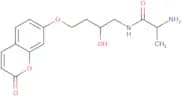
CAS:Chromogenic substrate for fucosyltransferasesFórmula:C20H28N2O13Pureza:Min. 98 Area-%Cor e Forma:White PowderPeso molecular:504.44 g/mol7-((4'-L-Alaninamido)-rac-3'-hydroxybutyloxy) coumarin
This Clips-O substrate 7-((4'-L-Alaninamido)-rac-3'-hydroxybutyloxy) coumarin allows the detection of single and dual enzymatic activity (L-alanine aminopetidase and oxidation of 4-amino-3-hydroxybutyloxy spacer either enzymatically or by exposure to sodium periodate) with a single substrate resulting in a fluorescent signal. The main virtues of Clips-O substrates are an increased stability towards non-enzymatic hydrolysis that results in a reduced background and high sensitivity.
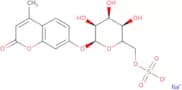
Fórmula:C16H20N2O5Pureza:Min. 95%Cor e Forma:PowderPeso molecular:320.35 g/mol4-Methylumbelliferyl b-D-galactopyranoside-6-sulphate sodium salt - Moscerdam™ biochemical purity
CAS:4-MU-Gal-6S (M4A) is a fluorogenic substrate of galactose-6-sulfate sulfatase (GALNS), used for the diagnosis of Mucopolysaccharidosis IV type A (MPS IV A). MPS IV, also known as Morquio syndrome, is a rare metabolic disorder in which the human body cannot process glycosaminoglycans (GAGs). MPS IV A is caused by the deficiency of the enzyme N-acetyl-galactosamine-6-sulfatase resulting in accumulation of keratan and chondroitin sulfate in tissues. M4A is used as the GALNS substrate in the anti-lysosomal enzyme antibody assay for the treatments of lysosomal storage disorders (LSDs) with enzyme replacement therapies (ERTs).Fórmula:C16H17NaO11SPureza:Min. 97 Area-%Cor e Forma:White PowderPeso molecular:440.36 g/mol4-Methylumbelliferyl 2-deoxy-2-sulfamino-b-D-glucopyranoside sodium salt
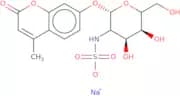
4-Methylumbelliferyl 2-deoxy-2-sulfamino-beta-D-glucopyranoside sodium salt is a fluorogenic substrate for N-sulfoglucosamine sulfohydrolase. After enzymatic cleaveage, free 4-methylumbelliferone (also known as hymecromone) is released, exhibiting blue fluorescence upon excitation with UV light. The strongest fluorescence of 4-methylumbelliferone requires deprotonation of the hydroxyl group (thus requires alkaline pH), with a maximal fluorescence intensity obtained with excitation at 350 to 370 nm and emission at 440 to 470 nm. The use of 4-methylumbelliferyl 2-deoxy-2-sulfamino-beta-D-glucopyranoside sodium saltas a substrate for measuring the N-sulfoglucosamine sulfohydrolase activity is used for screening of Mucopolysaccharidosis IIIA (MPS IIIA) and diagnosis of Sanfilippo A syndrome.Fórmula:C16H19NO10SNaPureza:Min. 95%Cor e Forma:PowderPeso molecular:439.37 g/molN,N,N',N'-Tetramethyl-p-phenylenediamine dihydrochloride
CAS:Reducing co-substrate for heme peroxidases; test reagent in microbiologyFórmula:C10H16N2·2HClPureza:Min. 95%Cor e Forma:White PowderPeso molecular:237.17 g/mol