Substratos enzimáticos
Subcategorias de "Substratos enzimáticos"
Foram encontrados 1527 produtos de "Substratos enzimáticos"
L-Luciferin, potassium salt
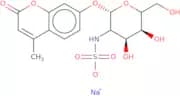
CAS:L-Luciferin is an enzyme substrate that is used in the detection of bioluminescence. It is a fluorogenic substrate that can be used to detect the presence of glucose in urine. L-Luciferin is also a chemiluminescent substrate that can be used to detect ATP, which is required for cell metabolism. L-Luciferin has been shown to be stable at pH levels ranging from 2.5 to 9 and can be stored for up to 3 years when stored at 4°C with no light or oxygen exposure. This product has CAS No. 754978-59-1, indicating high purity and quality. L-Luciferin will not stain or react with other compounds, making it highly suitable for use as a conjugate in diagnostic tests or as a ligand in fluorescent staining reactions.Fórmula:C11H7KN2O3S2Pureza:Min. 98.0 Area-%Peso molecular:318.42 g/mol4-Methylumbelliferyl 2-deoxy-2-sulfamino-a-D-glucopyranoside sodium salt - Moscerdam™ biochemical purity
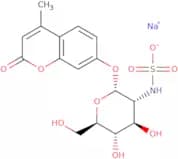
CAS:4-Methylumbelliferyl 2-deoxy-2-sulfamino-a-D-glucopyranoside sodium salt (M3A or MU-GlcNS) is a fluorogenic substrate of heparin sulfamidase, used in the diagnosis of Mucopolysaccharidosis III type A (MPS III A). MPS III A, also known as Sanfilippo syndrome type A, is caused by the deficiency of heparan N-sulfatase. Heparin sulfamidase in the assay desulfates MU-GlcNS to 4-methylumbelliferyl 2-amino-2-deoxy-α-D-glucopyranoside (MU-GlcNH2). To release fluorometrically measurable 4-methylumbelliferone (MU) and by-product glucosamine, MU-GlcNH2 is further hydrolysed by an enzyme such as yeast α-glucosidase during a second incubation.Fórmula:C16H18NO10SNaPureza:Min. 95 Area-%Cor e Forma:White PowderPeso molecular:439.37 g/molLuc-Salmonella
Luc-Salmonella is a conjugate of the enzyme luciferase and the substrate 5-bromo-4-chloro-3-indolyl phosphate. Luc-Salmonella has been used for diagnostic purposes in the detection of bacteria in culture media, as well as in environmental and food testing. Luc-Salmonella can be used to detect Salmonella, which is a bacterium that can cause gastrointestinal disease. Luminescence is measured using a luminometer or fluorimeter with an excitation wavelength of 485 nm and emission wavelengths at 510 nm. Luminescence from Luc-Salmonella is typically measured after 1 hour incubation with bacterial cells.
Luc-Salmonella has been shown to have high purity and quality due to its unique composition of enzyme substrate. This product has been tested for contamination by sensitive assays such as chemiluminescence, bioluminescence, or fluorescence. The purity level of Luc-SalPureza:Min. 96 Area-%Ref: 3D-L-8281
5mgA consultar10mgA consultar25mgA consultar50mgA consultar100mgA consultar-Unit-mgmgA consultar3-Nitrophenyl β-D-glucopyranoside
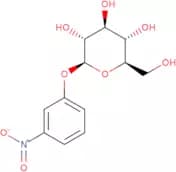
CAS:3-Nitrophenyl beta-D-glucopyranoside is a chromogenic enzyme substrate commonly used to assay for beta-glucosidase activity. Upon hydrolysis by the enzyme, it produces a yellow product that can be easily detected by spectrophotometry. This substrate is often used in the field of carbohydrate chemistry and biochemistry to study enzyme kinetics and inhibition in both in vitro and in vivo systems.Fórmula:C12H15NO8Pureza:Min. 95%Cor e Forma:White Yellow PowderPeso molecular:301.25 g/mol4-Methylumbelliferyl cholin phosphate
CAS:4-Methylumbelliferyl phosphocholine, commonly known as 4-MUPC, is a synthetic phosphodiester used as an enzyme substrate for phospholipase enzymes. 4-MUPC is used as a fluorogenic substrate to measure the activity of phopholipases, which are important mediators of cell signalling.Fórmula:C15H20NO6PPureza:Min. 99.0 Area-%Peso molecular:341.30 g/molDDAO galactoside
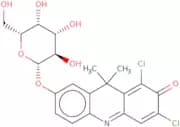
CAS:The DDAO molecule [7-hydroxy-9H-(1, 3-dichloro-9, 9 dimethylacridin-2-one] is used as a stain and a dye in molecular biology, due to its ability to bind intracellular and extracellular DNA. DDAO galactoside is a fluorogenic substrate for galactosidase.
Pureza:Min. 95%Cor e Forma:PowderPeso molecular:470.3 g/molN,N,N',N'-Tetramethyl-p-phenylenediamine dihydrochloride
CAS:Reducing co-substrate for heme peroxidases; test reagent in microbiologyFórmula:C10H16N2·2HClPureza:Min. 95%Cor e Forma:White PowderPeso molecular:237.17 g/mol5-Bromo-6-chloro-3-indolyl sulfate potassium salt
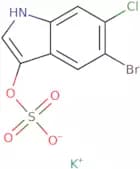
CAS:5-Bromo-6-chloro-3-indolyl sulfate potassium salt is a fluorogenic substrate that can be used for food testing. It is a conjugate of 5-bromo-6-chloroindolylsulfate and potassium, which is dissolved in buffer solution. This product can also be used as a chromogenic substrate in environmental testing, an enzyme substrate in diagnostics, and a ligand for bioluminescence. It has high purity and quality, and can be used for chemiluminescence or bioluminescence. The CAS number for this product is 6581-24-4.Fórmula:C8H4BrClNO4S·KPureza:Min. 95%Cor e Forma:PowderPeso molecular:364.64 g/mol5-Bromo-4-chloro-3-indolyl b-L-fucopyranoside
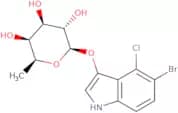
CAS:5-Bromo-4-chloro-3-indolyl β-L-fucopyranoside (X-Fuc) is a chromogenic substrate specifically designed for the identification and detection of fucosidase enzyme activity. Upon cleavage by fucosidase, it generates a blue-colored 5-Bromo-4-chloro-3-hydroxy-indole precipitate, which can be easily observed under a microscope or spectrophotometer. This feature makes X-Fuc an invaluable tool across various applications, such as biochemical analysis, histochemical staining, cell biology, and enzyme kinetic assays. By providing a fast, sensitive, and reliable readout for fucosidase activity, 5-Bromo-4-chloro-3-indolyl β-L-fucopyranoside facilitates essential research in the understanding of biological processes and the development of therapeutic interventions.Fórmula:C14H15BrClNO5Pureza:Min. 95%Cor e Forma:White PowderPeso molecular:392.63 g/molAldol® 458 nonanoate solution, 0.75 M in DMSO, Biosynth Patent: EP 2427431 and US 8940909
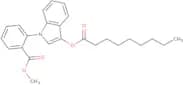
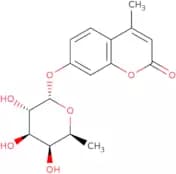
CAS:Produto ControladoAldol 458 nonanoate solution (0.75 M) is a substrate for enzymes and ligands, which is used in various applications such as food testing, staining, fluorogenic substrate, environmental testing, chromogenic substrate and conjugate. Aldol 458 nonanoate solution (0.75 M) has high purity and is highly stable at pH 2-12. This product can be used as a chemiluminescence or bioluminescence substrate. The CAS number for this product is 2484873-15-4.Fórmula:C25H29NO4Pureza:Min. 95%Cor e Forma:Clear LiquidPeso molecular:407.51 g/mol4-Methylumbelliferyl-alpha-L-rhamnopyranoside
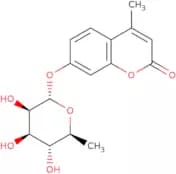
CAS:4-Methylumbelliferyl-alpha-L-rhamnopyranoside is a fluorogenic substrate for alpha-L-rhamnosidase. After enzymatic cleaveage, free 4-methylumbelliferone (also known as hymecromone) is released, exhibiting blue fluorescence upon excitation with UV light. The strongest fluorescence of 4-methylumbelliferone requires deprotonation of the hydroxyl group (thus requires alkaline pH), with a maximal fluorescence intensity obtained with excitation at 350 to 370 nm and emission at 440 to 470 nm. The use of 4-methylumbelliferyl-alpha-L-rhamnopyranosideas a substrate for measuring the alpha-L-rhamnosidase activity is used for detection of bacterial infection.Fórmula:C16H18O7Pureza:Min. 98 Area-%Cor e Forma:PowderPeso molecular:322.32 g/mol6-Chloro-3-indolyl β-D-cellobioside
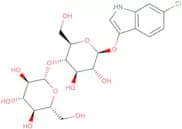
CAS:6-Chloro-3-indolyl b-D-cellobioside is a chromogenic substrate that produces a salmon-pink color after enzymatic cleavage. It is used for detecting the activity of beta-D-cellobiosidase in enzyme assays.
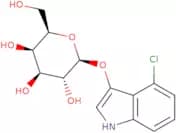
Pureza:Min. 95%Cor e Forma:White To Off-White SolidPeso molecular:491.87 g/mol4-Chloro-3-indolyl β-D-galactopyranoside
CAS:2-Chloro-4-nitrophenyl b-D-lactoside is a chromogenic enzyme substrate used to study the activity of enzymes. It produces a color when hydrolyzed, which makes it a valuable tool in screening for enzyme activity and studying enzyme kinetics.Fórmula:C14H16ClNO6Pureza:Min. 95%Cor e Forma:SolidPeso molecular:329.73 g/mol2-(N-Hexadecanoylamino)-4-nitrophenylphosphocholine hydroxide
CAS:2-(N-Hexadecanoylamino)-4-nitrophenylphosphocholine hydroxide, often abbreviated as HDA-PC, is a chromogenic substrate for acid sphingomyelinase enzyme. HDA-PC is used as a key substrate for measuring the activity of this enzyme, responsible for catalyzing the hydrolysis of sphingomyelin to ceramide. The activity assay for this measuring this enzyme's acitivy is to detect a deficiency (or lack) of the enzyme which is directly related to the Niemann-Pick disease.Fórmula:C27H50N3O8PPureza:Min. 95%Cor e Forma:Off-White PowderPeso molecular:575.68 g/molLuc-S.aureus K
Luc-S.aureus K is a fluoro-ligand that is used as a diagnostic to detect and quantify the activity of S.aureus in any given sample. It is a detection substrate for the enzyme β-galactosidase, which catalyzes the hydrolysis of the luciferin. When luciferin is cleaved by β-galactosidase, it emits light that can be detected using a luminometer to measure the amount of light produced and calculate the quantity of bacteria present in the sample. Luc-S.aureus K has been approved for use as a detector for bioluminescence in food testing, environmental testing, and other diagnostic applications.Pureza:Min. 95%Naphthol AS-BI β-L-fucopyranoside
CAS:Substrate for the detection of beta-D-fucosidaseFórmula:C24H24BrNO7Pureza:Min. 95%Peso molecular:518.35 g/mol4-Methylumbelliferyl 2-deoxy-2-sulfamino-b-D-glucopyranoside sodium salt
4-Methylumbelliferyl 2-deoxy-2-sulfamino-beta-D-glucopyranoside sodium salt is a fluorogenic substrate for N-sulfoglucosamine sulfohydrolase. After enzymatic cleaveage, free 4-methylumbelliferone (also known as hymecromone) is released, exhibiting blue fluorescence upon excitation with UV light. The strongest fluorescence of 4-methylumbelliferone requires deprotonation of the hydroxyl group (thus requires alkaline pH), with a maximal fluorescence intensity obtained with excitation at 350 to 370 nm and emission at 440 to 470 nm. The use of 4-methylumbelliferyl 2-deoxy-2-sulfamino-beta-D-glucopyranoside sodium saltas a substrate for measuring the N-sulfoglucosamine sulfohydrolase activity is used for screening of Mucopolysaccharidosis IIIA (MPS IIIA) and diagnosis of Sanfilippo A syndrome.Fórmula:C16H19NO10SNaPureza:Min. 95%Cor e Forma:PowderPeso molecular:439.37 g/mol3-(4,4-Difluoro-5,7-dimethyl-4-bora-3a,4a-diaza-s-indacene-3-propionamido)propyl b-D-lactoside
3-(4,4-Difluoro-5,7-dimethyl-4-bora-3a,4a-diaza-s-indacene-3-propionamido)propyl b -D -lactoside (FDPBP) is a substrate for alkaline phosphatase. It reacts with the enzyme to produce a blue color. FDPBP is used in diagnostic applications such as food testing and bioluminescence.Pureza:Min. 95%Cor e Forma:PowderPeso molecular:675.48 g/mol4-Methylumbelliferyl-beta-D-glucuronic acid dihydrate
CAS:4-Methylumbelliferyl beta-D-glucuronide (MUG) is commonly used as a substrate for detecting beta-glucuronidase. MUG is used for identifying E. coli contamination in food, drinking water, clinical samples and for rapid bacterial identification in blood cultures. It is recommended in international normatives (ISO, DIN) as a fluorogenic substrate for detection of E. coli. MUG is also a tool assaying the glucuronidase gene in plants.Fórmula:C16H20O11Pureza:Min. 99 Area-%Peso molecular:388.33 g/mol4-Methylumbelliferyl-α-L-fucopyranoside
CAS:Fluorogenic substrate for α-L-Fucosidase yielding a blue fluorescent solution upon cleavage.
Fórmula:C16H18O7Peso molecular:322.32 g/mol