Substratos enzimáticos
Subcategorias de "Substratos enzimáticos"
Foram encontrados 1527 produtos de "Substratos enzimáticos"
4-Nitrophenyl b-L-arabinopyranoside
CAS:4-Nitrophenyl beta-L-arabinopyranoside is a chromogenic substrate for beta-L-arabinosidase. Upon hydrolysis, para-nitrophenol is released yielding a yellowish colour. 4-Nitrophenyl beta-L-arabinopyranoside is used in different applications such as the Bacterial arabinan degradation assays, gut microbiome analysis
Fórmula:C11H13NO7Pureza:Min. 98 Area-%Cor e Forma:White PowderPeso molecular:271.22 g/molNaphthol AS-MX acetate
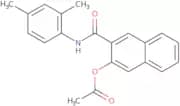
CAS:Modified naphtol AS substrate used in histochemical and cytochemical staining
Fórmula:C21H19NO3Pureza:Min. 80%Cor e Forma:White Off-White PowderPeso molecular:333.38 g/mol4-Nitrophenyl-N-acetyl-α-D-glucosaminide
CAS:4-Nitrophenyl-N-acetyl-α-D-glucosaminide is a chromogenic substrate for N-acetyl-β-D-glucosaminidase yielding a yellow solution upon cleavage.Fórmula:C14H18N2O8Peso molecular:342.31 g/molRef: 3D-N-4030
-Unit-ggA consultar1gA consultar100mgA consultar250mgA consultar500mgA consultar2500mgA consultar4-Methylumbelliferyl phosphate bis(cyclohexylammonium) salt
CAS:Sensitive fluorogenic substrate for fluorometric and UV-spectrophotometric assays of phosphatases. This may also be used for in-gel assaysFórmula:C22H35N2O6PPureza:Min 99%Cor e Forma:White to off-white solid.Peso molecular:454.50 g/mol4-Methylumbelliferyl-2-O-(α-L-fucopyranosyl)-β-L-fucopyranoside
4-Methylumbelliferyl-2-O-(alpha-L-fucopyranosyl)-beta-L-fucopyranoside is a fluorogenic substrate for alpha-L-fucosidase. After enzymatic cleaveage, free 4-methylumbelliferone (also known as hymecromone) is released, exhibiting blue fluorescence upon excitation with UV light. The strongest fluorescence of 4-methylumbelliferone requires deprotonation of the hydroxyl group (thus requires alkaline pH), with a maximal fluorescence intensity obtained with excitation at 350 to 370 nm and emission at 440 to 470 nm. The use of 4-methylumbelliferyl-2-O-(alpha-L-fucopyranosyl)-beta-L-fucopyranosideas a substrate for measuring the alpha-L-fucosidase activity is used for diagnosis of fucosidosis (defficiency of L-fucosidase).Pureza:Min. 95%Cor e Forma:White/Off-White SolidPeso molecular:468.45 g/molD-Luciferin Firefly, sodium salt monohydrate
CAS:Water soluble substrate for firefly luciferase.Fórmula:C11H9N2NaO4S2Pureza:Min. 99.0 Area-%Peso molecular:320.32 g/mol2'-(4-Methylumbelliferyl)-alpha-D-N-acetylneuraminic acid, sodium salt
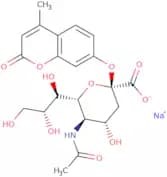
CAS:4-Methylumbelliferyl N-acetyl-a-D-neuraminic acid sodium salt (4-MUNANA) is a fluorogenic substrate of neuraminidase. 4-Methylumbelliferone is released from 4-MUNANA by neuraminidase in the assay and can be detected fluorometrically with excitation at 365-380 nm and emission at 445-454 nm. It can also be used for fluorescent staining of sialidases in PAGE.Fórmula:C21H24NNaO11Pureza:Min. 98 Area-%Peso molecular:489.42 g/mol4-Nitrophenyl-beta-L-fucopyranoside
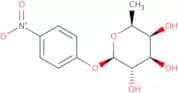
CAS:4-Nitrophenyl-beta-L-fucopyranoside is a high-quality pNP enzyme substrate developed for the sensitive detection and quantification of Beta-L-fucosidase activity. The enzymatic hydrolysis of the substrate generates 4-nitrophenol, a yellow chromogenic component that can be conveniently measured spectrophotometrically, allowing for accurate determination of enzyme concentration and kinetics. This substrate finds applications in various research fields, diagnostics, and industrial enzyme production.Fórmula:C12H15NO7Pureza:Min. 95%Cor e Forma:White PowderPeso molecular:285.25 g/mol3,4-Cyclohexenoesculetin β-D-galactopyranoside
CAS:Chromogenic substrate for beta-galactosidase
Fórmula:C19H22O9Pureza:Min. 95 Area-%Peso molecular:394.37 g/molLuciferin-α-D-galactoside, sodium salt
Luciferin-alpha-D-galactoside, sodium salt (LDA) is a bioluminescence substrate. It is used in diagnostic tests for the detection of bacteria and fungi. LDA is also used to measure the effectiveness of biocides and disinfectants. This product has been shown to be a potent fluorogenic substrate in chemiluminescent assays that can be used effectively with firefly luciferase.
Fórmula:C17H17NaN2O8S2Pureza:Min. 94 Area-%Peso molecular:464.44 g/molRef: 3D-L-8126
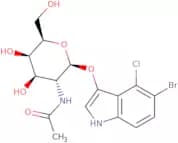
-Unit-mgmgA consultar5mgA consultar10mgA consultar25mgA consultar50mgA consultar100mgA consultar5-Bromo-4-chloro-3-indoxyl-N-acetyl-beta-D-galactosaminide
CAS:5-Bromo-4-Chloro-3-Indoxyl-N-Acetyl-Beta-D-Galactosaminide is a chromogenic substrate for detecting beta-galactosidase and GalNAc-transferase enzymes. Upon hydrolysis by the enzyme, it produces a blue-green colored compound that can be detected visually or measured spectrophotometrically. This substrate is useful in characterizing the activity of Beta-Galactosidase and GalNAc-transferase enzymes involved in glycobiology research and diagnostic applications.Fórmula:C16H18BrClN2O6Pureza:Min. 98 Area-%Cor e Forma:Crystalline PowderPeso molecular:449.68 g/mol1-Naphthyl β-D-mannopyranoside
CAS:1-Naphthyl β-D-mannopyranoside is a chromogenic (also fluorogenic) substrate. After cleavage, 1-naphthol is released and is used to quantify beta-mannosidase activity.Fórmula:C16H18O6Pureza:Min. 95%Cor e Forma:PowderPeso molecular:306.31 g/molLuc-Enterococcus K
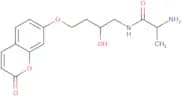
Luc-Enterococcus K (LK) is a Chromogenic substrate that can be used for the detection of Enterococcus. LK is a conjugate of beta-lactamase and luciferase, which are both enzymes. LK is used in diagnostics to detect the presence of Enterococcus in food and environmental samples. LK can also be used as a chemiluminescent substrate for the detection of Enterococcus in clinical specimens or as an enzyme substrate for the detection of Enterococcus in clinical specimens. CAS No.: 64739-74-8Fórmula:C17H17KN2O8S2Pureza:Min. 94 Area-%Peso molecular:480.55 g/mol7-((4'-L-Alaninamido)-rac-3'-hydroxybutyloxy) coumarin
This Clips-O substrate 7-((4'-L-Alaninamido)-rac-3'-hydroxybutyloxy) coumarin allows the detection of single and dual enzymatic activity (L-alanine aminopetidase and oxidation of 4-amino-3-hydroxybutyloxy spacer either enzymatically or by exposure to sodium periodate) with a single substrate resulting in a fluorescent signal. The main virtues of Clips-O substrates are an increased stability towards non-enzymatic hydrolysis that results in a reduced background and high sensitivity.
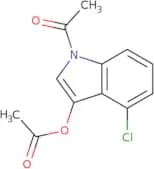
Fórmula:C16H20N2O5Pureza:Min. 95%Cor e Forma:PowderPeso molecular:320.35 g/mol4-Chloro-3-Indoxyl-1,3-diacetate
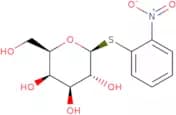
CAS:4-Chloro-3-indoxyl-1,3-diacetate is a fluorogenic or chromogenic substrate used in food testing. It is also an enzyme substrate that can be used to detect the presence of bioluminescence. 4-Chloro-3-indoxyl-1,3-diacetate has been shown to have high purity and high quality for use in diagnostic kits. 4-Chloro-3-indoxyl-1,3-diacetate is a ligand that is conjugated with other molecules to form complexes for use in fluorescence and chemiluminescence experiments.Pureza:Min. 95%Peso molecular:251.67 g/mol2-Nitrophenyl-β-D-thiogalactopyranoside
CAS:2-Nitrophenyl-beta-D-thiogalactopyranoside is a chromogenic substrate used to detect the presence of galactosidase enzymes in various biological and biochemical assays. It consists of a nitrophenyl group attached to a galactose sugar molecule through a thioglycosidic bond. When acted upon by enzymes such as galactosidases, it releases the colored nitrophenyl group, which can be detected using spectrophotometry. This substrate is commonly used in assays for the detection of LacZ activity in bacterial cultures, as lacZ encodes for β-galactosidase.Fórmula:C12H15NO7SPureza:Min. 98 Area-%Cor e Forma:Yellow PowderPeso molecular:317.32 g/mol4-Methylumbelliferyl-beta-D-glucopyranoside
CAS:Fluorogenic substrate for beta-glucosidase yielding a blue fluorescent solution. Used for the detection of beta-glucosidase as an indicator of Enterococci.Fórmula:C16H18O8Pureza:Min. 99 Area-%Peso molecular:338.32 g/molL-Leucine 7-amido-4-methylcoumarin hydrochloride
CAS:Sensitive fluorogenic substrate for leucine aminopeptidase or a broad specificity aminopeptidase like aminopeptidase M that releases a bright blue fluorescent dye, 7-amino-4-methylcoumarin upon enzyme activity (excitation 380nm emission 440nm).Fórmula:C16H21ClN2O3Pureza:Min. 97.5 Area-%Peso molecular:324.81 g/molRef: 3D-L-2800
-Unit-ggA consultar1gA consultar100mgA consultar250mgA consultar500mgA consultar2500mgA consultarAldol® 458 beta-D-galactopyranoside, Biosynth Patent: EP 2427431 and US 8940909
CAS:Aldol® 458 beta-D-galactopyranoside is a chromogenic and fluorogenic enzyme substrate used for detection of beta-galactosidase activity. The colorless enzyme substrate is cleaved by lactose utilizing bacteria grown in liquid or solid media, yielding yellow coloration and green fluorescence. Aldol® 458 beta-D-galactopyranoside can also be used in beta-galactosidase gene reporter assays or immunoassay applications (ELISA). Aldol® 458 beta-D-galactopyranoside can be used under aerobic and anaerobic conditions.Fórmula:C22H23NO8Pureza:Min. 95 Area-%Cor e Forma:PowderPeso molecular:429.42 g/mol4-Methylumbelliferyl-β-L-fucopyranoside
CAS:4-Methylumbelliferyl-beta-L-fucopyranoside is a fluorogenic substrate that is used in food testing. It also has uses as a chromogenic substrate and a ligand for biological studies. 4-Methylumbelliferyl-beta-L-fucopyranoside is a conjugate of 4-methylumbelliferone and beta-D-fucopyranosyl ester, which is an enzyme substrate for the detection of phosphatases. This product can be used to detect the activity of phosphatase enzymes in various media, including culture media, environmental testing, and staining. 4MUFBPY also has chemiluminescent properties that can be used for bioluminescence assays.Fórmula:C16H18O7Peso molecular:322.31 g/molRef: 3D-M-5541
-Unit-ggA consultar1gA consultar5gA consultar250mgA consultar500mgA consultar2500mgA consultar