Substratos enzimáticos
Subcategorias de "Substratos enzimáticos"
Foram encontrados 1527 produtos de "Substratos enzimáticos"
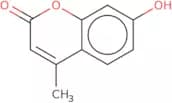
4-Methylumbelliferyl acetate
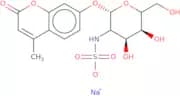
CAS:Fluorogenic substrate for carboxylesteraseFórmula:C12H10O4Pureza:Min. 95%Cor e Forma:White PowderPeso molecular:218.21 g/mol4-Methylumbelliferyl 2-deoxy-2-sulfamino-b-D-glucopyranoside sodium salt
4-Methylumbelliferyl 2-deoxy-2-sulfamino-beta-D-glucopyranoside sodium salt is a fluorogenic substrate for N-sulfoglucosamine sulfohydrolase. After enzymatic cleaveage, free 4-methylumbelliferone (also known as hymecromone) is released, exhibiting blue fluorescence upon excitation with UV light. The strongest fluorescence of 4-methylumbelliferone requires deprotonation of the hydroxyl group (thus requires alkaline pH), with a maximal fluorescence intensity obtained with excitation at 350 to 370 nm and emission at 440 to 470 nm. The use of 4-methylumbelliferyl 2-deoxy-2-sulfamino-beta-D-glucopyranoside sodium saltas a substrate for measuring the N-sulfoglucosamine sulfohydrolase activity is used for screening of Mucopolysaccharidosis IIIA (MPS IIIA) and diagnosis of Sanfilippo A syndrome.Fórmula:C16H19NO10SNaPureza:Min. 95%Cor e Forma:PowderPeso molecular:439.37 g/mol4-Methylumbelliferyl-α-L-fucopyranoside
CAS:Fluorogenic substrate for α-L-Fucosidase yielding a blue fluorescent solution upon cleavage.
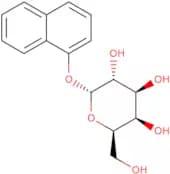
Fórmula:C16H18O7Peso molecular:322.32 g/mol1-Naphthyl a-D-galactopyranoside
CAS:1-Naphthyl a-D-galactopyranoside is a chromogenic substrate use to detect alpha-galactosidase activity.Fórmula:C16H18O6Pureza:Min. 95%Cor e Forma:PowderPeso molecular:306.31 g/molLuciferin-β-D-galactoside
CAS:Luciferin-beta-D-galactoside is an acceptor in immunoassays. It is used as a label for specific antibodies and antigens, and the light emitted by this compound can be measured with a luminometer. Luciferin-beta-D-galactoside binds to the bacterial enzyme β-galactosidase, which catalyzes the hydrolysis of lactose to form glucose and galactose. Mammalian cells have been used as a source of β-galactosidase in order to measure luciferin-beta-D-galactoside activity. The substrate specificity of this enzyme has also been studied using mammalian tissue extracts.Fórmula:C17H18N2O8S2Pureza:Min. 95 Area-%Peso molecular:442.46 g/molRef: 3D-L-8121
-Unit-ggA consultar5mgA consultar10mgA consultar25mgA consultar50mgA consultar100mgA consultarD-Psicose 6-phosphate sodium
CAS:D-Psicose 6-phosphate sodium is an analog from D-psicose, a rare, natural monosaccharide with 70% the sweetness of sucrose. It is used as a low-calorie sweetener in food industry. In research, it is used to investigate its effects on metabolism, diabetes, and other health conditions.Fórmula:C6H13O9P•NaPureza:90%MinCor e Forma:PowderPeso molecular:283.14 g/mol4-Nitrophenyl 2-acetamido-6-O-(2-acetamido-2-deoxy-b-D-glucopyranosyl)-3-O-(b-D-galactopyranosyl)-2-deoxy-a-D-galactopyranoside
CAS:4-Nitrophenyl 2-acetamido-6-O-(2-acetamido-2-deoxy-b-D-glucopyranosyl)-3-O-(b-D-galactopyranosyl)-2-deoxy-a-D-galactopyranoside is a specific chromogenic substrate designed for the highly sensitive and accurate detection of glycosidase enzyme activity. Glycosidases are responsible for the cleavage of glycosidic bonds between saccharide units in various carbohydrates. The hydrolysis of this substrate by glycosidase enzymes produces 4-nitrophenol, a yellow-colored compound that can be easily monitored through spectrophotometric measurements due to its strong absorbance at 405 nm. This chromogenic substrate is widely used in the analysis of glycosidase activity in various biological samples, including bacterial, fungal, and plant tissues, as well as in environmental samples and biotechnological applications.Fórmula:C28H41N3O18Pureza:Min. 95 Area-%Cor e Forma:White PowderPeso molecular:707.63 g/molL-Histidine 7-amido-4-methylcoumarin hydrochloride
CAS:L-Histidine 7-amido-4-methylcoumarin hydrochloride is a fluorogenic substrate, which is a synthetic chemical that is used as a substitute for natural substrates. It reacts with enzymes in the presence of hydrogen peroxide to produce light. This product has been used as an enzyme substrate, a diagnostic tool and has been used to detect bacterial growth in culture media. L-Histidine 7-amido-4-methylcoumarin hydrochloride is also used for food testing and environmental testing, where it can be used as a chromogenic substrate or conjugate respectively. This product has CAS number 5981-00-6 and molecular weight of 254.27 g/mol.Fórmula:C16H17ClN4O3Peso molecular:348.79 g/molLuc-coliforms Na
CAS:Luc-coliforms Na is a high quality, chromogenic substrate for the detection of coliforms. It is used widely in the food industry to detect whether coliforms are present in milk, cheese, and other dairy products. Luc-coliforms Na provides a color change from yellow to blue when it reacts with coliforms and has a high pH range of 4.0-8.0. Luc-coliforms Na has a CAS number of 93824-43-4.Pureza:Min. 95%Aldol® 484 alpha-D-glucopyranoside, Biosynth Patent: EP 2427431 and US 8940909
CAS:Aldol® 484 alpha-D-glucopyranoside is a chromogenic and fluorogenic enzyme substrate for alpha-glucosidase activity (EC 3.2.1.20, alpha-1,4-glucosidase, also known as maltase). The colorless enzyme substrate is cleaved by bacteria producing this enzyme in liquid or solid media, yielding orange color. Green fluorescence is also generated if a suitable matrix is present such as: cellulose acetate filters, polypropylene tubes or microplates and polyethylene vials. Aldol® 484 alpha-D-glucopyranoside can be used under aerobic and anaerobic conditions.
Fórmula:C26H24ClFN2O7Pureza:Min. 95%Cor e Forma:PowderPeso molecular:530.93 g/molN,N,N',N'-Tetramethyl-p-phenylenediamine dihydrochloride
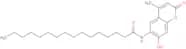
CAS:Reducing co-substrate for heme peroxidases; test reagent in microbiologyFórmula:C10H16N2·2HClPureza:Min. 95%Cor e Forma:White PowderPeso molecular:237.17 g/mol6-Hexadecanoylamino-4-methylumbelliferone
CAS:Fluorochrome for calibration of fluorimeters. Used with corresponding fluorogenic substrates for the diagnosis of Krabbe - and Niemann-Pick A/B disease.Fórmula:C26H39NO4Pureza:Min. 95%Cor e Forma:White PowderPeso molecular:429.59 g/mol4-Nitrophenyl-alpha-D-galactopyranoside
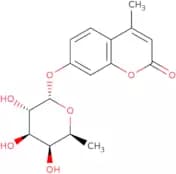
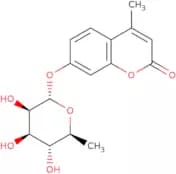
CAS:Chromogenic substrate yielding a soluble chromophore for the colorimetric assay of α-D-galactosidase upon cleavage. Used for the detection of hydrolases in tissues and membranes.Fórmula:C12H15NO8Pureza:Min. 99.0 Area-%Peso molecular:301.26 g/mol4-Methylumbelliferyl-alpha-L-rhamnopyranoside
CAS:4-Methylumbelliferyl-alpha-L-rhamnopyranoside is a fluorogenic substrate for alpha-L-rhamnosidase. After enzymatic cleaveage, free 4-methylumbelliferone (also known as hymecromone) is released, exhibiting blue fluorescence upon excitation with UV light. The strongest fluorescence of 4-methylumbelliferone requires deprotonation of the hydroxyl group (thus requires alkaline pH), with a maximal fluorescence intensity obtained with excitation at 350 to 370 nm and emission at 440 to 470 nm. The use of 4-methylumbelliferyl-alpha-L-rhamnopyranosideas a substrate for measuring the alpha-L-rhamnosidase activity is used for detection of bacterial infection.Fórmula:C16H18O7Pureza:Min. 98 Area-%Cor e Forma:PowderPeso molecular:322.32 g/molD-Luciferin Firefly, potassium salt - endotoxin free
CAS:Water soluble substrate for firefly luciferase. Used for imaging the expression of the LUC marker gene and luciferase-fusion conjugates in living cells, tissues and organisms. Extensively utilized in reporter gene assays, immunoassays and hygiene monitoring. Endotoxin free product.
Fórmula:C11H7KN2O3S2Pureza:Min. 95%Cor e Forma:PowderPeso molecular:318.42 g/molOstazin brilliant red H-3B galactomannan
Ostazin Brilliant Red H-3B Galactomannan is a chemiluminescent substrate used for the detection of β-1,4-galactomannans. It reacts with the glucose residues on the mannan backbone to produce a red fluorescent product. This product can be detected by spectrophotometry at an excitation wavelength of 395 nm and emission wavelength of 510 nm. The Ostazin Brilliant Red H-3B Galactomannan substrate is useful in detecting Staphylococcus aureus, Streptococcus pyogenes, Streptococcus pneumoniae, Group A streptococci, Group B streptococci, Group D streptococci, Group G streptococci, and Group C streptococci.
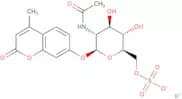
Pureza:Min. 95%4-Methylumbelliferyl 2-acetamido-2-deoxy-β-D-glucopyranoside-6-sulfate potassium salt
CAS:4-Methylumbelliferyl 2-acetamido-2-deoxy-beta-D-glucopyranoside-6-sulfate potassium salt is a fluorogenic substrate for beta-N-acetylglucosaminidase. After enzymatic cleaveage, free 4-methylumbelliferone (also known as hymecromone) is released, exhibiting blue fluorescence upon excitation with UV light. The strongest fluorescence of 4-methylumbelliferone requires deprotonation of the hydroxyl group (thus requires alkaline pH), with a maximal fluorescence intensity obtained with excitation at 350 to 370 nm and emission at 440 to 470 nm. The use of 4-methylumbelliferyl 2-acetamido-2-deoxy-beta-D-glucopyranoside-6-sulfate potassium saltas a substrate for measuring the beta-N-acetylglucosaminidase activity is used for diagnosis of Mucopolysaccharidosis IIIB (MPS IIIB) (a rare lysosomal storage disorder) and Sanfilippo B syndrome screening.
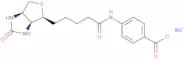
Fórmula:C18H20KNO11SPureza:Min. 95%Cor e Forma:White Off-White PowderPeso molecular:497.52 g/mol(+)-Biotin 4-amidobenzoic acid sodium salt
CAS:(+)-Biotin 4-amidobenzoic acid sodium salt, often referred as (+)-biotin PABA, is a fluorogenic substrate used to measure biotinidase activity, especially in newborn screening programs.
Fórmula:C17H20N3NaO4SPureza:Min. 95%Cor e Forma:White Slightly Yellow PowderPeso molecular:385.41 g/mol4-Nitrophenyl β-D-galactofuranoside
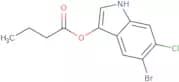
CAS:Chromogenic substrate for beta-galactofuranosidaseFórmula:C12H15NO8Pureza:Min. 98 Area-%Cor e Forma:White PowderPeso molecular:301.25 g/mol5-Bromo-6-chloro-3-indoxyl butyrate
CAS:5-Bromo-6-chloro-3-indoxyl butyrate is a chromogenic substrate that yields a magenta-colored product after cleavage. The chromophore 5-bromo-6-chloro-indoxyl is released, generating the observable color. It is used in lipid digestion assays.Fórmula:C12H11BrClNO2Pureza:Min. 95%Cor e Forma:PowderPeso molecular:316.58 g/mol