Substratos enzimáticos
Subcategorias de "Substratos enzimáticos"
Foram encontrados 1527 produtos de "Substratos enzimáticos"
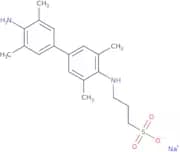
N-(3-Sulfopropyl)-3,3',5,5'-tetramethylbenzidine sodium
CAS:N-(3-Sulfopropyl)-3,3',5,5'-tetramethylbenzidine (TMB) sodium salt is a highly sensitive chromogenic substrate used for the detection and quantification of peroxidase enzyme activity. This water-soluble substrate undergoes a color change from colorless to blue upon oxidation by peroxidase enzymes in the presence of hydrogen peroxide. The reaction can be stopped by adding an acid, resulting in a yellow color that can be measured spectrophotometrically. TMB sodium salt is widely used in various applications, including enzyme-linked immunosorbent assays (ELISA), immunohistochemistry, and other diagnostic tests, due to its high sensitivity, low background signal, and excellent stability.
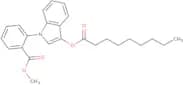
Pureza:Min. 95%Cor e Forma:PowderPeso molecular:384.47 g/molAldol® 458 nonanoate solution, 0.75 M in DMSO, Biosynth Patent: EP 2427431 and US 8940909
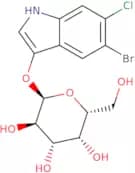
CAS:Produto ControladoAldol 458 nonanoate solution (0.75 M) is a substrate for enzymes and ligands, which is used in various applications such as food testing, staining, fluorogenic substrate, environmental testing, chromogenic substrate and conjugate. Aldol 458 nonanoate solution (0.75 M) has high purity and is highly stable at pH 2-12. This product can be used as a chemiluminescence or bioluminescence substrate. The CAS number for this product is 2484873-15-4.Fórmula:C25H29NO4Pureza:Min. 95%Cor e Forma:Clear LiquidPeso molecular:407.51 g/mol5-Bromo-6-chloro-3-indolyl a-D-galactopyranoside
CAS:5-Bromo-6-chloro-3-indolyl a-D-galactopyranoside is a chromogenic substrate that yields a magenta-colored product after cleavage. The chromophore 5-bromo-6-chloro-indoxyl is released, generating the observable color. It is used in glycolipid metabolism studies.Fórmula:C14H15BrClNO6Cor e Forma:White to off-white solid.Peso molecular:408.63 g/molResorufin b-D-xylobioside
Resorufin b-D-xylobioside is a fluorogenic substrate for xylanases useful for xylanase activity assays.Pureza:Min. 95%Cor e Forma:PowderPeso molecular:477.42 g/molL-Pyroglutamic acid 7-amido-4-methylcoumarin
CAS:Fluorogenic substrate for proglutamyl peptidase 1 yielding a blue fluorescent solution upon cleavage. Used in identification of Enterococcus spp. and group A streptococci (Streptococcus pyogenes).Fórmula:C15H14N2O4Pureza:Min. 98 Area-%Peso molecular:286.29 g/mol6-Chloro-3-indolyl β-D-cellobioside
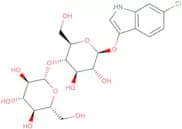
CAS:6-Chloro-3-indolyl b-D-cellobioside is a chromogenic substrate that produces a salmon-pink color after enzymatic cleavage. It is used for detecting the activity of beta-D-cellobiosidase in enzyme assays.
Pureza:Min. 95%Cor e Forma:White To Off-White SolidPeso molecular:491.87 g/mol4-Nitrophenyl N,N',N''-triacetyl-b-D-chitotriose
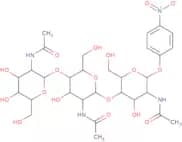
CAS:Substrate for determining hydrolytic activity of chitinasePureza:Min. 95%Cor e Forma:White PowderPeso molecular:748.69 g/mol4-Nitrophenyl a-D-thiomannopyranoside
CAS:4-Nitrophenyl a-D-thiomannopyranoside is a chemiluminescence substrate that can be used to measure the activity of β-galactosidase, an enzyme involved in the hydrolysis of lactose. This product is available as a white to yellowish powder and has been shown to have high purity and quality. It also displays strong fluorescence when reacted with hydrogen peroxide and has been used for diagnostics tests such as staining, food testing, and enzyme substrate reactions.Pureza:Min. 95%Peso molecular:317.32 g/mol4-Methylumbelliferyl-beta-D-galactopyranoside
CAS:Fluorogenic substrate for β-D-galactosidase yielding a blue fluorescent solution upon cleavage.Fórmula:C16H18O8Pureza:Min. 98.0 Area-%Peso molecular:338.32 g/mol2-(N-Hexadecanoylamino)-4-nitrophenylphosphocholine hydroxide
CAS:2-(N-Hexadecanoylamino)-4-nitrophenylphosphocholine hydroxide, often abbreviated as HDA-PC, is a chromogenic substrate for acid sphingomyelinase enzyme. HDA-PC is used as a key substrate for measuring the activity of this enzyme, responsible for catalyzing the hydrolysis of sphingomyelin to ceramide. The activity assay for this measuring this enzyme's acitivy is to detect a deficiency (or lack) of the enzyme which is directly related to the Niemann-Pick disease.Fórmula:C27H50N3O8PPureza:Min. 95%Cor e Forma:Off-White PowderPeso molecular:575.68 g/molLuc-S.aureus K
Luc-S.aureus K is a fluoro-ligand that is used as a diagnostic to detect and quantify the activity of S.aureus in any given sample. It is a detection substrate for the enzyme β-galactosidase, which catalyzes the hydrolysis of the luciferin. When luciferin is cleaved by β-galactosidase, it emits light that can be detected using a luminometer to measure the amount of light produced and calculate the quantity of bacteria present in the sample. Luc-S.aureus K has been approved for use as a detector for bioluminescence in food testing, environmental testing, and other diagnostic applications.Pureza:Min. 95%4-Nitrophenyl 2-acetamido-2-deoxy-β-D-glucopyranoside-6-sulfate potassium
CAS:4-Nitrophenyl 2-acetamido-2-deoxy-beta-D-glucopyranoside-6-sulfate potassium is a chromogenic substrate for N-acetylglucosamine-6-sulfatase. Upon hydrolysis, para-nitrophenol is released yielding a yellowish colour. 4-Nitrophenyl 2-acetamido-2-deoxy-beta-D-glucopyranoside-6-sulfate potassium is used in different applications such as the Mucopolysaccharidosis IIID (Sanfilippo D) screeningFórmula:C14H17N2O11S•KPureza:Min. 95%Cor e Forma:PowderPeso molecular:460.46 g/molN-Acetyl-5-bromo-3-indoxyl-2,3,4-tri-O-acetyl-β-D-glucuronic acid methyl ester
N-Acetyl-5-bromo-3-indoxyl-2,3,4-tri-O-acetyl-beta-D-glucuronic acid methyl ester is a chromogenic substrate that can be used for the detection of bile acids and bilirubin in food testing. It is a conjugate of an acetylated 2,3,4 triacetyl glucuronic acid methyl ester with 5 bromo 3 indoxyl. This product has high purity and high quality.Fórmula:C23H24BrNO11Pureza:Min. 98.0 Area-%Peso molecular:570.34 g/molRef: 3D-A-0702
-Unit-ggA consultar5gA consultar10gA consultar25gA consultar50gA consultar2500mgA consultarAc-Abu-Tle-Leu-Gln-AMC TFA salt
A fluorogenic substrate for detection of enzymatic activity of the SARS-CoV-2 Mpro protease. The fluorophore 7-Amino-4-methylcoumarin (AMC) is linked to the tetrapeptide via a peptide bond at the C-terminal of the glutamine residue. Following the hydrolytic activity of the Mpro protease, the fluorogenic AMC group get released from the substrate, generating a fluorescent signal (Ex 380 nm / Em 455 nm).Fórmula:C33H48N6O8(freebase)Pureza:Min. 95.0 Area-%Peso molecular:656.77 g/mol4-Nitrophenyl palmitate
CAS:4-Nitrophenyl palmitate is a lipase-sensitive chromogenic substrate commonly used in the study of lipase and esterase activity. Its hydrolysis by lipases produces a yellow 4-nitrophenol, which can be easily detected spectrophotometrically, offering a quantitative measure of enzyme activity. This substrate is widely utilized in the screening of lipase-producing microorganisms and the optimization of enzyme-catalyzed reactions in various fields, including biotechnology and pharmaceutical research.Fórmula:C22H35NO4Pureza:Min. 95%Cor e Forma:Off-White PowderPeso molecular:377.52 g/mol4-Nitrophenyl 2,3,4,6-tetra-O-acetyl-b-D-thioglucopyranoside
CAS:4-Nitrophenyl 2,3,4,6-tetra-O-acetyl-b-D-thioglucopyranoside is a fluorescent dye that is used in recording and registration. It has been shown to be a very sensitive reporter of protein interactions in living cells. This dye binds to proteins via the hydroxyl groups on its sugar moiety, and has been shown to bind to a variety of proteins such as myosin light chain kinase and phosphatidylinositol 4-kinase. The fluorescent properties of this dye make it useful for tracking protein localization in the cell.Pureza:Min. 95%Peso molecular:485.46 g/mol5-Bromo-3-indoxyl caprylate
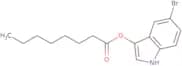
CAS:Also known as Lapis-caprylate; targeting esterase with C8 activity; Blue colorFórmula:C16H20BrNO2Pureza:Min. 98 Area-%Cor e Forma:PowderPeso molecular:338.24 g/molAldol® 470 β-D-galactopyranoside, Biosynth Patent: EP 2427431 and US 8940909
CAS:Aldol® 470 beta-D-galactopyranoside is a chromogenic and fluorogenic enzyme substrate used for detection of ?-galactosidase activity. The colorless enzyme substrate is cleaved by lactose-utilizing bacteria grown in liquid or solid media, yielding yellow coloration and green fluorescence. Aldol® 470 beta-D-galactopyranoside can also be used in ?-galactosidase gene reporter assays or immunoassay applications (ELISA). Aldol® 470 beta-D-galactopyranoside can be used under aerobic and anaerobic conditions.
Fórmula:C29H29NO9Pureza:Min. 95.0 Area-%Peso molecular:535.54 g/mol4-Nitrophenyl 3-O-(β-D-glucopyranosyl)-β-D-glucopyranoside
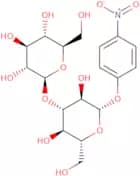
CAS:Chromogenic substrate for beta-glucanaseFórmula:C18H25NO13Pureza:Min. 95 Area-%Cor e Forma:PowderPeso molecular:463.39 g/mol4-Methylumbelliferyl-beta-D-cellobioside
CAS:Fluorogenic substrate for β-D-Cellobiosidase yielding a blue fluorescent solution upon cleavage.Fórmula:C22H28O13Pureza:Min. 98.0 Area-%Peso molecular:500.46 g/mol