Substratos enzimáticos
Subcategorias de "Substratos enzimáticos"
Foram encontrados 1525 produtos de "Substratos enzimáticos"
N-(4,4-Difluoro-5,7-dimethyl-4-bora-3a,4a-diaza-s-indacene-3-dodecanoyl)sphingosyl 1-b-D-galactopyranoside
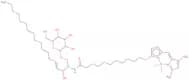
N-(4,4-Difluoro-5,7-dimethyl-4-bora-3a,4a-diaza-s-indacene-3-dodecanoyl)sphingosyl 1bDgalactopyranoside is a fluorescent reagent. It has been used to detect the presence of boron in biological samples and as a substrate for enzymes. This product is also used in the diagnosis of tuberculosis and other bacterial infections. N-(4,4-Difluoro-5,7-dimethyl-4bora3a,4adiazasindacene 3dodecanoyl)sphingosyl 1bDgalactopyranoside is not intended for use in humans or animals and should be handled with care. This product is not available for sale in the state of California.Pureza:Min. 95%Peso molecular:861.95 g/mol5-Bromo-6-chloro-3-indoxyl nonanoate
CAS:5-Bromo-6-chloro-3-indoxyl nonanoate is a chemical compound that is used in the detection of bioluminescence. It is a substrate for enzymes, such as luciferase, and can be used to measure the amount of light emitted during the reaction. The CAS number for this molecule is 682802-80-8.Pureza:Min. 95%Peso molecular:386.71 g/mol2-Nitrophenyl 2-acetamido-3,4,6-tri-O-acetyl-2-deoxy-a-D-glucopyranoside
CAS:2-Nitrophenyl 2-acetamido-3,4,6-tri-O-acetyl-2-deoxy-a-D-glucopyranoside is a chromogenic substrate commonly used in enzyme assays for the detection and quantification of enzyme activity. It is a colorless substrate that is enzymatically converted into a yellowish product, the intensity of which is directly proportional to the enzyme activity present in the sample.Pureza:Min. 95%Peso molecular:468.41 g/mol4-Nitrophenyl 2-acetamido-3-O-(2,3,4,6-tetra-O-acetyl-b-D-galactopyranosyl)-2-deoxy-a-D-galactopyranoside
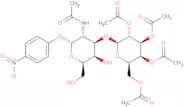
CAS:4-Nitrophenyl 2-acetamido-3-O-(2,3,4,6-tetra-O-acetyl-b-D-galactopyranosyl)-2-deoxy-a-D-galactopyranoside is a chromogenic substrate designed for the detection and quantification of enzyme activity. This tetra-acetylated compound is specifically designed to be cleaved by enzymes, releasing a yellow 4-nitrophenol product that can be easily measured spectrophotometrically, allowing for accurate and sensitive analysis of enzyme kinetics and inhibition studies.
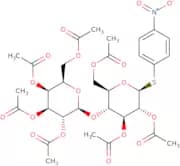
Pureza:Min. 95%Peso molecular:672.59 g/mol4-Nitrophenyl 4-O-(2,3,4,6-tetra-O-acetyl-b-D-galactopyranosyl)-2,3,6-tri-O-acetyl-b-D-thioglucopyranoside
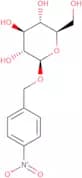
CAS:4-Nitrophenyl 4-O-(2,3,4,6-tetra-O-acetyl-b-D-galactopyranosyl)-2,3,6-tri-O-acetyl-b-D-thioglucopyranoside is a superior chromogenic substrate for the detection of enzymes. Specifically designed for optimal performance, it provides exquisite sensitivity and definitive results in enzyme assays. Its exceptional properties make it a top choice among researchers and professionals in biochemistry, enabling accurate analysis and quantification of enzymatic activities.Pureza:Min. 95%Peso molecular:773.71 g/mol(4-Nitrophenyl)methyl-b-D-glucopyranoside
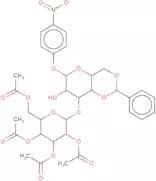
CAS:This product is a fluorogenic substrate that is used in the detection of enzymes in biological systems. It is also used as a ligand to study enzyme activity and can be used to quantify enzyme activity. This product is made from high-purity, high-quality reagents and is often used as an enzyme substrate in diagnostic kits for food testing, environmental testing, and detection of bacteria with the help of chemiluminescence. The CAS number for this product is 700368-52-1. This product can be used for fluorescence staining and bioluminescence.Pureza:Min. 95%Peso molecular:315.28 g/mol4-Nitrophenyl 4,6-O-benzylidene-3-O-(2,3,4,6-tetra-O-acetyl-b-D-glucopyranosyl)-b-D-glucopyranoside
4-Nitrophenyl 4,6-O-benzylidene-3-O-(2,3,4,6-tetra-O-acetyl-b-D-glucopyranosyl)-b-D-glucopyranoside is a high purity fluorescent reagent that can be used as a substrate for many enzymes. It is also used in environmental testing and to detect the presence of nitrophenols in food. This product has CAS number 545414.
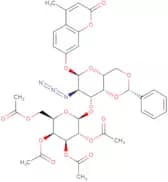
Pureza:Min. 95%Peso molecular:719.64 g/mol4-Methylumbelliferyl 2-azido-2-deoxy-3-O-(tetra-O-acetyl-b-D-galactopyranosyl)-4,6-O-benzylidene-a-D-galactopyranoside
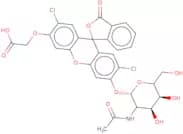
CAS:4-Methylumbelliferyl 2-azido-2-deoxy-3-O-(tetra-O-acetyl-b-D-galactopyranosyl)-4,6-O-benzylidene a D galactopyranoside is a chemiluminescent substrate for detecting ligands. It has been used to detect the presence of bacteria, fungi, and parasites in food samples and as an indicator for enzymatic activity. This product is an excellent fluorescent substrate for the detection of nucleic acids such as DNA. This product is a conjugate with high purity, which makes it suitable for use in various types of applications.Fórmula:C37H39N3O16Pureza:Min. 95%Peso molecular:781.72 g/mol6'-(O-(Carboxymethyl))-2',7'-dichlorofluoroscein 3'-(O-(N-acetyl-b-D-glucosamide))
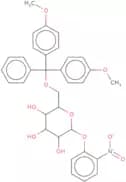
6'-(O-(Carboxymethyl))-2',7'-dichlorofluoroscein 3'-(O-(N-acetyl-b-D-glucosamide)) is a chemiluminescent substrate that can be used in the detection of ligands. This product has a CAS number of 44636-76-8 and is available at a purity level of 98%. It has been tested for bacterial contamination, as well as for adverse effects on culture media and environmental testing. 6'-(O-(Carboxymethyl))-2',7'-dichlorofluoroscein 3'-(O-(N-acetyl-b-D-glucosamide)) is an enzymatic substrate that can be used in diagnostic applications such as the detection of fluorescence, staining, and bioluminescence. It has also been shown to be useful in food testing.Pureza:Min. 95%Peso molecular:662.44 g/mol2-Nitrophenyl 6-O-DMT-b-D-galactopyranoside
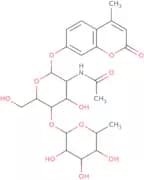
N-Acetyl-2-nitrophenyl 6-O-DMT-b-D-galactopyranoside is a fluorogenic substrate that is used in enzyme and chromogenic assays, including the determination of aminoglycoside activity. This product has been shown to be suitable for detection of bacterial contamination in food products and environmental samples. N-Acetyl-2-nitrophenyl 6-O-DMT-b-D-galactopyranoside reacts with aminoglycosides at the O4 position, forming a fluorescent product that can be measured using a fluorometer.Pureza:Min. 95%Peso molecular:603.62 g/mol4-Methylumbelliferyl 2-acetamido-2-deoxy-4-O-(a-L-fucopyranosyl)-b-D-glucopyranoside
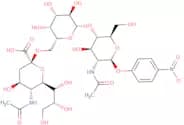
CAS:4-Methylumbelliferyl 2-acetamido-2-deoxy-4-O-(alpha-L-fucopyranosyl)-beta-D-glucopyranoside is a fluorogenic substrate for alpha-L-fucosidase. After enzymatic cleaveage, free 4-methylumbelliferone (also known as hymecromone) is released, exhibiting blue fluorescence upon excitation with UV light. The strongest fluorescence of 4-methylumbelliferone requires deprotonation of the hydroxyl group (thus requires alkaline pH), with a maximal fluorescence intensity obtained with excitation at 350 to 370 nm and emission at 440 to 470 nm. The use of 4-methylumbelliferyl 2-acetamido-2-deoxy-4-O-(alpha-L-fucopyranosyl)-beta-D-glucopyranosideas a substrate for measuring the alpha-L-fucosidase activity is used for fucosidosis diagnosis (deficiency of the enzyme alpha-L-fucosidase) and glycoprotein metabolism disorder detection.Fórmula:C24H31NO12Pureza:Min. 95 Area-%Cor e Forma:PowderPeso molecular:525.5 g/mol4-Nitrophenyl O-(N-acetyl-a-neuraminosyl)-(2-6)-b-D-galactopyranosyl-(1-4)-2-acetamido-2-deoxy-b-D-glucopyranoside
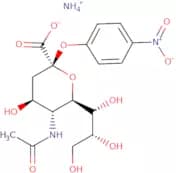
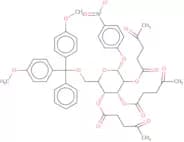
CAS:4-Nitrophenyl O-(N-acetyl-a-neuraminosyl)-(2-6)-b-D-galactopyranosyl-(1-4)-2-acetamido-2-deoxy-b-D-glucopyranoside is a fluorogenic substrate used in the detection of sialidase activity. It is also used as a chromogenic substrate in the determination of β -galactosidase activity.Pureza:Min. 95%Cor e Forma:White PowderPeso molecular:795.7 g/mol4-Nitrophenyl 6-O-DMT-2,3,4-tri-O-levulinoyl-a-D-mannopyranoside
4-Nitrophenyl 6-O-DMT-2,3,4-tri-O-levulinoyl-a-D-mannopyranoside is a fluorogenic substrate that can be used for the detection of DMT (dihydroxyacetone) in food products. It has been shown to be an excellent alternative to the more commonly used 4,5′,6,7,8,-Tetrabromoindoxyl 3′,5′,6′,-tetraacetic acid (TBA). This product is also used as a chromogenic substrate for the determination of phenols in environmental testing and as a ligand conjugate for immunohistochemistry staining. The purity of this product is guaranteed and it has been tested extensively.
Pureza:Min. 95%Peso molecular:897.92 g/molLuc-B.cereus Na
Bacillus cereus is a rod-shaped β hemolytic bacterium commonly found in food and soil. Some strains can be associated with food intoxications, mainly from raw meat and poultry products. One example is the so called “fried rice syndrome”, that occurs when dishes containing cooked rice are left for several hours at room temperature. Typical symptoms of the infection include severe nausea, vomiting and diarrhea. Some strains of Bacillus cereus on the contrary are not harmful at all and they are used as probiotics food additives in animal farming to reduce the presence of other pathogens like Salmonella in the cecum end intestine. Bacillus cereus expresses phosphatidyl-choline specific phospholipase C (PC-PLC), encoded by the plc gene, which is regulated by PlcR. In addition, the expression of PlcR is dependent on the growth medium. Luc-B.cereus Na (L-8275) is a synthetic chemiluminescent substrate for the phosphatidyl-choline specific phospholipase C. The enzyme cleaves off phosphocholine from L-8275, leading to the release of D-Luc, and consequent strong light emission B. cereus culture exhibited strong luminescence, while RLU values were much lower for samples with B. thuringiensis.
Fórmula:C16H17N3NaO6PS2Pureza:Min. 95 Area-%Peso molecular:465.41 g/mol4-Methylumbelliferyl 2-O-(2,3,4-tri-O-benzoyl-a-L-fucopyranosyl)-b-D-galactopyranoside
4-Methylumbelliferyl 2-O-(2,3,4-tri-O-benzoyl-a-L-fucopyranosyl)-b-D-galactopyranoside is a fluorescent substrate for β–galactosidase. It is used to detect the enzyme in biological samples and as a diagnostic agent. This substrate can be used to develop chemiluminescent, chromogenic, and fluorogenic substrates for use in diagnostics. 4MUF 2OBG can also be conjugated to various ligands for use in bioluminescence assays or as a marker in immunoassays.
Pureza:Min. 95%Peso molecular:796.77 g/molOctyl 4-nitrophenyl hexyl phosphonate
CAS:Octyl 4-nitrophenyl hexyl phosphonate is a lipase suicide inhibitor that is a chromogenic substrate for lipases which upon enzymatic action, binds irreversibly to the lipase and inactivates it. The substrate can be used for the determination of active sites in lipases, especially in lipases preferring hydrophobic leaving groups.Pureza:Min. 95%Peso molecular:399.46Aldol® 518 myo-inositol-1-phosphate, Biosynth Patent: EP 2427431 and US 8940909
CAS:Aldol® 518 myo-inositol-1-phosphate is a chromogenic and fluorogenic enzyme substrate used for detection of phosphatidyl-inositol specific phospholipase C activity (PI-PLC, EC 4.6.1.13). The colorless enzyme substrate is cleaved by PI-PLC or PI-PLC-positive microorganisms grown in liquid or solid media, yielding an intense red coloration. In combination with Aldol® 355 fluorescence enhancer, red fluorescence can also obtained. Aldol® 518 myo-inositol-1-phosphate is suitable for use in liquid and solid media, under aerobic as well as anaerobic conditions.
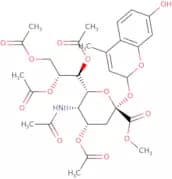
Fórmula:C29H30ClN2O10PPureza:Min. 95.0 Area-%Peso molecular:632.98 g/mol4-Methylumbelliferyl N-acetyl-4,7,8,9-tetra-O-acetyl-a-D-neuraminic acid methyl ester
CAS:4-Methylumbelliferyl N-acetyl-4,7,8,9-tetra-O-acetyl-a-D-neuraminic acid methyl ester (4MU) is a chemiluminescence substrate. It is used in the detection of an enzyme involved in the synthesis of glycoproteins and glycolipids. The enzyme conjugates 4MU with a sugar molecule to form a fluorescent product. This product can be detected by its emission of light at 560 nm when illuminated with light at 450 nm.Pureza:Min. 95%Peso molecular:649.6 g/mol[2-Methoxy-4-(2-nitrovinyl)phenyl] b-D-galactopyranoside
CAS:[2-Methoxy-4-(2-nitrovinyl)phenyl] b-D-galactopyranoside (MNVP-gal) is a chromogenic enzyme substrate that is commonly used to detect the activity of beta-galactosidase in biological samples. MNVP-gal produces a distinctive magenta color when hydrolyzed by beta-galactosidase, making it particularly useful for applications where visual detection is necessary. This substrate is also resistant to endogenous proteases, making it well-suited for use in cellular and tissue preparations.Pureza:Min. 95%Peso molecular:357.31 g/mol6,8-Difluoro-4-methylumbelliferyl b-D-cellotetraoside
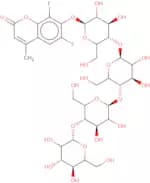
6,8-Difluoro-4-methylumbelliferyl b-D-cellotetraoside is a chemiluminescent substrate for the detection of esterases. It is also used as an enzyme substrate in diagnostic applications and as a fluorogenic substrate in food testing. 6,8-Difluoro-4-methylumbelliferyl b-D-cellotetraoside has been shown to be an excellent ligand for use in immunoassays and can be conjugated to antibodies or antigens. 6,8-Difluoro-4-methylumbelliferyl b-D-cellotetraoside is chemically stable and has high purity and high quality.Pureza:Min. 95%Peso molecular:860.71 g/mol




![[2-Methoxy-4-(2-nitrovinyl)phenyl] b-D-galactopyranoside](/_next/image/?url=https%3A%2Fstatic.cymitquimica.com%2Fproducts%2F3D%2Fthumb-webp%2FEM06779.webp&w=3840&q=75)