Substratos enzimáticos
Substratos enzimáticos são moléculas sobre as quais as enzimas atuam para catalisar reações químicas. O substrato liga-se ao sítio ativo da enzima, onde passa por uma transformação específica para formar o produto da reação. Os substratos enzimáticos são ferramentas essenciais na pesquisa para estudar a cinética enzimática, especificidade e mecanismo de ação. Eles também são usados em ensaios diagnósticos e estudos bioquímicos. Na CymitQuimica, oferecemos uma seleção diversificada de substratos enzimáticos de alta qualidade para apoiar suas pesquisas em enzimologia e bioquímica.
Subcategorias de "Substratos enzimáticos"
Foram encontrados 1527 produtos de "Substratos enzimáticos"
Ordenar por
Pureza (%)
0
100
|
0
|
50
|
90
|
95
|
100
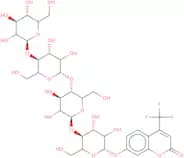
4-(Trifluoromethyl)umbelliferyl-b-D-cellotetraoside
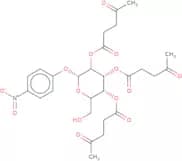
CAS:<p>4-(Trifluoromethyl)umbelliferyl-b-D-cellotetraoside is a chemiluminescent substrate that can be used in the detection of peroxidase, horseradish peroxidase, and other enzymes. It is a fluorescent product that emits light upon reaction with hydrogen peroxide. This product has been tested for purity and quality and has shown to have no detectable levels of heavy metals or other contaminants. 4-(Trifluoromethyl)umbelliferyl-b-D-cellotetraoside is not cytotoxic and can be used for the detection of enzyme activity in living cells. 4-(Trifluoromethyl)umbelliferyl-b-D-cellotetraoside is also known as TMBECFDA, which stands for Trifluoromethyl)umbelliferone (Cellobiose) (Biot</p>Pureza:Min. 95%Peso molecular:878.7 g/mol4-Nitrophenyl 2,3,4-tri-O-levulinoyl-a-D-mannopyranoside
<p>4-Nitrophenyl 2,3,4-tri-O-levulinoyl-a-D-mannopyranoside is a fluorogenic substrate that contains a reactive group of 2,3,4-tri-O-levulinoyl. This compound can be used to measure the activity of enzymes such as beta-glucosidase and alpha-galactosidase. 4NP2OMP is an excellent ligand for metal ions and has been shown to bind to copper in the presence of ATP. 4NP2OMP can also be used as a diagnostic agent for measuring the activity of bacterial beta-glucosidase and alpha galactosidase.</p>Pureza:Min. 95%Peso molecular:595.55 g/mol4-Nitrophenyl b-D-galactopyranoside hydrate
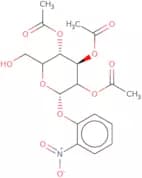
CAS:<p>4-Nitrophenyl b-D-galactopyranoside hydrate is a water-soluble pNP-based enzyme substrate ideal for quantifying b-galactosidase activity in a variety of sample types. This chromogenic substrate features a unique hydrate composition, which allows for enhanced solubility and stability when compared to standard pNP-galactosides. With its high sensitivity and robust performance, this substrate is widely used in biotechnology, biochemistry, and molecular biology fields, including the investigation of enzyme kinetics, characterization of glycoside hydrolase specificity, and assessment of gene expression levels.</p>Pureza:Min. 95%Peso molecular:319.27 g/mol2-Nitrophenyl 2,3,4-tri-O-acetyl-b-D-galactopyranoside
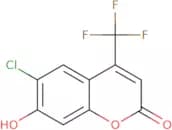
CAS:<p>2-Nitrophenyl 2,3,4-tri-O-acetyl-b-D-galactopyranoside is a fluorogenic substrate that can be used to detect β-galactosidase activity. This specific substrate is one of the most commonly used substrates for detecting β-galactosidase activity in diagnostic assays. It reacts with the enzyme to produce a blue color and has a fluorescence emission maximum at about 480 nm. The product is available in high purity and high quality and it is also an enzyme substrate.</p>Pureza:Min. 95%Peso molecular:427.36 g/mol6-Chloro-7-hydroxy-4-(trifluoromethyl)coumarin
CAS:<p>6-Chloro-7-hydroxy-4-(trifluoromethyl)coumarin is a fungicide that inhibits the growth of fungi by interfering with their DNA synthesis. It does this by inhibiting the activity of two enzymes: the fungal enzyme oxime and the enzyme cinerea, which is found in many fungi. 6-Chloro-7-hydroxy-4-(trifluoromethyl)coumarin has been shown to be effective against Alternaria and Botrytis cinerea. The compound also has an antifungal effect against other types of fungi, such as Penicillium roqueforti, when used in combination with a solvent such as ether.</p>Pureza:Min. 95%Peso molecular:264.58 g/mol6-Chloro-4-methylumbelliferyl b-D glucuronide
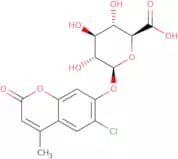
CAS:<p>6-Chloro-4-methylumbelliferyl b-D glucuronide is a fluorogenic substrate for beta-glucuronidase that exhibits longer absorption/emission maxima (~385/500 nm) than typical 4MU-derived substrates.</p>Fórmula:C16H15ClO9Pureza:Min. 97 Area-%Cor e Forma:White PowderPeso molecular:386.74 g/molMaltotetraose 2-aminobenzamide
<p>Maltotetraose 2-aminobenzamide is a chemiluminescent substrate that emits light in the presence of certain oxidizing agents. It provides high quality and environmental testing, as well as staining and ligand capability. Maltotetraose 2-aminobenzamide is used in diagnostics to identify bacteria and other microorganisms. Maltotetraose 2-aminobenzamide can be used for the detection of bacterial colonies on agar plates using a fluorogenic substrate, or for the detection of fungi using a chromogenic substrate. Maltotetraose 2-aminobenzamide is also used as an enzyme substrate in food testing or conjugate with enzymes for bioluminescence.</p>Pureza:Min. 95%Aldol® 470 N-tosyl-L-alanine ester, Biosynth Patent: EP 2427431 and US 8940909
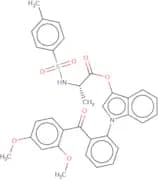
CAS:Produto Controlado<p>Aldol® 470 N-tosyl-L-alanine ester is a fluorogenic substrate that is used in enzyme and chromogenic assays. It is a high purity, high quality, and highly soluble substrate for chemiluminescent reactions. Aldol® 470 N-tosyl-L-alanine ester can be used to detect the presence of bacteria in culture media and as an indicator of bacterial growth. It is also used to test for the presence of different types of enzymes that catalyze the oxidation of alcohols.</p>Fórmula:C33H30N2O7SPureza:Min. 90.0 Area-%Peso molecular:598.67 g/mol3-Carboxyumbelliferyl b-D-galactopyranoside
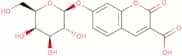
CAS:<p>3-Carboxyumbelliferyl b-D-galactopyranoside is a fluorescent probe that can be used to study protein synthesis in live cells. It binds to the active site of the enzyme peptidyl transferase, which catalyzes the covalent linkage of amino acids to form a polypeptide chain. 3CMBG is specific for the amino acid proline and is a substrate for peptidyl transferase. The fluorescence of 3CMBG increases when it is bound to peptidyl transferase, making it useful as a marker for protein synthesis.</p>Pureza:Min. 95%Peso molecular:368.28 g/molAldol® 496 acetate, Biosynth Patent: EP 2427431 and US 8940909
CAS:<p>Aldol 496 acetate is a chromogenic substrate for the enzyme Aldolase. It is also used as a ligand to detect the presence of Aldolase in biological fluids and tissues. This product is designed for Food testing, Diagnostics, Chromogenic substrate, Staining, Enzyme substrate, Bioluminescence, Fluorogenic substrate, Chemiluminescence, and Culture media. Aldol 496 acetate is an organic chemical with high purity and high quality.</p>Fórmula:C27H24N2O4Pureza:Min. 95.0 Area-%Peso molecular:440.49 g/mol6-Amino-6-deoxyluciferin
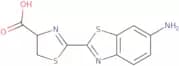
CAS:<p>6-Amino-6-deoxyluciferin is a synthetic analog of luciferin. It is used as a substrate for bacterial luciferase and in immunoassays to detect neutrophils, infectious diseases, and various protease activities. 6-Amino-6-deoxyluciferin is synthesized by the condensation of an amide with a hydroxyl group from acetaldehyde. This reaction requires the use of a coupling agent such as dicyclohexylcarbodiimide or 1-(3-dimethylaminopropyl)-3-ethylcarbodiimide hydrochloride (EDC), which are often used to form amides from carboxylic acids and amines. The conjugation of 6-amino-6-deoxyluciferin with antibodies can be accomplished by chemical crosslinking methods, such as glutaraldehyde, which react thiol groups on the antibody</p>Fórmula:C11H9N3O2S2Pureza:Min. 95%Cor e Forma:Yellow SolidPeso molecular:279.34 g/molAldol® 515 propionate, Biosynth Patent: EP 2427431 and US 8940909
CAS:<p>Aldol® 515 propionate is a chromogenic substrate that is used as a reagent in food testing, diagnostics, and environmental testing. It reacts with an enzyme to form a fluorescent product that can be detected with a spectrophotometer. The substrate has been shown to have high purity and high quality.</p>Fórmula:C26H24N2O3Pureza:Min. 95.0 Area-%Peso molecular:412.48 g/mol6,8-Difluoro-4-methylumbelliferyl b-D-cellotrioside
<p>6,8-Difluoro-4-methylumbelliferyl b-D-cellotrioside is a ligand that binds to active sites of enzymes such as beta-glucuronidase and beta-glucosidase. It is used in diagnostics for the detection of bacteria in culture media and food testing where it can be used as a chromogenic or fluorogenic substrate. 6,8-Difluoro-4-methylumbelliferyl b-D-cellotrioside is also used to detect the presence of bacteria and fungi in environmental samples. It has a high purity and conjugate with other molecules for use in fluorescence microscopy.</p>Pureza:Min. 95%Cor e Forma:White to off-white powder.Peso molecular:698.57 g/molβ-Alanine 7-amido-4-methylcoumarin trifluoroacetate
CAS:<p>Beta-alanine 7-amido-4-methylcoumarin, trifluoroacetate salt is a high purity, ligand, and conjugate. It can be used in the food testing and environmental testing fields. This product has been shown to be a good substrate for enzyme activity and can also function as a fluorescent dye in chemiluminescence assays. Beta-alanine 7-amido-4-methylcoumarin, trifluoroacetate salt is soluble in water and has a CAS number of 201847-54-3.</p>Fórmula:C15H15F3N2O5Peso molecular:360.29 g/molRef: 3D-A-4501
1gA consultar100mgA consultar250mgA consultar500mgA consultar2500mgA consultar-Unit-ggA consultar2-Methyl-4-nitrophenyl b-D-galactopyranoside
<p>2-Methyl-4-nitrophenyl b-D-galactopyranoside is a chemiluminescent substrate that is used in various applications. It is a ligand that binds to the enzyme beta-galactosidase and is used in diagnostics for detecting the presence of the enzyme. 2-Methyl-4-nitrophenyl b-D-galactopyranoside has been shown to be an appropriate substrate for chemiluminescence reactions, such as those used in diagnostic or research applications. The product also has been tested for potential toxicity and found not to be toxic at concentrations up to 100mg/mL. This product can be used in a variety of applications, including food testing, bacterial culture media, and environmental testing.</p>Pureza:Min. 95%Peso molecular:315.28 g/mol4-Nitrophenyl 2-O-(2,3,4,6-tetra-O-acetyl-a-D-mannopyranosyl)-a-D-mannopyranoside
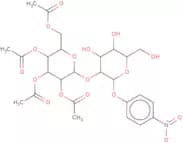
<p>4-Nitrophenyl 2-O-(2,3,4,6-tetra-O-acetyl-a-D-mannopyranosyl)-a-D-mannopyranoside is a fluorogenic substrate that is used as a diagnostic tool and can be used to detect the presence of β--glucosidase in the gut. It is also used as a conjugate with enzymes such as peroxidase or alkaline phosphatase for use in enzyme catalyzed reactions. The product has been shown to be active against a variety of bacteria, including Staphylococcus aureus and Escherichia coli. This product has been shown to produce chemiluminescence when incubated with horseradish peroxidase and hydrogen peroxide. This product is light sensitive and should be stored at room temperature away from direct sunlight.</p>Pureza:Min. 95%Peso molecular:631.54 g/molAldol® 515 N-glutaryl-L-phenylalanine amide potassium salt, Biosynth Patent: EP 2427431 and US 8940909
CAS:<p>Aldol® 515 N-glutaryl-L-phenylalanine amide is a chromogenic and fluorogenic enzyme substrate used for detection of L-glutamate-phenylalanine (GluPhe)-specific peptidase activity. The colorless enzyme substrate is cleaved the GluPhe-specific peptidase, yielding development of orange-red coloration. In addition, red fluorescence is generated when Aldol® 355 fluorescence enhancer or a suitable matrix is present. Aldol® 515 N-glutaryl-L-phenylalanine amide can be used in enzyme assays and live bacterial cultures. Aldol® 515 N-glutaryl-L-phenylalanine amide is suitable for use in liquid and solid media, under aerobic as well as anaerobic conditions.</p>Fórmula:C37H35KN4O5Pureza:Min. 95.0 Area-%Peso molecular:654.80 g/molZ-Gly-Pro-Arg-pNA acetate
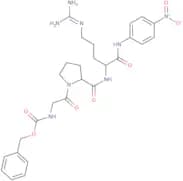
CAS:<p>Z-Gly-Pro-Arg-pnaacetate is a substrate commonly used in enzyme research, particularly in the study of proteases. Proteases are enzymes responsible for catalyzing the hydrolysis of peptide bonds in proteins. In a study investigating the activation of protein C in blood plasma by a protease from Aspergillus ochraceus, the enzyme activity was qualitatively assessed using chromogenic peptide substrates, such as pGlu-Pro-Arg-pNA.</p>Fórmula:C27H34N8O7Pureza:Min. 95%Peso molecular:582.6 g/mol5-Bromo-6-chloro-1H-indol-3-yl-a-D-mannopyranoside
CAS:<p>5-Bromo-6-chloro-1H-indol-3-yl-a-D-mannopyranoside is a chromogenic substrate that yields a magenta-colored product after cleavage. The chromophore 5-bromo-6-chloro-indoxyl is released, generating the observable color. It is used in lysosomal storage disorder screening.</p>Fórmula:C14H15BrClNO6Pureza:Min. 95 Area-%Cor e Forma:White Off-White PowderPeso molecular:408.63 g/molAldol® 470 L-alanine ester, hydrochloride, Biosynth Patent: EP 2427431 and US 8940909
CAS:Produto Controlado<p>Aldol® 470 L-alanine ester, hydrochloride is a chromogenic substrate that is used as a food testing reagent and enzyme substrate in diagnostics. It is also used to detect the presence of ligands in an environment. Aldol® 470 L-alanine ester, hydrochloride is used in chemiluminescence and bioluminescence reactions.</p>Fórmula:C26H25ClN2O5Pureza:Min. 95.0 Area-%Peso molecular:480.95 g/mol