Substratos enzimáticos
Substratos enzimáticos são moléculas sobre as quais as enzimas atuam para catalisar reações químicas. O substrato liga-se ao sítio ativo da enzima, onde passa por uma transformação específica para formar o produto da reação. Os substratos enzimáticos são ferramentas essenciais na pesquisa para estudar a cinética enzimática, especificidade e mecanismo de ação. Eles também são usados em ensaios diagnósticos e estudos bioquímicos. Na CymitQuimica, oferecemos uma seleção diversificada de substratos enzimáticos de alta qualidade para apoiar suas pesquisas em enzimologia e bioquímica.
Subcategorias de "Substratos enzimáticos"
Foram encontrados 1529 produtos de "Substratos enzimáticos"
Ordenar por
Pureza (%)
0
100
|
0
|
50
|
90
|
95
|
100
Aldol® 355 fluorescence enhancer
CAS:<p>Aldol® 355 fluorescence enhancer is an enhancer of fluorescence signals of the Aldol® fluorogenic substrates. Aldol® 355 fluorescence enhancer allows concentrations of fluorogenic Aldol® substrates in media to reduce up to 6 times. Aldol® 355 fluorescence enhancer can be combined with Aldol® substrates, releasing water-insoluble dyes upon enzymatic cleavage, such as Aldol® 470 range, Aldol® 495 range, Aldol® 518 range, and Aldol®515 range of fluorogenic enzyme substrates.</p>Fórmula:C39H52N2O2Pureza:Min. 95.0 Area-%Peso molecular:580.84 g/molAldol® 495 β-D-glucuronic acid, Biosynth Patent: EP 2427431 and US 8940909
CAS:Aldol® 495 beta-D-glucuronic acid is a chromogenic and fluorogenic enzyme substrate used for detection of beta-glucuronidase activity. The living cells of Escherichia coli can be reliably detected in growth media containing Aldol® 495 beta-D-glucuronic acid, as beta-glucuronidase occurs almost exclusively in E. coli. Aldol® 495 beta-D-glucuronic acid can also be in GUS reporter assays. Aldol® 495 beta-D-glucuronic acid can be used in liquid culture and solid media, and is suitable for use under aerobic and anaerobic conditions. Upon exposure to active beta-glucuronidase, Aldol® 495 beta-D-glucuronic acid develops orange colour and green fluorescence.Fórmula:C26H23ClN2O8Pureza:Min. 95.0 Area-%Peso molecular:526.93 g/molAquaSpark® H2S/-SH probe, TFA salt, Ramot at Tel-Aviv University Ltd. Patent family WO 2017/130191
<p>AquaSpark® H2S/-SH is a chemiluminescent probe for the detection of sulfides and thiols. The chemiluminescence obtained through sulfide is 3-5 fold higher than chemiluminescence obtained through thiols. AquaSpark® H2S/-SH probe was used in a study identifying antibiotic-resistant bacterial strains by detecting the beta-lactamase-driven hydrolysis of beta-lactam antibiotics, where hydrogen sulfide is a biodegradation metabolite (Popat Gholap et al, 2021).</p>Fórmula:C35H31ClF3NO9S2Pureza:Min. 90 Area-%Peso molecular:766.2 g/molAquaSpark® Broad Range Phosphatase Substrate, 2 mM in DMSO, Ramot at Tel-Aviv University Ltd. Patent family WO 2017/130191
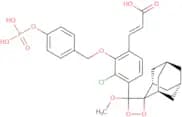
CAS:<p>AquaSpark® Broad Range Phosphatase Substrate is a chemiluminescent substrate for a variety of phosphatase enzymes including bacterial phosphatases and (calf intenstine) alkaline phosphatase (AP) commonly used in immuno-assays.</p>Fórmula:C28H30ClO10PPeso molecular:592.13 g/mol3,4-Cyclohexenoesculetine-N-acetyl-glucosamine
<p>Please enquire for more information about 3,4-Cyclohexenoesculetine-N-acetyl-glucosamine including the price, delivery time and more detailed product information at the technical inquiry form on this page</p>Pureza:Min. 95%3,4-Cyclohexenoesculetine phosphate disodium
<p>Chromogenic substrate for phosphatase</p>Pureza:Min. 95%Aldol® 470 L-alanine amide, acetate salt, Biosynth Patent: EP 2427431 and US 8940909
CAS:Produto ControladoAldol® 470 L-alanine amide is a chromogenic and fluorogenic enzyme substrate used for detection of L-alanine aminopeptidase activity. The colorless enzyme substrate is cleaved by L-alanine aminopeptidase, yielding orange-yellow coloration. In addition, green fluorescence is generated when Aldol® 355 fluorescence enhancer or a suitable matrix is present. Aldol® 470 L-alanine amide can also be used in enzymatic assays or within live bacterial cultures. Aldol® 470 L-alanine amide is suitable for use in liquid and solid media, under aerobic as well as anaerobic conditions.Fórmula:C28H29N3O6Pureza:Min. 95.0 Area-%Peso molecular:503.55 g/molAldol® 495 inositol-phosphate, ammonium salt, Biosynth Patent: EP 2427431 and US 8940909
CAS:Aldol® 495 inositol-phosphate is a chromogenic and fluorogenic enzyme substrate used for detection of phosphatidylinositol specific phospholipase C activity (PI-PLC, EC 4.6.1.13). The colorless enzyme substrate is cleaved by PI-PLC or PI-PLC-positive microorganisms in liquid or solid media, yielding orange color. In addition, green fluorescence is generated when a suitable matrix is present, e.g. PE-Pellets or cellulose acetate filter. Aldol® 495 inositol-phosphate is suitable for use in liquid and solid media, under aerobic as well as anaerobic conditions.Fórmula:C26H29ClN3O10PPureza:Min. 95.0 Area-%Peso molecular:609.95 g/mol6-Chloro-3-indoxyl-β-D-glucuronic acid, cyclohexylammonium salt
CAS:6-Chloro-3-indoxyl-beta-D-glucuronic acid (cyclohexylammonium salt) is a chromogenic substrate for beta-glucuronidase yielding a salmon colored precipitate upon cleavage.Fórmula:C20H27ClN2O7Pureza:Min. 98.0 Area-%Peso molecular:442.90 g/mol5-Bromo-4-chloro-3-indoxyl-α-D-N-acetylneuraminic acid, sodium salt
CAS:Chromogenic substrate for neuraminidase yielding a blue precipitate upon cleavage.Fórmula:C19H21BrClN2NaO9Pureza:Min. 98.0 Area-%Peso molecular:559.74 g/molAldol® 518 β-D-glucopyranoside, Biosynth Patent: EP 2427431 and US 8940909
CAS:Aldol® 518 beta-D-glucopyranoside is a chromogenic and fluorogenic enzyme substrate used for detection of beta-glucosidase activity. The colorless enzyme substrate is cleaved by beta-glucosidase-producing bacteria in liquid or solid media, yielding intense red color and red fluorescence. Aldol® 518 beta-D-glucopyranoside can be used under aerobic and anaerobic conditions.Fórmula:C29H29ClN2O7Pureza:Min. 95.0 Area-%Peso molecular:553 g/mol5-Iodo-3-indoxyl-β-D-galactopyranoside
CAS:5-Iodo-3-indoxyl-beta-D-galactopyranoside is a chromogenic substrate for beta-galactosidase.Fórmula:C14H16INO6Pureza:Min. 99 Area-%Peso molecular:421.19 g/molL-Glutamic acid γ-(4-nitroanilide) monohydrochloride
CAS:<p>L-Glutamic acid gamma-(4-nitroanilide) monohydrochloride is a fluorescent substrate for various enzymes. It is used in the detection of aminopeptidase and dipeptidase activity, as well as in the determination of ATPase activity. L-Glutamic acid gamma-(4-nitroanilide) monohydrochloride is also used in fluorogenic assays for the detection of phosphate, pyruvate, pyrophosphate and sulfite. This product has been tested by both enzyme and cell culture methods to ensure high purity and quality.<br>L-Glutamic acid gamma-(4-nitroanilide) monohydrochloride is not intended for use in diagnostics, food testing or bioluminescence reactions.</p>Fórmula:C11H14ClN3O5Pureza:Min. 98 Area-%Peso molecular:303.70 g/molGlutaryl-glycyl-L-arginine 7-amido-4-methylcoumarin hydrochloride
CAS:Glutaryl-glycyl-L-arginine 7-amido-4-methylcoumarin hydrochloride is a chromogenic substrate that can be used in the detection of enzymes and other proteins. It is a fluorogenic substrate that can be used in chemiluminescence to detect and measure free radicals. Glutaryl-glycyl-L-arginine 7-amido-4-methylcoumarin hydrochloride is stable at pH 7, and has a high purity with a CAS number of 103213-40-7. This product is suitable for use as an enzyme substrate or ligand, as well as for staining and diagnostics.Fórmula:C23H31ClN6O7Peso molecular:538.98 g/molRef: 3D-G-3950
1gA consultar25mgA consultar100mgA consultar250mgA consultar500mgA consultar-Unit-ggA consultar7-((4'-L-Alaninamido)-rac-3'-hydroxybutyloxy) coumarin hydrochloride
This Clips-O substrate 7-((4'-L-Alaninamido)-rac-3'-hydroxybutyloxy) coumarin allows the detection of single and dual enzymatic activity (L-alanine aminopetidase and oxidation of 4-amino-3-hydroxybutyloxy spacer either enzymatically or by exposure to sodium periodate) with a single substrate resulting in a fluorescent signal. The main virtues of Clips-O substrates are an increased stability towards non-enzymatic hydrolysis that results in a reduced background and high sensitivity.Fórmula:C16H21ClN2O5Peso molecular:356.8 g/mol5-Bromo-6-chloro-3-indoxyl-β-D-glucopyranoside
CAS:Chromogenic substrate for β-D-glucosidase yielding a magenta precipitate. Differentiation of Salmonella spp. (negative) from other Enterobacteriaceae.Fórmula:C14H15BrClNO6Pureza:Min. 99 Area-%Peso molecular:408.64 g/mol3-Indoxyl phosphate disodium salt
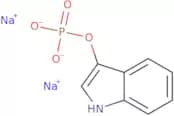
CAS:Produto Controlado<p>Histochemical substrate for alkaline phosphatase; Dark-blue color</p>Pureza:Min. 98 Area-%Cor e Forma:PowderPeso molecular:257.09 g/mol4-Methylumbelliferyl-α-L-arabinofuranoside
CAS:4-Methylumbelliferyl-alpha-L-arabinofuranoside is a nucleic acid molecule that has an average diameter of 10 nm. It is used as a tracer in electron microscopy to detect the presence of nucleic acid molecules in cells. This compound is also used to study the interactions between DNA and RNA molecules by labeling the DNA strand with 4-methylumbelliferyl-alpha-L-arabinofuranoside, which contains an alpha-(2,4,6) arabinofuranosyl group. The recombinant expression of this compound can be carried out in corynebacterium glutamicum, and it has a bulk density that ranges from 1.7 to 2.1 g/cm3 and an average particle diameter ranging from 0.5 to 1 micron. It is not soluble in water or alcohol but is soluble in acetone or chloroform.Fórmula:C15H16O7Pureza:Min. 98 Area-%Peso molecular:308.29 g/molRef: 3D-M-5509
1gA consultar100mgA consultar250mgA consultar500mgA consultar2500mgA consultar-Unit-ggA consultar5-Bromo-3-indoxyl-β-D-galactopyranoside
CAS:Chromogenic substrate for beta-D-galactosidase yielding a lapis colored precipitate. 5-Bromo-3-indoxyl-beta-D-galactopyranoside can be used in conjunction with isopropyl-beta-D-thiogalactopyranoside as an alternative to 5-bromo-4-chloro-3-indolyl-beta-D-galactopyranoside (X-gal), producing a darker blue color for detection of beta-galactosidase activity in bacterial colonies in a colorimetric assay to detect recombinants (white) from non-recombinants (blue). 5-Bromo-3-indoxyl-beta-D-galactopyranoside is also used in histochemistry to demonstrate beta-galactosidase activity in tissues.Fórmula:C14H16BrNO6Pureza:Min. 99.0 Area-%Peso molecular:374.20 g/molIsopropyl-β-D-thiogalactopyranoside, approx. 15.0% dioxane
CAS:A non-metabolizable allolactose analogue, widely used in molecular biology for overexpression of recombinant proteins from inducible systems under the control of lac promoter. IPTG binds to the LacI repressor and causes its release from the lac operator, allowing gene expression to take place. Present in vectors of pGEX, pGEM-T, pET, pRSET, pMAL class and others.Fórmula:C9H18O5SPeso molecular:238.30 g/molRef: 3D-I-8050
1kgA consultar100gA consultar250gA consultar500gA consultar2500gA consultar-Unit-ggA consultar