Substratos Cromogénicos
Os substratos cromogênicos são compostos que produzem uma mudança de cor visível quando são metabolizados por enzimas específicas. Esses substratos são amplamente utilizados em ensaios diagnósticos, pesquisa bioquímica e ensaios imunoenzimáticos (ELISA) para detectar e quantificar a atividade enzimática. A mudança de cor permite uma identificação visual fácil e rápida das reações enzimáticas, tornando os substratos cromogênicos ferramentas essenciais na análise laboratorial. Na CymitQuimica, oferecemos uma seleção diversificada de substratos cromogênicos de alta qualidade para apoiar suas aplicações de pesquisa e diagnóstico.
Foram encontrados 712 produtos de "Substratos Cromogénicos"
Ordenar por
Pureza (%)
0
100
|
0
|
50
|
90
|
95
|
100
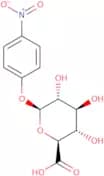
4-Nitrophenyl-β-D-glucuronic acid
CAS:<p>Chromogenic β-glucuronidase substrate yielding a yellow solution upon cleavage. Used to detect E. coli contamination in food and drinking water due to their β-glucuronidase activity.</p>Fórmula:C12H13NO9Pureza:Min. 98.0 Area-%Peso molecular:315.24 g/molAldol® 458 nonanoate, Biosynth Patent: EP 2427431 and US 8940909
CAS:Produto Controlado<p>Aldol 458 nonanoate is a fluorogenic substrate that can be used in the detection of enzyme activity particularly C8/C9-esterases, lipases activity producing a yellow/green-orange color. Aldol 458 nonanoate reacts with enzymes, such as oxidoreductases and hydrolases, to produce light. This product is a conjugate of aldol 458 nonanoate and an enzyme substrate for the detection of these enzymes. It has been shown to be useful in food testing, staining, fluorogenic substrate, environmental testing, chromogenic substrate, conjugate, high purity, enzyme substrate for diagnostics and ligand.</p>Fórmula:C25H29NO4Pureza:Min. 95%Peso molecular:407.5 g/mol4-Nitrocatechol sulfate dipotassium salt
CAS:<p>Chromogenic sulfatase substrate</p>Fórmula:C6H3NO7SK2Pureza:Min. 98 Area-%Cor e Forma:PowderPeso molecular:311.35 g/mol4-Chloro-1-naphthol
CAS:<p>Substrate for horseradish peroxidase</p>Fórmula:C10H7ClOPureza:Min. 96.0 Area-%Cor e Forma:Brown PowderPeso molecular:178.61 g/mol5-Cyano-3-indoxyl-β-D-galactopyranoside
<p>For detection of beta-galactosidase activity. <br>The colors of the chromogen can be adjusted by incorporating different functional groups, e.g. cyano or nitro group, which yields purple or black green colonies with beta-galactosidase positive strain.</p>Fórmula:C15H16N2O6Peso molecular:320.3 g/molAldol® 484 β-D-galactopyranoside, Biosynth Patent: EP 2427431 and US 8940909
CAS:<p>Aldol® 484 beta-D-galactopyranoside is a chromogenic enzyme substrate for beta-galactosidase activity. The colorless product is cleaved by lactose-utilizing bacteria in liquid or solid media, yielding intense red color. Aldol® 484 beta-D-galacto-pyranoside can also be used in beta-gal reporter gene assays or for identification of beta-gal positive transformants on agar. Aldol® 484 beta-D-galactopyranoside can be used under aerobic and anaerobic conditions.</p>Fórmula:C26H24ClFN2O7Pureza:Min. 95%Cor e Forma:PowderPeso molecular:530.93 g/mol4-Nitrophenylphosphorylcholine
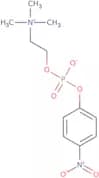
CAS:<p>Chromogenic substrate used to measure phospholipase C (PLC) activity</p>Fórmula:C11H17N2O6PPureza:Min. 95 Area-%Cor e Forma:PowderPeso molecular:304.24 g/molNaphthol AS-MX acetate
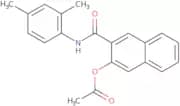
CAS:<p>Modified naphtol AS substrate used in histochemical and cytochemical staining</p>Fórmula:C21H19NO3Pureza:Min. 80%Cor e Forma:White Off-White PowderPeso molecular:333.38 g/molIPTG
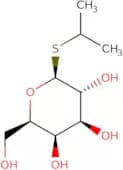
CAS:<p>Isopropyl-beta-D-thiogalactopyranoside (IPTG) is a non-metabolizable allolactose analogue, widely used in molecular biology for overexpression of recombinant proteins from inducible systems under the control of lac promoter. IPTG binds to the LacI repressor and causes its release from the lac operator, allowing gene expression of lac operon to take place. IPTG is present in vectors of pGEX, pGEM-T, pET, pRSET, pMAL class and others.</p>Fórmula:C9H18O5SPureza:Min. 99 Area-%Cor e Forma:White PowderPeso molecular:238.3 g/mol6-Bromo-2-naphthyl β-D-galactopyranoside
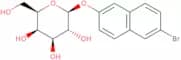
CAS:<p>6-Bromo-2-naphthyl β-D-galactopyranoside is a chromogenic substrate commonly used for the detection of the enzymatic activity of β-galactosidase. It can produce a yellow precipitate upon hydrolysis by β-galactosidase, indicating the presence of the enzyme. It is often used in molecular biology applications to detect gene expression or to monitor cloning efficiency.</p>Fórmula:C16H17BrO6Pureza:Min. 98 Area-%Cor e Forma:PowderPeso molecular:385.21 g/mol5-Nitro-3-indoxyl-β-D-galactopyranoside
<p>Please enquire for more information about 5-Nitro-3-indoxyl-β-D-galactopyranoside including the price, delivery time and more detailed product information at the technical inquiry form on this page</p>Fórmula:C14H16N2O8Pureza:Min. 95%Peso molecular:340.29 g/molChlorophenol red-b-D-galactopyranoside sodium salt
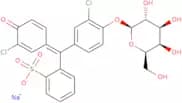
CAS:<p>Chlorophenol red-b-D-galactopyranoside sodium salt is the salt from of CPRG (chlorophenol red-b-D-galactopyranoside), that has a higher solubility. It is a chromogenic substrate for beta-galactosidases that, after enzymatic cleavage, releases chlorophenol red, a dark red compound quantified by absorbance at 570 nm.</p>Fórmula:C25H21Cl2O10SNaPureza:Min. 96 Area-%Cor e Forma:PowderPeso molecular:607.4 g/mol5-Bromo-4-chloro-3-indolyl a-D-maltopyranoside
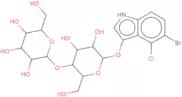
CAS:<p>5-Bromo-4-chloro-3-indolyl a-D-maltopyranoside is a chromogenic substrate used to detect the specific enzymatic activity of alpha-glucosidase. After cleavage, 5-bromo-4-chloro-indoxyl is released, resulting in a blue to blue-green color change in bacterial colonies or media. 5-Bromo-4-chloro-3-indolyl a-D-maltopyranoside is used in Pompe disease screening and glycogen storage disorder diagnosis.</p>Fórmula:C20H25BrClNO11Pureza:Min. 95%Cor e Forma:PowderPeso molecular:570.77 g/mol4-Nitrophenyl 3-O-(a-D-glucopyranosyl)-a-D-glucopyranoside
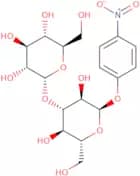
CAS:<p>4-Nitrophenyl 3-O-(a-D-glucopyranosyl)-a-D-glucopyranoside (pNP-Glc-Glc) is a highly sensitive and potent chromogenic substrate for the enzymatic detection and measurement of alpha-glucosidase activity. The rapid color change triggered by the hydrolysis of pNP-Glc-Glc provides a clear and efficient method for monitoring enzyme kinetics, screening inhibitors, and functional characterization of α-glucosidases. This substrate is soluble in aqueous and polar organic solvents and yields a detectable 4-nitrophenol product with a distinct yellow color under both visible and ultraviolet light, enabling quantitative spectrophotometric measurements. With a superior signal-to-noise ratio and maximal sensitivity, pNP-Glc-Glc is a reliable and robust option for biochemical and biomedical research involving glucosidase enzymes.</p>Pureza:Min. 95%Cor e Forma:PowderPeso molecular:463.39 g/mol2-Naphthyl-α-L-fucopyranoside
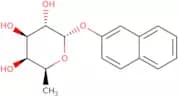
CAS:<p>Chromogenic substrate for α-L-Fucosidase. 2-naphthol is released upon hydrolyzation. By simultaneous coupling with a suitable staining reagent, such as hexazonium p-rosaniline, the corresponding azo-dye is formed. Naphthols can also be detected by fluorescence analysis.</p>Fórmula:C16H18O5Pureza:Min. 98 Area-%Peso molecular:290.32 g/mol2-O-(4-Nitrophenyl)-a-D-N-glycolylneuraminic acid
CAS:<p>2-O-(4-Nitrophenyl)-a-D-N-glycolylneuraminic acid is commonly used to measure the activity of sialidase enzymes, specifically those that cleave glycoconjugates containing 2-O-(4-nitrophenyl)-alpha-D-N-glycolylneuraminic acid. The resulting product can be detected by measuring the absorbance at a specific wavelength using a spectrophotometer. This substrate offers a high degree of specificity for glycolylneuraminic acid-containing substrates and is useful for both research and diagnostic purposes.</p>Pureza:Min. 95%Cor e Forma:PowderPeso molecular:446.36 g/mol4-Nitrophenyl phosphate, bis(cyclohexylammonium) salt
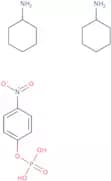
CAS:<p>Chromogenic substrate yielding a soluble yellow chromophor for the colorimetric assay of phosphatases.</p>Fórmula:C18H32N3O6PPureza:97.0 To 103.0%Peso molecular:417.45 g/mol2-Naphthyl caprylate
CAS:<p>2-Naphthyl caprylate is a substrate that is employed in an assays for carboxylesterase and lipase and when hydrolyzed, produces 2-naphthol, a compound that can also be identified via fluorescence analysis. By combining it with a diazonium salt, the formation of the corresponding azo dye occurs. In particular, this substrate is used to detect the extracellular lipase of Pseudomonas fluorescens B52.</p>Fórmula:C18H22O2Pureza:Min. 95%Cor e Forma:White PowderPeso molecular:270.37 g/mol2-Fluoro-4-nitrophenyl b-D-galactopyranoside
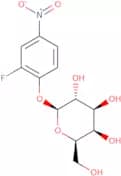
CAS:<p>2-Fluoro-4-nitrophenyl b-D-galactopyranoside is a chromogenic substrate in enzymatic assays with β-galactosidase. Commonly abbreviated as PFONPG, it is a hydrophilic compound that can be dissolved in saline and blood samples, which makes it a suitable candidate for diagnostic applications as a gene reporter probe by simple analytic methodologies. 2-Fluoro-4-nitrophenyl b-D-galactopyranoside have been used to detect and monitor the growth of prostate tumor cells.</p>Pureza:Min. 95%Cor e Forma:PowderPeso molecular:319.24 g/molAldol® 495 nonanoate solution, 0.75 M in DMSO, Biosynth Patent: EP 2427431 and US 8940909
CAS:Produto Controlado<p>Aldol® 495 nonanoate is a chromogenic and fluorogenic enzyme substrate used for detection of lipase activity. The colorless enzyme substrate is cleaved by C9 esterases, yielding development of an orange coloration. In addition, green fluorescence is generated when Aldol® 355 fluorescence enhancer or a suitable matrix is present. Aldol® 495 nonanoate can be used in enzyme assays and live bacterial cultures. Aldol® 495 nonanoate is suitable for use in liquid and solid media, under aerobic as well as anaerobic conditions.</p>Fórmula:C29H31ClN2O3Pureza:Of Solute (Hplc) 95.0 To 100.0 Area-%Peso molecular:491.02 g/mol