Substratos Cromogénicos
Foram encontrados 712 produtos de "Substratos Cromogénicos"
β-Naphthyl stearate
CAS:Beta-naphthyl stearate is a chromogenic substrate for measuring enzymatic activity.Pureza:Min. 95%Cor e Forma:PowderPeso molecular:410.63 g/mol6-Bromo-2-naphthyl-b-D-xylopyranoside
CAS:6-Bromo-2-naphthyl-b-D-xylopyranoside (BNX) is a chromogenic enzyme substrate used primarily to detect xylosidase activity. It is cleaved by the enzyme, resulting in the release of a colored product that can be measured spectrophotometrically. BNX is widely used as a substrate in research studies for the detection and quantification of various glycoside hydrolases, and it is particularly useful for studying cellulases and xylanases.Pureza:Min. 95%Cor e Forma:PowderPeso molecular:355.18 g/mol4-Nitrophenyl 2-acetamido-6-O-(2-acetamido-2-deoxy-b-D-glucopyranosyl)-3-O-(b-D-galactopyranosyl)-2-deoxy-a-D-galactopyranoside
CAS:4-Nitrophenyl 2-acetamido-6-O-(2-acetamido-2-deoxy-b-D-glucopyranosyl)-3-O-(b-D-galactopyranosyl)-2-deoxy-a-D-galactopyranoside is a specific chromogenic substrate designed for the highly sensitive and accurate detection of glycosidase enzyme activity. Glycosidases are responsible for the cleavage of glycosidic bonds between saccharide units in various carbohydrates. The hydrolysis of this substrate by glycosidase enzymes produces 4-nitrophenol, a yellow-colored compound that can be easily monitored through spectrophotometric measurements due to its strong absorbance at 405 nm. This chromogenic substrate is widely used in the analysis of glycosidase activity in various biological samples, including bacterial, fungal, and plant tissues, as well as in environmental samples and biotechnological applications.Fórmula:C28H41N3O18Pureza:Min. 95 Area-%Cor e Forma:White PowderPeso molecular:707.63 g/mol3,4-Cyclohexenoesculetin beta-D-galactopyranoside
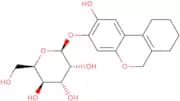
CAS:Chromogenic substrate for beta-galactosidaseFórmula:C19H22O9Pureza:Min. 95 Area-%Cor e Forma:PowderPeso molecular:394.37 g/molAldol® 484 beta-D-galactopyranoside, Biosynth Patent: EP 2427431 and US 8940909
CAS:Aldol® 484 beta-D-galactopyranoside is a chromogenic enzyme substrate for beta-galactosidase activity. The colorless product is cleaved by lactose-utilizing bacteria in liquid or solid media, yielding intense red color. Aldol® 484 beta-D-galacto-pyranoside can also be used in beta-gal reporter gene assays or for identification of beta-gal positive transformants on agar. Aldol® 484 beta-D-galactopyranoside can be used under aerobic and anaerobic conditions.Fórmula:C26H24ClFN2O7Pureza:Min. 95%Cor e Forma:PowderPeso molecular:530.93 g/mol4-Chloro-1-naphthol
CAS:Substrate for horseradish peroxidase
Fórmula:C10H7ClOPureza:Min. 96.0 Area-%Cor e Forma:Brown PowderPeso molecular:178.61 g/mol4-Nitrophenyl 2-acetamido-2-deoxy-a-D-glucopyranoside
CAS:4-Nitrophenyl 2-acetamido-2-deoxy-a-D-glucopyranoside is a chromogenic pNP substrate specifically designed for the analysis of N-acetylglucosaminidase activity. Upon enzyme action, the substrate releases 4-nitrophenol, a yellow compound that can be detected by spectrophotometric methods, providing a reliable and sensitive means of quantifying enzyme activity. This versatile substrate is widely used in biochemical studies, disease diagnostics, and the enzyme production industry.Fórmula:C14H18N2O8Cor e Forma:White Off-White PowderPeso molecular:342.3 g/mol5-Bromo-4-chloro-3-indolyl a-L-arabinofuranoside
5-Bromo-4-chloro-3-indolyl a-L-arabinofuranoside is a chromogenic substrate used to detect the specific enzymatic activity of alpha-L-arabinofuranosidase. After cleavage, 5-bromo-4-chloro-indoxyl is released, resulting in a blue to blue-green color change in bacterial colonies or media. 5-Bromo-4-chloro-3-indolyl a-L-arabinofuranoside is used in bacterial arabinan degradation assays (e.g. Bacillus spp.).Fórmula:C13H13BrClNO5Pureza:Min. 98.0 Area-%Cor e Forma:PowderPeso molecular:378.6 g/mol2-Naphthyl butyrate
CAS:2-Naphthyl butyrate is used as a chromogenic substrate in hematological studies via measuring esterase activity. This type of assays are important as it can help in distinguishing acute leukemias with monocytic or granulocytic differentiation. After hydrolysis of 2-naphthyl butyrate by the esterase (for example acylase), b-napthol is released that can be quantified spectrophotometrically (Exc 320 nm; Em 410 nm).Fórmula:C14H14O2Pureza:Min. 98 Area-%Cor e Forma:Colorless Clear LiquidPeso molecular:214.26 g/molAldol® 470 nonanoate, Biosynth Patent: EP 2427431 and US 8940909
CAS:Produto ControladoAldol® 470 nonanoate is a chemiluminescent substrate that can be used as a ligand for the detection of C8/C9-esterases, lipases activity, to result in an orange/green color. Aldol® 470 nonanoate has been shown to be active with horseradish peroxidase in a number of different assay systems. The purity and quality of Aldol® 470 nonanoate has been tested with culture media, environmental testing, bioluminescence, staining, fluorogenic substrate, chromogenic substrate, enzyme substrate, food testing and conjugates.Fórmula:C32H35NO5Pureza:Min. 95%Cor e Forma:PowderPeso molecular:513.62 g/mol6-Chloro-3-indolyl butyrate
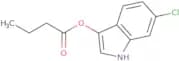
CAS:6-Chloro-3-indolyl butyrate is a chromogenic substrate for lipases. Use in lipid digestion and metabolism studies, it produces a salmon-pink color when 6-chloro-3-indolyl is released after enzymatic cleavage.Fórmula:C12H12ClNO2Pureza:Min. 95%Cor e Forma:PowderPeso molecular:237.68 g/mol2-Nitrophenyl a-D-galactopyranoside
CAS:2-Nitrophenyl alpha-D-galactopyranoside is a chromogenic substrate used to detect the enzymatic activity of alpha-galactosidase. After cleavage, the nitrophenyl moiety is released exhibiting a light yellowish color. 2-Nitrophenyl alpha-D-galactopyranoside is used in Fabry disease screening.Fórmula:C12H15NO8Pureza:Min. 95%Cor e Forma:White Off-White PowderPeso molecular:301.25 g/mol5-Bromo-4-chloro-3-indoxyl-alpha-D-N-acetylneuraminic acid, cyclohexylammonium salt
5-Bromo-4-chloro-3-indoxyl-alpha-D-N-acetylneuraminic acid, cyclohexylammonium salt is a chemiluminescent substrate that provides a significant increase in light emission. It has a CAS number of 59820-92-0 and is supplied in high purity and high quality. This product is used for the detection of various biological reactions, including diagnostics, enzyme substrates, food testing, and more.Pureza:Min. 95%4-Nitrophenyl 2-acetamido-2-deoxy-b-D-glucopyranoside-6-sulfate sodium salt
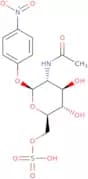
CAS:4-Nitrophenyl 2-acetamido-2-deoxy-beta-D-glucopyranoside-6-sulfate sodium salt is a chromogenic substrate for N-acetylglucosamine-6-sulfatase. Upon hydrolysis, para-nitrophenol is released yielding a yellowish colour. 4-Nitrophenyl 2-acetamido-2-deoxy-beta-D-glucopyranoside-6-sulfate sodium salt is used in different applications such as the Mucopolysaccharidosis IIID (Sanfilippo D) diagnosis
Fórmula:C14H17N2O11S·NaPureza:Min. 95 Area-%Cor e Forma:PowderPeso molecular:444.35 g/mol4-Nitrophenyl 6-O-(a-D-glucopyranosyl)-b-D-glucopyranoside
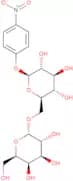
CAS:4-Nitrophenyl 6-O-(alpha-D-glucopyranosyl)-beta-D-glucopyranoside is a chromogenic substrate for beta-glucosidase. Upon hydrolysis, para-nitrophenol is released yielding a yellowish colour. 4-Nitrophenyl 6-O-(alpha-D-glucopyranosyl)-beta-D-glucopyranoside is used in different applications such as the Cellulose metabolism research, biofuel productionPureza:Min. 95%Cor e Forma:PowderPeso molecular:463.39 g/molAldol® 458 phosphate, disodium salt, Biosynth Patent: EP 2427431 and US 8940909
CAS:Aldol® 458 phosphate is a chromogenic and fluorogenic enzyme substrate used for detection of phosphatase activity. The colorless enzyme substrate is cleaved by phosphatases secreted by bacteria grown in liquid media, yielding yellow color and green fluorescence. Aldol® 458 phosphate can also be used in assays involving phosphatase-coupled antibodies in immunoassay applications (ELISA). Aldol® 458 phosphate can be used under aerobic and anaerobic conditions.Fórmula:C16H12NNa2O6PPureza:Min. 95%Cor e Forma:PowderPeso molecular:391.22 g/mol6-Bromo-2-naphthyl α-D-mannopyranoside
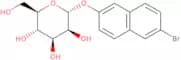
CAS:Chromogenic substrate to visualize the activity of alpha-D-mannopyranoside; red color producedFórmula:C16H17BrO6Pureza:Min. 95%Cor e Forma:PowderPeso molecular:385.21 g/molNaphthol AS-BI β-D-galactopyranoside
CAS:Substrate for beta-galactosidaseFórmula:C24H24BrNO8Pureza:Min. 95%Cor e Forma:PowderPeso molecular:534.35 g/mol4-Nitrophenyl 2-O-(β-D-glucopyranosyl)-β-D-glucopyranoside
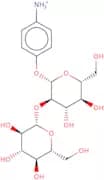
CAS:4-Nitrophenyl 2-O-(beta-D-glucopyranosyl)-beta-D-glucopyranoside is a chromogenic substrate for beta-glucosidase. Upon hydrolysis, para-nitrophenol is released yielding a yellowish colour. 4-Nitrophenyl 2-O-(beta-D-glucopyranosyl)-beta-D-glucopyranoside is used in different applications such as the Cellulose degradation studies, biofuel researchFórmula:C18H25NO13Pureza:Min. 95%Cor e Forma:White solid.Peso molecular:463.39 g/mol2-Chloro-4-nitrophenyl a-D-maltotrioside
CAS:2-Chloro-4-nitrophenyl a-D-maltotrioside (2CNP) is a potent hypoglycemic agent that has been shown to decrease postprandial blood glucose levels in humans. 2CNP is a white crystalline solid that is soluble in water and ethanol. The transfer reactions of 2CNP are enhanced by benzalkonium chloride, which forms an organic complex with the drug. The optimum concentration for the hypoglycemic effect of 2CNP is determined to be 10 μM, which can be detected using an optical sensor. This compound also inhibits α-amylase and other enzymes involved in carbohydrate metabolism, leading to the accumulation of glycogen and lowering the blood glucose level.
Fórmula:C24H34CiNO18Pureza:Min. 95%Cor e Forma:Off-White Yellow PowderPeso molecular:659.98 g/mol