

3H-UTT-1012 - acryloxypropyl-t-structure-siloxane-10-30-cst
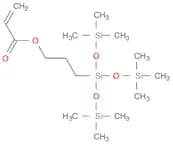
(3-Acryloxypropyl)tris(trimethylsiloxy)silane
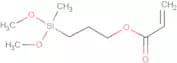
CAS:Fórmula:C15H36O5Si4Pureza:95%Cor e Forma:LiquidPeso molecular:408.7853(3-Acryloxypropyl)Methyldimethoxysilane
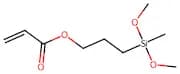
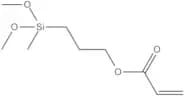
CAS:(3-Acryloxypropyl)Methyldimethoxysilane
Pureza:99%+Peso molecular:218.32g/molRef: 54-OR1008057
1gA consultar5gA consultar25gA consultar100gA consultar500gA consultar2.5kgA consultar(3-ACRYLOXYPROPYL)METHYLDIMETHOXYSILANE, tech
CAS:Acrylate Functional Dialkoxysilane
Silane coupling agents have the ability to form a durable bond between organic and inorganic materials to generate desired heterogeneous environments or to incorporate the bulk properties of different phases into a uniform composite structure. The general formula has two classes of functionality. The hydrolyzable group forms stable condensation products with siliceous surfaces and other oxides such as those of aluminum, zirconium, tin, titanium, and nickel. The organofunctional group alters the wetting or adhesion characteristics of the substrate, utilizes the substrate to catalyze chemical transformations at the heterogeneous interface, orders the interfacial region, or modifies its partition characteristics, and significantly effects the covalent bond between organic and inorganic materials.
3-(acryloxypropyl)methyldimethoxysilane, dimethoxymethylsilylpropyl acrylate
Employed in fabrication of photoimageable, low shrinkage multimode waveguidesCoupling agent for UV cure systemsUsed in microparticle surface modificationComonomer for free-radical polymerizaitonInhibited with MEHQFórmula:C9H18O4SiPureza:techCor e Forma:Straw LiquidPeso molecular:218.33(3-ACRYLOXYPROPYL)TRIMETHOXYSILANE, 96%
CAS:Acrylate Functional Trialkoxy Silane
Silane coupling agents have the ability to form a durable bond between organic and inorganic materials to generate desired heterogeneous environments or to incorporate the bulk properties of different phases into a uniform composite structure. The general formula has two classes of functionality. The hydrolyzable group forms stable condensation products with siliceous surfaces and other oxides such as those of aluminum, zirconium, tin, titanium, and nickel. The organofunctional group alters the wetting or adhesion characteristics of the substrate, utilizes the substrate to catalyze chemical transformations at the heterogeneous interface, orders the interfacial region, or modifies its partition characteristics, and significantly effects the covalent bond between organic and inorganic materials.
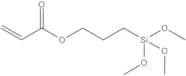
3-Acryloxypropyltrimethoxysilane, 3-(trimethoxysilyl)propyl acrylate
Coupling agent for UV cure and epoxy systemsEmployed in optical fiber coatingsUsed in microparticle surface modification Comonomer for free-radical polymerizaitonAnalog of methacryloxypropyltrimethoxysilane (SIM6487.4)Used in combination with dipodal silane, Bis(3-trimethoxysilylproply)amine (SIB1833.0), to increase strength and hydrolytic stability of dental compositesInhibited with BHTBase silane in SIVATE™ A200Fórmula:C9H18O5SiPureza:96%Cor e Forma:Straw LiquidPeso molecular:234.32(3-Acryloxypropyl)methyldimethoxysilane inhibited with MEHQ
CAS:S00130 - (3-Acryloxypropyl)methyldimethoxysilane inhibited with MEHQ
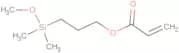
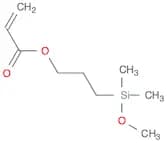
Fórmula:C9H18O4SiPureza:95%Cor e Forma:Liquid, ClearPeso molecular:218.324(3-Acryloxypropyl)dimethylmethoxysilane
CAS:S25022 - (3-Acryloxypropyl)dimethylmethoxysilane
Fórmula:C9H18O3SiPureza:95%Cor e Forma:Liquid, ClearPeso molecular:202.325(3-Acryloxypropyl)tris(trimethylsiloxy)silane inhibited with MEHQ tech-95
CAS:S25023 - (3-Acryloxypropyl)tris(trimethylsiloxy)silane inhibited with MEHQ tech-95
Fórmula:C15H36O5Si4Pureza:95%Cor e Forma:Liquid, ClearPeso molecular:408.788(Acryloxypropyl)methylsiloxane-dimethylsiloxane co-polymer cSt 80-120
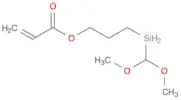
CAS:Cor e Forma:Liquid, ClearPeso molecular:520.36195192-Propenoic acid, 3-(dimethoxymethylsilyl)propyl ester
CAS:Fórmula:C9H18O4SiPureza:95%Cor e Forma:LiquidPeso molecular:218.32233-[[methoxy(dimethyl)silyl]oxy-dimethylsilyl]propyl prop-2-enoate
CAS:Fórmula:C11H24O4Si2Peso molecular:276.47692-Propenoic acid, 3-(methoxydimethylsilyl)propyl ester
CAS:Fórmula:C9H18O3SiPureza:95%Cor e Forma:LiquidPeso molecular:202.3229Ref: IN-DA007DFD
1g39,00€5g71,00€10g112,00€15g163,00€25g161,00€50g316,00€75g623,00€100g575,00€100mg25,00€250mg31,00€[3-(Acryloxy)propyl]trichlorosilane
CAS:Fórmula:C6H9Cl3O2SiPureza:95%Cor e Forma:LiquidPeso molecular:247.57903-[1,1,1,5,5,5-Hexamethyl-3-[(trimethylsilyl)oxy]trisiloxan-3-yl]propyl Acrylate (stabilized with BHT)
CAS:Fórmula:C15H36O5Si4Pureza:>90.0%(GC)Cor e Forma:Colorless to Light yellow clear liquidPeso molecular:408.793-Mercaptopropyl Trimethoxylsilane-13C3
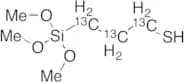
CAS:Produto ControladoFórmula:C3C3H16O3SSiCor e Forma:NeatPeso molecular:199.318BIS(3-TRIMETHOXYSILYLPROPYL)AMINE, 96%
CAS:Amine Functional Alkoxy Silane
Silane coupling agents have the ability to form a durable bond between organic and inorganic materials to generate desired heterogeneous environments or to incorporate the bulk properties of different phases into a uniform composite structure. The general formula has two classes of functionality. The hydrolyzable group forms stable condensation products with siliceous surfaces and other oxides such as those of aluminum, zirconium, tin, titanium, and nickel. The organofunctional group alters the wetting or adhesion characteristics of the substrate, utilizes the substrate to catalyze chemical transformations at the heterogeneous interface, orders the interfacial region, or modifies its partition characteristics, and significantly effects the covalent bond between organic and inorganic materials.
Dipodal Silane
Dipodal silanes are a series of adhesion promoters that have intrinsic hydrolytic stabilities up to ~10,000 times greater than conventional silanes and are used in applications such as plastic optics, multilayer printed circuit boards and as adhesive primers for ferrous and nonferrous metals. They have the ability to form up to six bonds to a substrate compared to conventional silanes with the ability to form only three bonds to a substrate. Many conventional coupling agents are frequently used in combination with 10-40% of a non-functional dipodal silane, where the conventional coupling agent provides the appropriate functionality for the application, and the non-functional dipodal silane provides increased durability. Also known as bis-silanes additives enhance hydrolytic stability, which impacts on increased product shelf life, ensures better substrate bonding and also leads to improved mechanical properties in coatings as well as composite applications.
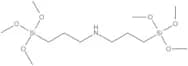
Bis-(3-trimethoxysilylpropyl)amine
Secondary amine allows more control of reactivity with isocyanatesEmployed in optical fiber coatingsUsed in combination with silane, (3-Acryloxypropyl)trimethoxysilane, (SIA0200.0), to increase strength and hydrolytic stability of dental compositesDipodal analog of AMEO (SIA0611.0 )Fórmula:C12H31NO6Si2Pureza:96%Cor e Forma:Straw LiquidPeso molecular:341.56METHACRYLOXYPROPYLTRIMETHOXYSILANE
CAS:Methacrylate Functional Trialkoxy Silane
Silane coupling agents have the ability to form a durable bond between organic and inorganic materials to generate desired heterogeneous environments or to incorporate the bulk properties of different phases into a uniform composite structure. The general formula has two classes of functionality. The hydrolyzable group forms stable condensation products with siliceous surfaces and other oxides such as those of aluminum, zirconium, tin, titanium, and nickel. The organofunctional group alters the wetting or adhesion characteristics of the substrate, utilizes the substrate to catalyze chemical transformations at the heterogeneous interface, orders the interfacial region, or modifies its partition characteristics, and significantly effects the covalent bond between organic and inorganic materials.
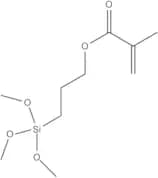
Methacryloxypropyltrimethoxysilane, 3-(Trimethoxysilyl)propyl methacrylate, MEMO
Viscosity: 2 cStSpecific wetting surface: 314 m2/gCopolymerization parameters-e, Q: 0.07, 2.7Coupling agent for radical cure polymer systems and UV cure systemsWidely used in unsaturated polyester-fiberglass compositesCopolymerized with styrene in formation of sol-gel compositesAnalog of (3-acryloxypropyl)trimethoxysilane (SIA0200.0)Used in microparticle surface modification and dental polymer compositesSlower hydrolysis rate than methacryloxymethyltrimethoxysilane (SIM6483.0)Comonomer for free-radical polymerizaitonDetermined by TGA a 25% weight loss of dried hydrolysates at 395°Inhibited with MEHQ, HQFórmula:C10H20O5SiPureza:97%Cor e Forma:Straw LiquidPeso molecular:248.353-(1,1,1,5,5,5-Hexamethyl-3-((Trimethylsilyl)Oxy)Trisiloxan-3-Yl)Propyl Acrylate
CAS:3-(1,1,1,5,5,5-Hexamethyl-3-((Trimethylsilyl)Oxy)Trisiloxan-3-Yl)Propyl AcrylatePureza:97%Peso molecular:408.79g/mol3-[Dimethoxy(methyl)silyl]propyl Acrylate (stabilized with MEHQ)
CAS:Fórmula:C9H18O4SiPureza:>95.0%(GC)Cor e Forma:Colorless to Light yellow clear liquidPeso molecular:218.32









![3-[1,1,1,5,5,5-Hexamethyl-3-[(trimethylsilyl)oxy]trisiloxan-3-yl]propyl Acrylate (stabilized with …](/_next/image/?url=https%3A%2Fstatic.cymitquimica.com%2Fproducts%2F3B%2Fthumb-webp%2FT4411.webp&w=3840&q=75)



![3-[Dimethoxy(methyl)silyl]propyl Acrylate (stabilized with MEHQ)](/_next/image/?url=https%3A%2Fstatic.cymitquimica.com%2Fproducts%2F3B%2Fthumb-webp%2FD5556.webp&w=3840&q=75)