AC-41955 - sodium-hypochlorite-4-6 | 7681-52-9
Lamentamos, não foi encontrado nenhum produto com a referência AC-41955, mas por favor, verifique os seguintes produtos semelhantes:
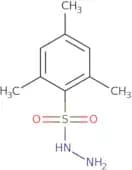
2,4,6-Trimethylbenzenesulfonohydrazide
CAS:<p>2,4,6-Trimethylbenzenesulfonohydrazide is a hydrazide that has been shown to have the ability to reduce the level of vitamin D3 in the body. It binds with chloride ions and hydroxyl groups on furan rings and hydrogenates them. This reaction leads to an increase in the amount of 2,4,6-trimethylbenzenesulfonic acid (2,4,6-TMS) and a decrease in vitamin D3. The physiological activity of 2,4,6-TMS is unknown; however it has been shown to react with sodium hypochlorite to form hydroxyl radicals. Hydroxyl radicals are known for their strong oxidizing properties and can be used in medicine as antibiotics. Hydroxyl radicals also react with cyclic compounds like phenols or amines leading to alkylation reactions that may lead to DNA damage or cancer cell death.</p>Fórmula:C9H14N2O2SPureza:Min. 95%Peso molecular:214.29 g/mol1,2,3,4,6-Penta-O-acetyl-5-thio-D-galactose
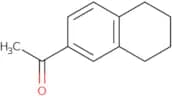
<p>1,2,3,4,6-Penta-O-acetyl-5-thio-D-galactose is a fluorinated monosaccharide that is synthesized by the reaction of 1,2,3,4,6-penta-O-acetyl-D-galactose with sodium hypochlorite in the presence of sodium bicarbonate. This compound has been shown to be an excellent substrate for glycosylation reactions and can be used as a sugar donor in polysaccharide synthesis. 1,2,3,4,6 penta O acetyl 5 thio D galactose can also be methylated with dimethylsulfoxide and trimethylsilyl chloride to form the corresponding methylated derivative. This product is available at high purity levels and CAS No. 68713-89-1.END></p>Fórmula:C16H22O10SPureza:Min. 95%Peso molecular:406.41 g/mol6-Acetyl-1,2,3,4-tetrahydronaphthalene
CAS:<p>6-Acetyl-1,2,3,4-tetrahydronaphthalene is a β-unsaturated ketone that has been shown to have anticancer activity in vitro. It can be used as an analgesic and has a low safety profile. This compound interacts with thiourea and sodium hypochlorite, which are compounds commonly used in the laboratory to induce DNA damage. 6-Acetyl-1,2,3,4-tetrahydronaphthalene also inhibits viral replication through interaction with iminium groups of nucleotide bases.</p>Fórmula:C12H14OPureza:Min. 95%Cor e Forma:Clear LiquidPeso molecular:174.24 g/mol3-Bromo-4-hydroxy-5-methoxybenzoic acid
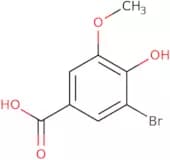
CAS:3-Bromo-4-hydroxy-5-methoxybenzoic acid is an organic compound that is a chlorinated derivative of benzoic acid. It can be synthesized by the reaction between benzene and sodium hypochlorite in the presence of a nuclear reactor. The reaction produces 3-bromo-4,5-dihydroxyphenylacetic acid which reacts with chlorine to produce 3,4,5-trichlorobenzoic acid. This compound can then be oxidized to form 3-bromo-4,5-dihydroxybenzoic acid or chlorinated to form 3,4,5,6 -tetrachlorobenzoic acid. The latter compound has been used as a precursor for herbicides such as Benlate and Clorox.Fórmula:C8H7BrO4Pureza:Min. 95%Peso molecular:247.04 g/mol4-Fluoro-2-methylbenzoic acid
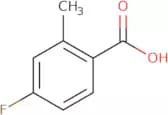
CAS:4-Fluoro-2-methylbenzoic acid is a chemical compound with the molecular formula of C7H6FO2. It is a white solid that has two isomers. 4-Fluoro-2-methylbenzoic acid can be synthesized by Friedel–Crafts acylation with acetyl chloride, which is an industrial reaction for the production of esters. The synthesis method for this compound includes: reacting aluminum or sodium hypochlorite with anhydrous chlorobenzene in the presence of a catalytic amount of copper powder and a slight excess of methylamine. This chemical synthesis method results in 4-fluoro-2-methylbenzoic acid and 3,4,5,6 tetrafluorobenzoic acid as products.Fórmula:C8H7FO2Pureza:Min. 95%Peso molecular:154.14 g/mol1-(5-Acetyl-2,6-dimethyl-1,4-dihydropyridin-3-yl)ethan-1-one
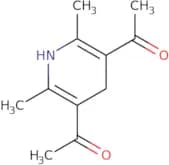
1-Acetyl-2,6-dimethyl-1,4-dihydropyridin-3-one is a fluorescent derivative that is used in analytical chemistry. It is prepared by treating the acetyl derivative of 2,6-dimethylaniline with carbon disulphide and acetaldehyde in an alkaline solution. 1-(5-Acetyl-2,6-dimethyl-1,4-dihydropyridin-3-yl)ethanone has been shown to have high fluorescence intensity when exposed to human serum and can be used to measure uptake of drugs into cells. Fluorescent derivatives are also used in biodiesel as nonpolar solvents and flow systems for chromatography. The reaction mechanism involves the conversion of a ketone to an alcohol by addition of formaldehyde followed by oxidation of the alcohol back to a ketone using sodium hypochlorite or hydrogen peroxide.Fórmula:C11H15NO2Pureza:Min. 95%Peso molecular:193.24 g/mol5-Chloroquinoline
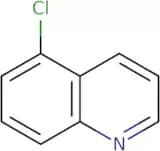
5-Chloroquinoline is a chemical compound that has been analysed using spectroscopy. It has been shown to have cross-coupling reactions with a number of organic compounds. 5-Chloroquinoline can be synthesized from 1,2,4-triazole and chloroacetyl chloride in the presence of an acid catalyst. This synthesis requires the use of dry solvents to remove moisture and prevent hydrolysis. 5-Chloroquinoline can also be synthesized by reacting phenol with 2,4,6-trichlorophenol and then adding sodium hypochlorite in ethanol to produce the desired product. The magnetic properties of 5-chloroquine have also been studied using nuclear magnetic resonance (NMR) studies and it has been found that this compound is capable of undergoing proton exchange without any change in its chemical structure. The theory behind these reactions is still being researched.Fórmula:C9H6ClNPureza:Min. 95%Peso molecular:163.6 g/molRef: 3D-FC20383
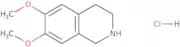
Produto descontinuado6,7-Dimethoxy-1,2,3,4-tetrahydroisoquinoline hydrochloride
6,7-Dimethoxy-1,2,3,4-tetrahydroisoquinoline hydrochloride (URB602) is a potential antidepressant drug that has been shown to activate the sodium hypochlorite pathway in the brain. URB602 has an excitatory effect and induces nociceptive behaviours in rats. This drug also activates the 2-arachidonoylglycerol (2-AG) system and inhibits periaqueductal grey neurons. These effects may be due to its ability to inhibit lipase activity and diacylglycerol (DAG) synthesis. URB602 also has antinociceptive properties and is scalable for industrial production.Fórmula:C11H15NO2Pureza:Min. 95%Peso molecular:193.24 g/molRef: 3D-FD13077
Produto descontinuado6-Chlorooxazolo[4,5-b]pyridin-2(3H)-one
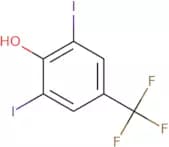
6-Chlorooxazolo[4,5-b]pyridin-2(3H)-one is an organic solvent that is used as a mobile phase for liquid chromatography. It has high solubility in water and low solubility in oils and organic solvents. 6-Chlorooxazolo[4,5-b]pyridin-2(3H)-one can be used to mineralize chlorine by reacting it with the hydrogen chloride produced from the reaction of sodium hypochlorite with water. 6-Chlorooxazolo[4,5-b]pyridin-2(3H)-one is mainly used as a pesticide for the control of daphnia populations. The mechanisms of its toxicity are not well understood but this compound may act by inhibiting protein synthesis or interfering with cell division.Fórmula:C6H3ClN2O2Pureza:Min. 95%Peso molecular:170.55 g/mol2,6-Diiodo-4-(trifluoromethyl)phenol
2,6-Diiodo-4-(trifluoromethyl)phenol is a coordination compound that has been studied by intramolecular, spectroscopy and kinetics methods. The compound can be prepared in two ways: by the oxidation of 2,6-dichloro-4-(trifluoromethyl)phenol with iodine or by the reaction of 4-iodophenol with sodium hypochlorite. 2,6-Diiodo-4-(trifluoromethyl)phenol has been found to undergo substitution reactions at the ortho position of the phenolic hydroxyl group to form an intramolecular addition product. The rate enhancement due to metal ions was found to be due to bond cleavage of the intramolecular product. The mechanism for this process is proposed as follows: ICH3 + ROH → RC(O)I + H2O (rate limiting step).Fórmula:C7H3F3I2OPureza:Min. 95%Peso molecular:413.9 g/mol

![6-Chlorooxazolo[4,5-b]pyridin-2(3H)-one](/_next/image/?url=https%3A%2Fstatic.cymitquimica.com%2Fproducts%2F3D%2Fthumb-webp%2FKBA57068.webp&w=3840&q=75)