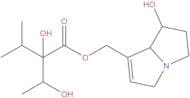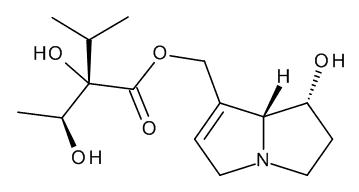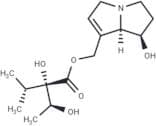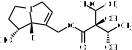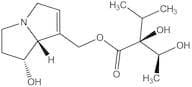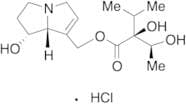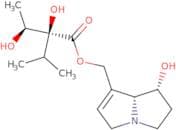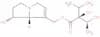
CAS 10285-07-1
:(+)-Lycopsamin
Beschreibung:
(+)-Lycopsamin ist ein natürlich vorkommendes Alkaloid, das hauptsächlich in bestimmten Pflanzenarten vorkommt, insbesondere innerhalb der Familie Asteraceae. Es ist durch seine komplexe bicyclische Struktur gekennzeichnet, die einen Pyrrolidinring und eine Hydroxylgruppe umfasst, was zu seiner biologischen Aktivität beiträgt. Diese Verbindung weist eine Reihe von pharmakologischen Eigenschaften auf, einschließlich potenzieller neurotoxischer Effekte, die in Bezug auf ihre Auswirkungen auf zelluläre Mechanismen untersucht wurden. (+)-Lycopsamin ist bekannt für seine Rolle in der traditionellen Medizin, obwohl sein Sicherheitsprofil aufgrund seiner Toxizität in bestimmten Kontexten besorgniserregend ist. Die Verbindung wird häufig auf ihre Anwesenheit in pflanzlichen Nahrungsergänzungsmitteln und Pflanzenextrakten analysiert, wo sie sowohl zu therapeutischen Effekten als auch zu unerwünschten Reaktionen beitragen kann. Ihre Stereochemie, die durch die (+)-Bezeichnung angezeigt wird, deutet darauf hin, dass es sich um die optisch aktive Form von Lycopsamin handelt, die ihre Wechselwirkung mit biologischen Systemen beeinflussen kann. Wie bei vielen Alkaloiden wird die Forschung fortgesetzt, um ihre potenziellen Anwendungen und die Mechanismen zu erkunden, die ihren Einfluss auf die menschliche Gesundheit zugrunde liegen.
Formel:C15H25NO5
InChl:InChI=1S/C15H25NO5/c1-9(2)15(20,10(3)17)14(19)21-8-11-4-6-16-7-5-12(18)13(11)16/h4,9-10,12-13,17-18,20H,5-8H2,1-3H3/t10-,12+,13+,15-/m0/s1
InChI Key:InChIKey=SFVVQRJOGUKCEG-ZGFBFQLVSA-N
SMILES:C(OC([C@]([C@H](C)C)([C@H](C)O)O)=O)C=1[C@]2(N(CC1)CC[C@H]2O)[H]
Synonyme:- (1R-(1alpha,7(2S*,3S*),7abeta))-(2,3,5,7a-Tetrahydro-1-hydroxy-1H-pyrrolizin-7-yl)methyl 2,3-dihydroxy-2-(1-methylethyl)butanoate
- 3′-epi-Intermedine
- Butanoic acid, 2,3-dihydroxy-2-(1-methylethyl)-, ((1R,7aR)-2,3,5,7a-tetrahydro-1-hydroxy-1H-pyrrolizin-7-yl)methyl ester, (2S,3S)-
- Butanoic acid, 2,3-dihydroxy-2-(1-methylethyl)-, (2,3,5,7a-tetrahydro-1-hydroxy-1H-pyrrolizin-7-yl)methyl ester, (1R-(1alpha,7(2S*,3S*),7abeta))-
- Butanoic acid, 2,3-dihydroxy-2-(1-methylethyl)-, (2,3,5,7a-tetrahydro-1-hydroxy-1H-pyrrolizin-7-yl)methyl ester, [1R-[1α,7(2S*,3S*),7aβ]]-
- Ccirs 9199
- Ccris 9199
- Retronecine 9-((-)-viridiflorate)
- [(1R,7aR)-1-hydroxy-2,3,5,7a-tetrahydro-1H-pyrrolizin-7-yl]methyl (2S,3S)-2,3-dihydroxy-2-(propan-2-yl)butanoate
- Lycopsamine
- (+)-Lycopsamine
Sortieren nach
Reinheit (%)
0
100
|
0
|
50
|
90
|
95
|
100
9 Produkte.
Lycopsamine 100 µg/mL in Water
CAS:Kontrolliertes ProduktFormel:C15H25NO5Farbe und Form:Single SolutionMolekulargewicht:299.363Lycopsamine
CAS:Lycopsamine is a bioactive chemical.Formel:C15H25NO5Farbe und Form:SolidMolekulargewicht:299.36Lycopsamine
CAS:Natural alkaloidFormel:C15H25NO5Reinheit:≥ 95.0 % (HPLC)Farbe und Form:PowderMolekulargewicht:299.37(+)-Lycopsamine Hydrochloride (~90%)
CAS:Applications (+)-Lycopsamine Hydrochloride, occurs in pyrrolizidine alkaloid-containing plants, which are the most common poisonous plants affecting livestock, wildlife, and humans. Thye are being known as hepatotoxins and tumorigens.It has been shown that pyrrolizidine Alkaloid-Derived DNA Adducts, are the common biological biomarker of pyrrolizidine alkaloid-induced liver tumor formation.
Not a dangerous good if item is equal to or less than 1g/ml and there is less than 100g/ml in the package
References Qingsu, X., et al.: Chem. Res. Toxic., 26, 1384 (2013); Bosi,, C. F., et al.: Revista Brasileira de Farmacognosia, 23, 425 (2013);Formel:C15H25NO5·HClReinheit:~90%Farbe und Form:NeatMolekulargewicht:335.82Lycopsamine
CAS:Lycopsamine is a pyrrolizidine alkaloid, which is a naturally occurring compound found in several plant species, particularly those within the Boraginaceae family. These alkaloids are primarily sourced from plants known for producing secondary metabolites as a defense mechanism against herbivores and pathogens. Lycopsamine's mode of action involves its biotransformation in the liver where it forms reactive metabolites that can bind to cellular macromolecules. This results in hepatotoxicity, disrupting liver function and potentially leading to conditions such as veno-occlusive disease.Formel:C15H25NO5Reinheit:Min. 95%Farbe und Form:PowderMolekulargewicht:299.36 g/mol