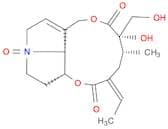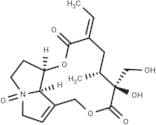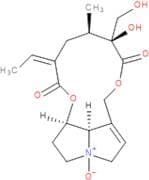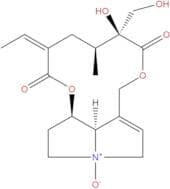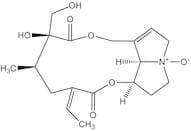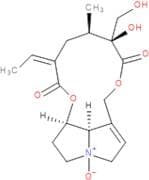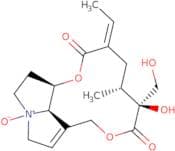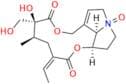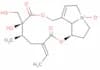
CAS 15503-86-3
:Retrorsin, N-oxid
- (1,6)Dioxacyclododecino(2,3,4-gh)pyrrolizine-2,7-dione, 3-ethylidene-3,4,5,6,9,11,13,14,14a,14b-decahydro-6-hydroxy-6-(hydroxymethyl)-5-methyl-, 14-oxide, (3Z,5R,6S,14aR,14bR)-
- (5R,6S,14aR)-3-ethylidene-6-hydroxy-6-(hydroxymethyl)-5-methyl-3,4,5,6,9,11,13,14,14a,14b-decahydro[1,6]dioxacyclododecino[2,3,4-gh]pyrrolizine-2,7-dione 12-oxide
- (5R,6S,14aR,14bR)-3-ethylidene-6-hydroxy-6-(hydroxymethyl)-5-methyl-3,4,5,6,9,11,13,14,14a,14b-decahydro[1,6]dioxacyclododecino[2,3,4-gh]pyrrolizine-2,7-dione 12-oxide
- 12,18-Dihydroxysenecionan-11,16-dione 4-oxide
- Brn 0058804
- Ccris 4339
- Hsdb 3499
- Isatidine
- Retrorsine N-oxide
- Retrorsine oxide
- Senecionan-11,16-dione, 12,18-dihydroxy-, 4-oxide
- Senecionan-11,16-dione, 12,18-dihydroxy-, 4-oxide (9CI)
- [1,6]Dioxacyclododecino[2,3,4-gh]pyrrolizine-2,7-dione, 3-ethylidene-3,4,5,6,9,11,13,14,14a,14b-decahydro-6-hydroxy-6-(hydroxymethyl)-5-methyl-, 12-oxide, (3Z,5R,6S,14aR,14bR)-
- cis-Retronecic acid ester of retronecine-N-oxide
- trans-15-Ethylidene-12beta-hydroxy-12alpha-hydroxymethyl-13beta-methylsenec-1-enine-4-oxide
- Weitere Synonyme anzeigen
Retrorsine N-oxide
CAS:Isatidine is a pyrrolizidine alkaoid.Formel:C18H25NO7Farbe und Form:SolidMolekulargewicht:367.40Retrorsine-N-oxide 100 µg/mL in Water
CAS:Kontrolliertes ProduktFormel:C18H25NO7Farbe und Form:Single SolutionMolekulargewicht:367.39Retrorsine n-oxide
CAS:Natural alkaloidFormel:C18H25NO7Reinheit:≥ 95.0 % (HPLC)Farbe und Form:PowderMolekulargewicht:367.4Retrorsine N-Oxide
CAS:Stability Hygroscopic
Applications Retrorsine N-oxide is a pyrrolizidine alkaloid that is naturally found in Senecio isatideus, a flowering plant that is native to the Netherlands. Retrorsine N-oxide is also known to raise blood pressure and can induce abnormal changes in the liver if ingested by animals or humans.
Not a dangerous good if item is equal to or less than 1g/ml and there is less than 100g/ml in the package
References Cooper, R.: Trop. Anim. Health Pro., 39, 439 (2007); Mattocks, A.: Xenobiotica, 1, 563 (1971); Neumann, C. & Boland, W.: Helv. Chim. Acta, 73, 754 (1990); Vera, R., et al.: J. Essent. Oil Res., 6, 21 (1994)Formel:C18H25NO7Farbe und Form:NeatMolekulargewicht:367.39Retrorsine N-oxide
CAS:Retrorsine N-oxide is a synthetic pyrrolizidine alkaloid derivative, which is meticulously synthesized in the laboratory. It originates from the structural modification of naturally occurring alkaloids found in certain plant species of the Senecio genus. The mode of action of Retrorsine N-oxide involves its biotransformation into reactive intermediates that form adducts with cellular macromolecules, particularly within the liver. These interactions result in the inhibition of cellular division and protein synthesis, significantly affecting hepatocyte function.
Formel:C18H25NO7Reinheit:Min. 95%Farbe und Form:PowderMolekulargewicht:367.39 g/mol