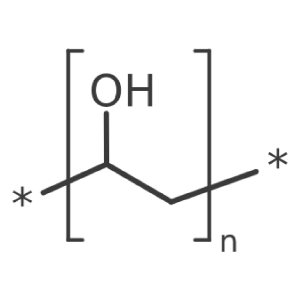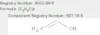
CAS 9002-89-5
:Poly(vinylalkohol)
Beschreibung:
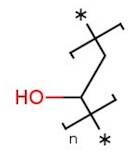
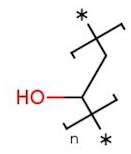
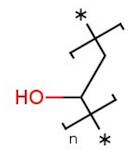
Poly(vinylalkohol) (PVA) ist ein synthetisches Polymer, das durch seine Wasserlöslichkeit, Biokompatibilität und filmformenden Eigenschaften gekennzeichnet ist. Es wird durch die Hydrolyse von Poly(vinylacetat) hergestellt und ist bekannt für seine hervorragende Haftung, Flexibilität und Beständigkeit gegen Öle und Fette. PVA wird typischerweise in verschiedenen Anwendungen eingesetzt, einschließlich Klebstoffen, Beschichtungen und Folien, aufgrund seiner Fähigkeit, starke Wasserstoffbrücken mit Wassermolekülen zu bilden, was seine Löslichkeit erhöht. Der Grad der Hydrolyse und das Molekulargewicht können seine Eigenschaften wie Viskosität und mechanische Festigkeit erheblich beeinflussen. PVA ist auch biologisch abbaubar, was es zu einer umweltfreundlichen Option in vielen Anwendungen macht. Darüber hinaus zeigt es eine gute thermische Stabilität und kann modifiziert werden, um seine Eigenschaften für spezifische Anwendungen zu verbessern, wie in biomedizinischen Anwendungen oder als Bestandteil in Verbundmaterialien. Insgesamt ist PVA ein vielseitiges Polymer mit einer breiten Palette von industriellen und kommerziellen Anwendungen.
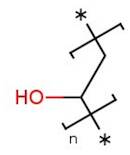
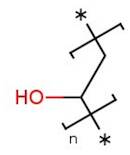
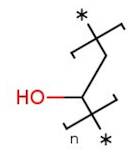
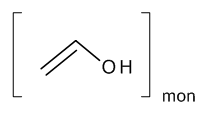
Formel:(C2H4O)x
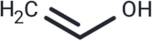
InChl:InChI=1S/C2H4O/c1-2-3/h2-3H,1H2
InChI Key:InChIKey=IMROMDMJAWUWLK-UHFFFAOYSA-N
SMILES:C(=C)O
Synonyme:- 100-27H
- 100-37H
- 100-40H
- 1799S
- 1R2110
- 22-99H
- 9P75R
- 9X75Rs
- 9X75Sr
- Alvyl
- Bijam+
- Bovlon
- CST
- Claria
- Clinicel
- Covol
- Duslo
- Elvanol
- Fiberol
- Fibrilbond
- Fsam-H
- Gelutol
- Gelvatol
- Gh-Jy
- Gohsenol
- Kuragel
- Lemol
- LentiKats
- Liquifilm
- Merocel
- Microbreath
- Mowibase
- Mowiol
- PPL
- PVA
- PVS
- Polydesis
- Polyvinol
- Polyvinylalkohol
- Polyviol
- Poval
- PualCob
- Pva-Cst
- Pva-Ec
- Pva-H
- Pva-Hc
- Pva-Ld
- Pva-Sm
- Pva-Sn
- Pva-Uv
- Pvoh
- Px-CVG
- Px-CVR
- Rhodoviol
- SI
- TTF
- Vf-Hp
- Vf-Lh
- Vf-Pm
- Vf-Ps
- Vf-Px
- Vf-Xh
- Vf-Xs
- Vinalak
- Vinarol
- Vinol
- Wash-A-Way
- Winacol
- Lemol 5-98
- Vinyl alcohol, polymers
- Lemol 5-88
- Ethenol, homopolymer
- Weitere Synonyme anzeigen
Filtern nach
Reinheitsanteil
0
100
|
0
|
50
|
90
|
95
|
100
- Niedrigster Preis
- Höchster Preis
- Niedrigste Reinheit
- Höchste Reinheit
- Schnellste Lieferung
Poly(vinyl Alcohol) (n=approx. 2000) (degree of saponification ca. 80mol%)
CAS:Farbe und Form:White to Light yellow powder to crystalPolyvinyl alcohol, 98-99% hydrolyzed, high molecular weight
CAS:Polyvinyl alcohol is used in food industries as a binding and coating agent. Its viscosity favors the application as coating agent to tablets and capsules. Mixed-matrix membrane prepared by dispersion of NaA zeolite particles is used to study the pervaporative separation of water-butanol mixtures.Formel:(C2H4O)nReinheit:98-99%Farbe und Form:Granular powder, Pale creamPolyvinyl alcohol, 87-89% hydrolyzed, high molecular weight
CAS:Polyvinyl alcohol is used as a biological reagent to test the dispersion of zinc oxide nanoparticles. It is an effective protein resistant material and is used to stabilize gold colloids of diameter 3-8nm. It is used as an emulsion polymerization aid to make polyvinyl acetate, as a protective colloiFormel:(C2H4O)nReinheit:87-89%Farbe und Form:White to off-white, Powder or crystals or crystalline powder or granulesPolyvinyl alcohol, 86-89% hydrolyzed, medium molecular weight
CAS:Polyvinyl alcohol is used as a biological reagent to test the dispersion of zinc oxide nanoparticles. It is an effective protein resistant material and is used to stabilize gold colloids of diameter 3-8nm. It is used as an emulsion polymerization aid to make polyvinyl acetate, as a protective colloiFormel:(C2H4O)nReinheit:86-89%Farbe und Form:White to off-white, PowderPolyvinyl alcohol, 98-99% hydrolyzed, medium molecular weight
CAS:Polyvinyl alcohol is used in papermaking, textiles, and in a variety of coatings. It is used as an emulsion polymerization aid to make polyvinyl acetate, as a protective colloid, as a film used in the water transfer printing process, as a surfactant for the formation of polymer encapsulated nanobeadFormel:(C2H4O)nReinheit:98-99%Farbe und Form:Powder, Whit to off-white to creamPolyvinyl alcohol, 86-89% hydrolyzed, low molecular weight
CAS:Polyvinyl alcohol is used as a biological reagent to test the dispersion of zinc oxide nanoparticles. It is an effective protein resistant material and is used to stabilize gold colloids of diameter 3-8nm. It is used as an emulsion polymerization aid to make polyvinyl acetate, as a protective colloiFormel:(C2H4O)nReinheit:86-89%Farbe und Form:White to pale yellow, Granular powderPolyvinyl alcohol, 98-99% hydrolyzed, low molecular weight
CAS:Polyvinyl alcohol is used as a biological reagent to test the dispersion of zinc oxide nanoparticles. It is an effective protein resistant material and is used to stabilize gold colloids of diameter 3-8nm. It is used as an emulsion polymerization aid to make polyvinyl acetate, as a protective colloiFormel:(C2H4O)nReinheit:98-99%Farbe und Form:Granular powder, WhiteVinyl Alcohol Homopolymer 60000
CAS:Polyvinyl alcohols, whether or not containing unhydrolyzed acetate groupsFormel:(C2H4O)nFarbe und Form:White GranularPolyvinyl Alcohol
CAS:Polyvinyl alcohols, whether or not containing unhydrolyzed acetate groupsFormel:H(C2H4O)m(C4H6O2)nHFarbe und Form:PowderMolekulargewicht:46.0684Poly Vinyl Alcohol
CAS:Poly Vinyl AlcoholFormel:(C2H4O)xReinheit:≥95%Farbe und Form:SolidMolekulargewicht:44.05Polyvinyl Alcohol (PVA)
CAS:Formel:C2H4OnFarbe und Form:White To Off-White SolidMolekulargewicht:86000 (average)Polyvinyl Alcohol
CAS:Kontrolliertes ProduktApplications Polyvinyl Alcohol is a useful research chemical. Polyvinyl Alcohol/ZnS composite films are used as nanocatalyst for organ dye degradation.
References Khan, R., et al.: ACS Omega, 4, 6144 (2019)Formel:(C2H4O)nFarbe und Form:NeatMolekulargewicht:44.05Poly Vinyl Alcohol
CAS:Polyvinyl alcohol: water-soluble, biodegradable polymer; used for biomedical applications and medical excipients.Formel:(C2H4O)nReinheit:98%Farbe und Form:White SolidMolekulargewicht:30000-70000 (Average)