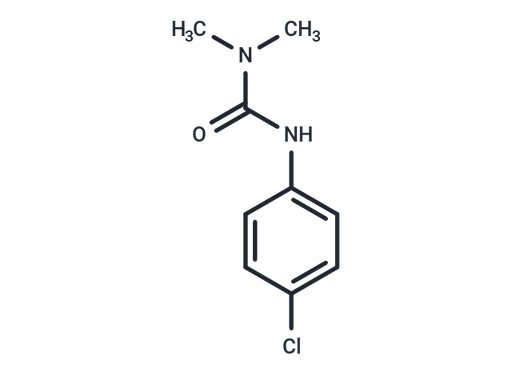
CAS 150-68-5
:3-(4-Clorofenil)-1,1-dimetilurea
Descripción:
3-(4-Clorofenil)-1,1-dimetilurea, comúnmente conocido como diurón, es un compuesto químico con la fórmula molecular C9H10ClN2O. Se caracteriza por su forma sólida cristalina blanca y se utiliza principalmente como herbicida en aplicaciones agrícolas para controlar una variedad de malezas. El diurón funciona inhibiendo la fotosíntesis en las plantas, dirigiéndose específicamente al complejo del fotosistema II. El compuesto es moderadamente soluble en agua y exhibe propiedades lipofílicas, lo que le permite penetrar eficazmente en los tejidos vegetales. Su estabilidad bajo diversas condiciones ambientales lo convierte en un herbicida de uso común, aunque está sujeto a un escrutinio regulatorio debido a los posibles impactos ambientales y la toxicidad para los organismos acuáticos. El diurón tiene una presión de vapor relativamente baja, lo que indica una volatilidad limitada, y puede persistir en el suelo y el agua, lo que genera preocupaciones sobre sus efectos ecológicos a largo plazo. Se recomiendan medidas de seguridad al manipular esta sustancia, ya que puede representar riesgos para la salud si se ingiere o inhala.
Fórmula:C9H11ClN2O
InChI:InChI=1S/C9H11ClN2O/c1-12(2)9(13)11-8-5-3-7(10)4-6-8/h3-6H,1-2H3,(H,11,13)
Clave InChI:InChIKey=BMLIZLVNXIYGCK-UHFFFAOYSA-N
SMILES:N(C(N(C)C)=O)C1=CC=C(Cl)C=C1
Sinónimos:- 1,1-Dimethyl-3-(4-chlorophenyl)urea
- 1,1-Dimethyl-3-(p-chlorophenyl)urea
- 1-(4-Chloro phenyl)-3,3-dimethyluree
- 1-(4-Chlorophenyl)-3,3-Dimethyluree
- 1-(4-Chlorophenyl)-3,3-Dimethyluree(French)
- 1-(4-Chlorophenyl)-3,3-dimethylurea
- 1-(p-Chlorophenyl)-3,3-dimethylurea
- 3-(4-Chlorophenyl)-1,1-dimethylurea
- 3-(p-Chlorophenyl)-1,1-dimethylurea
- CMU
- Chlorfenidim
- Karmex Monuron Herbicide
- Karmex W. monuron herbicide
- Monurex
- Monuron
- N,N-Dimethyl-N'-(4-chlorophenyl)urea
- N-(4-Chlorophenyl)-N,N'-Dimethylurea
- N-(p-Chlorophenyl)-N',N'-dimethylurea
- Nsc 8949
- Telvar
- Telvar Monuron Weedkiller
- Telvar W. monuron weedkiller
- Telvar(R)
- Urea, 3-(p-chlorophenyl)-1,1-dimethyl-
- Ver más sinónimos
Filtrar por
Porcentaje de pureza
0
100
|
0
|
50
|
90
|
95
|
100
Se han encontrado 12 productos.
- Precio más bajo
- Precio más alto
- Pureza más baja
- Pureza más alta
- Entrega estimada más rápida
3-(4-Chlorophenyl)-1,1-dimethylurea
CAS:Producto controladoFórmula:C9H11ClN2OPureza:>95.0%(HPLC)(N)Forma y color:White to Almost white powder to crystalPeso molecular:198.653-(4-Chlorophenyl)-1,1-dimethylurea
CAS:Producto controlado3-(4-Chlorophenyl)-1,1-dimethylureaPureza:>95.0%(HPLC)(N)Peso molecular:198.6499939Monuron
CAS:Producto controladoMonuron ,with CAS No. 150-68-5, is a fragment molecule that serves as an important scaffold for molecular linking, expansion, and modification. Monuron provides a structural basis and research tool for the design and screening of novel drug candidates, and is commonly used in drug discovery, drug synthesis, and related research.Fórmula:C9H11ClN2OPureza:98%Peso molecular:198.649LC PestiMix 1 10 µg/mL in Acetonitrile
CAS:Producto controlado- 1014-70-6
- 101463-69-8
- 10265-92-6
- 107534-96-3
- 110235-47-7
- 110488-70-5
- 1113-02-6
- 112226-61-6
- 112410-23-8
- 1129-41-5
- 116-06-3
- 118134-30-8
- 119-12-0
- 119168-77-3
- 121-75-5
- 121552-61-2
- 122-42-9
- 13071-79-9
- 13171-21-6
- 131807-57-3
- 131860-33-8
- 134-62-3
- 13457-18-6
- 135410-20-7
- 13593-03-8
- 13684-56-5
- 138261-41-3
- 140923-17-7
- 141517-21-7
- 148-79-8
- 150-68-5
- 153233-91-1
- 153719-23-4
- 1563-66-2
- 1610-17-9
- 1610-18-0
- 161050-58-4
- 1646-88-4
- 1698-60-8
- 173584-44-6
- 188425-85-6
- 1912-24-9
- 1982-49-6
- 2032-65-7
- 21725-46-2
- 2275-23-2
- 22781-23-3
- 2310-17-0
- 23103-98-2
- 2312-35-8
- 23505-41-1
- 24017-47-8
- 2595-54-2
- 2597-03-7
- 2631-37-0
- 28249-77-6
- 29232-93-7
- 297-97-2
- 29973-13-5
- 30125-63-4
- 311-45-5
- 31218-83-4
- 315-18-4
- 330-55-2
- 3383-96-8
- 34014-18-1
- 35554-44-0
- 3689-24-5
- 41198-08-7
- 41814-78-2
- 51-03-6
- 51707-55-2
- 52888-80-9
- 55179-31-2
- 55219-65-3
- 57018-04-9
- 57966-95-7
- 5915-41-3
- 59669-26-0
- 6190-65-4
- 63-25-2
- 63284-71-9
- 66332-96-5
- 6923-22-4
- 69327-76-0
- 6988-21-2
- 71626-11-4
- 7286-69-3
- 7287-19-6
- 732-11-6
- 78587-05-0
- 80844-07-1
- 83164-33-4
- 834-12-8
- 84087-01-4
- 841-06-5
- 85509-19-9
- 87130-20-9
- 886-50-0
- 88671-89-0
- 950-35-6
- 950-37-8
- 95737-68-1
Forma y color:MixtureMonuron 100 µg/mL in Acetonitrile
CAS:Producto controladoFórmula:C9H11ClN2OForma y color:Single SolutionPeso molecular:198.65Monuron 10 µg/mL in Acetonitrile
CAS:Producto controladoFórmula:C9H11ClN2OForma y color:Single SolutionPeso molecular:198.65Monuron in Acetonitrile
CAS:Producto controladoAcetonitrileFórmula:C9H11ClN2OForma y color:White solid; [CAMEO]Peso molecular:198.65Monuron in Acetone
CAS:Producto controladoAcetoneFórmula:C9H11ClN2OForma y color:White solid; [CAMEO]Peso molecular:198.65Monuron
CAS:Producto controladoMonuron is an herbicide that is used to control weeds in crops, pastures, and other agricultural settings. It inhibits cell division by binding to the dinucleotide phosphate (DNP) site on the enzyme ribonucleotide reductase. Monuron inhibits the conversion of DNP and DAP into ribonucleotides, which are necessary for DNA synthesis. Monuron has been shown to be carcinogenic in rats and mice in several studies. This may be due to its ability to inhibit DNA synthesis by preventing the uptake of amino acids into cells, which prevents protein synthesis and cell division. The mechanism of action of Monuron is similar to that of other plant growth regulators such as 2,4-Dichlorophenoxyacetic acid which also causes cancerous changes in cells.END>
Fórmula:C9H11ClN2OPureza:Min. 95%Forma y color:White/Off-White SolidPeso molecular:198.65 g/mol