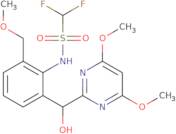
![N-{2-[(4,6-dimethoxypyrimidin-2-yl)(hydroxy)methyl]-6-(methoxymethyl)phenyl}-1,1-difluoromethanesu…](https://static.cymitquimica.com/cas-image/thumb-webp/392738-n-2-46-dimethoxypyrimidin-2-yl-hydroxy-methyl-6-methoxymethyl-phenyl-11-difluoromethanesulfonamide.webp)
CAS 221205-90-9
:N-{2-[(4,6-dimetoxipirimidin-2-il)(hidroxi)metil]-6-(metoximetil)fenil}-1,1-difluorometanosulfonamida
Descripción:
N-{2-[(4,6-dimetoxipirimidin-2-il)(hidroxi)metil]-6-(metoximetil)fenil}-1,1-difluorometanosulfonamida es un compuesto orgánico complejo caracterizado por sus características estructurales únicas, que incluyen un anillo de pirimidina y un grupo funcional sulfonamida. La presencia de múltiples grupos metoxi contribuye a su solubilidad y potencial reactividad, mientras que la porción difluorometanosulfonamida puede mejorar su actividad biológica. Este compuesto probablemente exhibirá interacciones específicas con objetivos biológicos, lo que lo hace de interés en la química medicinal, particularmente en el desarrollo de fármacos. Su estructura molecular sugiere aplicaciones potenciales en áreas como la inhibición enzimática o como agente terapéutico. Además, la presencia de grupos hidroximetilo y difluorometilo puede influir en sus propiedades farmacocinéticas, incluyendo absorción, distribución, metabolismo y excreción. En general, este compuesto ejemplifica el diseño intrincado que a menudo se encuentra en el desarrollo de medicamentos, donde las modificaciones en el marco molecular pueden impactar significativamente la eficacia biológica y los perfiles de seguridad.
Fórmula:C16H19F2N3O6S
InChI:InChI=1/C16H19F2N3O6S/c1-25-8-9-5-4-6-10(13(9)21-28(23,24)16(17)18)14(22)15-19-11(26-2)7-12(20-15)27-3/h4-7,14,16,21-22H,8H2,1-3H3
Clave InChI:NTBVTCXMRYKRTB-UHFFFAOYSA-N
SMILES:COCc1cccc(c1NS(=O)(=O)C(F)F)C(c1nc(cc(n1)OC)OC)O
Sinónimos:- 221205-90-9
Filtrar por
Porcentaje de pureza
0
100
|
0
|
50
|
90
|
95
|
100
Se han encontrado 5 productos.
- Precio más bajo
- Precio más alto
- Pureza más baja
- Pureza más alta
- Entrega estimada más rápida
LC PestiMix 9 10 µg/mL in Acetonitrile
CAS:Producto controlado- 1003318-67-9
- 1031756-98-5
- 104273-71-4
- 105779-78-0
- 1072957-71-1
- 1101132-67-5
- 1207727-04-5
- 121451-02-3
- 1220411-29-9
- 1228284-64-7
- 1229654-66-3
- 123572-88-3
- 1255734-28-1
- 1263133-33-0
- 130561-48-7
- 135186-78-6
- 1352994-67-2
- 1383809-87-7
- 1390661-72-9
- 140163-89-9
- 1417782-03-6
- 1472649-01-6
- 147411-69-6
- 1486617-22-4
- 156963-66-5
- 158237-07-1
- 162320-67-4
- 168088-61-7
- 173662-97-0
- 188489-07-8
- 200509-41-7
- 221205-90-9
- 224049-04-1
- 238410-11-2
- 256412-89-2
- 283159-90-0
- 330459-31-9
- 337458-27-2
- 352010-68-5
- 366815-39-6
- 42835-25-6
- 447399-55-5
- 473278-76-1
- 473798-59-3
- 494793-67-8
- 500207-04-5
- 517875-34-2
- 56073-07-5
- 5836-29-3
- 68049-83-2
- 688046-61-9
- 704886-18-0
- 799247-52-2
- 81-81-2
- 81-82-3
- 81334-34-1
- 81777-95-9
- 82692-44-2
- 847749-37-5
- 850881-70-8
- 862588-11-2
- 874195-61-6
- 874967-67-6
- 875915-78-9
- 881685-58-1
- 882182-49-2
- 902760-40-1
- 907204-31-3
- 911499-62-2
- 915972-17-7
- 926914-55-8
- 943831-98-9
Forma y color:MixturePyrimisulfan
CAS:Pyrimisulfan is a medicinal compound that has shown potent anticancer activity in both human and Chinese hamster cancer cell lines. It is an analog of pyrimidine, a naturally occurring compound found in urine. Pyrimisulfan works by inhibiting the activity of protein kinases, which are enzymes that regulate cell cycle progression and promote cell growth. This inhibition leads to apoptosis, or programmed cell death, in cancer cells. Pyrimisulfan has been shown to be a highly selective inhibitor of certain protein kinases, making it a promising candidate for the development of targeted cancer therapies. Its unique mechanism of action and specificity make it a valuable addition to the arsenal of anticancer inhibitors currently available.
Fórmula:C16H19F2N3O6SPureza:Min. 95%Peso molecular:419.4 g/molPyrimisulfan
CAS:Pyrimisulfan is a highly effective acetolactate synthase (ALS) inhibitor and a broad-spectrum herbicide. It selectively inhibits the acetolactate synthase in plants and is used for controlling a variety of paddy field weeds both pre-emergence and post-emergence, including annual grasses, sedges, broadleaf weeds, and sulfonylurea-resistant biotypes. Pyrimisulfan offers long residual activity and excellent safety for rice crops, and it is suitable for research related to paddy field herbicides.Fórmula:C16H19F2N3O6SPeso molecular:419.40