Asociado a microtúbulos
Los inhibidores de proteínas asociadas a microtúbulos se dirigen a proteínas que interactúan con los microtúbulos, los componentes estructurales del citoesqueleto de la célula, esenciales para la división celular. Estas proteínas regulan la estabilidad y la dinámica de los microtúbulos durante la mitosis. Inhibir las proteínas asociadas a microtúbulos puede interrumpir la función de los microtúbulos, lo que lleva al arresto del ciclo celular y la apoptosis, particularmente en células cancerosas de rápida división. Estos inhibidores se utilizan ampliamente en la investigación del cáncer y el desarrollo de fármacos. En CymitQuimica, ofrecemos una amplia gama de inhibidores de proteínas asociadas a microtúbulos de alta calidad para apoyar su investigación en división celular, dinámica del citoesqueleto y terapia contra el cáncer.
Se han encontrado 283 productos de "Asociado a microtúbulos"
Ordenar por
Pureza (%)
0
100
|
0
|
50
|
90
|
95
|
100
Monomethyl auristatin E intermediate-17
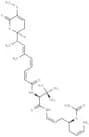
CAS:MonomethylauristatinE intermediate-17 is an intermediate compound used in the synthesis of MonomethylauristatinE. MonomethylauristatinE (MMAE) functions as a microtubule/tubulin inhibitor with anticancer properties. It is widely utilized as the cytotoxic component in antibody-drug conjugates (ADCs).Fórmula:C27H35NO7SPeso molecular:517.63PROTAC α-synuclein degrader 6
CAS:PROTACα-synuclein degrader 6 (compound T3) is a PROTAC degrader of α-synuclein and tau, with an EC50 of 1.57 μM and 4.09 μM, respectively. This compound plays a significant role in neurodegenerative disease (ND) research.
Fórmula:C37H39N5O9SPeso molecular:729.80PM-060184
CAS:PM-060184, a tubulin polymerisation inhibitor, is used potentially for the treatment of solid tumours and breast cancer.Fórmula:C31H45N3O7Pureza:98%Forma y color:SolidPeso molecular:571.7Tubulin polymerization-IN-32
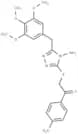
Tubulin polymerization-IN-32: a cancer cell growth inhibitor used for research in cancers like lymphoma.Fórmula:C29H30N2O7Forma y color:SolidPeso molecular:518.56Tubulin polymerization-IN-8
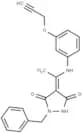
CAS:Compound IIc inhibits tubulin polymerization, arrests cell cycle at G2/M in HCT116 cells, IC50 12.7 μM, potential for cancer research.Fórmula:C21H24N4O4SForma y color:SolidPeso molecular:428.5Utrophin modulator 1
UM1 upregulates utrophin, has EC50 of 0.11 μM, useful in DMD research.Fórmula:C22H18N6OForma y color:SolidPeso molecular:382.42Antitubulin agent 1
Antitubulin agents-1 disrupts microtubules, ups α-tubulin acetylation, and has anticancer properties.Fórmula:C21H19N3O3Forma y color:SolidPeso molecular:361.39OXS007417
OXS007417 induces AML cell differentiation at 48 nM EC50 and shows potent in vivo antitumor effects.Fórmula:C20H14F3N3OForma y color:SolidPeso molecular:369.34Epothilone E
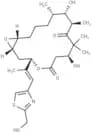
CAS:Epothilone E, a derivative of epothilone, functions by inhibiting microtubule protein activity, thereby halting cell division and exhibiting anti-tumorFórmula:C26H39NO7SForma y color:SolidPeso molecular:509.66JC168
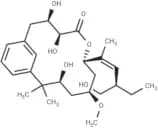
CAS:JC168 is a phenyl analog of peloruside and functions as a microtubule inhibitor with antiproliferative and anticancer properties. It enhances tubulin polymerization, thereby disrupting microtubule dynamics, making it a useful agent in the study of microtubule-associated diseases.Fórmula:C26H40O7Forma y color:SolidPeso molecular:464.592AMXI-5001 hydrochloride
AMXI-5001 hydrochloride, an oral inhibitor of PARP1/2 and microtubules, shows greater potency and selective anti-cancer effects.Fórmula:C25H21ClFN5O3Forma y color:SolidPeso molecular:493.92Tubulin polymerization-IN-35
Tubulin-IN-35 inhibits oxazolylisoindole microtubule formation, targeting VL51 marginal zone lymphoma.Fórmula:C31H35N3O5Forma y color:SolidPeso molecular:529.63Tau ligand-1
CAS:Tau ligand-1 (Compound 75) is a ligand of aggregated tau protein that can penetrate the blood-brain barrier. In tissues affected by Alzheimer's disease, progressive supranuclear palsy, corticobasal degeneration, and Pick's disease, Tau ligand-1 shows high affinity for aggregated tau protein, with equilibrium dissociation constants (KD) ranging from 1 to 3.8 nM. It holds potential as a positron emission tomography (PET) tracer for imaging studies of tau-related diseases within the central nervous system.Fórmula:C17H16FN3OForma y color:SolidPeso molecular:297.327TTBK1/2-IN-1
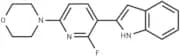
CAS:TTBK1/2-IN-1 (compound 3) is a potent inhibitor of Tau tubulin kinase 1 (TTBK1) and TTBK2, with IC50 values of 816 nM and 384 nM, respectively.Fórmula:C17H16N4OForma y color:SolidPeso molecular:292.335Icafolin-methyl
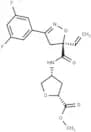
CAS:Icafolin-methyl is a plant-specific herbicide that acts as an inhibitor of tubulin polymerization. In plants, it metabolizes into the carboxylic acid icafolin, potentially inhibiting plant tubulin polymerization by binding to β-tubulin.Fórmula:C18H18F2N2O5Forma y color:SolidPeso molecular:380.343Tubulin polymerization-IN-75
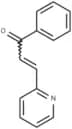
CAS:Tubulin polymerization-IN-75 (Compound 6) is an inhibitor of tubulin polymerization, with an IC50 value of 30 μM. It effectively suppresses the proliferation of cancer cells Huh7 and 293T, demonstrating IC50 values of 14.3 μM and 13.8 μM, respectively.Fórmula:C14H11NOForma y color:SolidPeso molecular:209.243Tubulin inhibitor 15
Tubulin inhibitor 15 is a potent tubulin inhibitor with antiproliferative activity. Tubulin inhibitor 15 exhibits cytotoxicity in HepG2 cells [1].Fórmula:C16H12FNO2Forma y color:SolidPeso molecular:269.27Dictyostatin
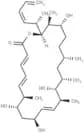
CAS:Dictyostatin: potent microtubule stabilizer & anticancer agent with antiproliferative effects; researched for tauopathies.Fórmula:C32H52O6Forma y color:SolidPeso molecular:532.75AMG28
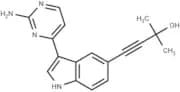
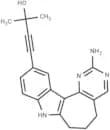
CAS:AMG28 is an inhibitor of Tau tubulin kinase 1 (TTBK1) and TTBK2, with IC50 values of 805 nM and 988 nM, respectively. Additionally, AMG28 suppresses the phosphorylation of tau protein at the Ser422 site, with an IC50 of 1.85 μM.Fórmula:C20H20N4OForma y color:SolidPeso molecular:332.399