Building Blocks
Subcategorías de "Building Blocks"
- Ácidos borónicos y derivados del ácido borónico(5.780 productos)
- Building Blocks quirales(1.240 productos)
- Building Blocks de hidrocarburos(6.100 productos)
- Building Blocks orgánicos(61.009 productos)
Se han encontrado 205248 productos de "Building Blocks"
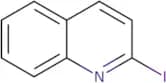
2-Iodoquinoline
CAS:2-Iodoquinoline is a quinoline derivative that has been shown to be a potent inhibitor of the uptake of amyloid protein in vitro. 2-Iodoquinoline is also able to inhibit the growth of cancer cells and induce apoptosis. The mechanism by which 2-Iodoquinoline inhibits tumor cell growth may be due to its ability to activate epidermal growth factor receptor (EGFR). This compound has also been shown to stimulate epidermal growth through the activation of EGFR and other signaling pathways, such as phosphatidylinositol 3 kinase (PI3K) and mitogen-activated protein kinase (MAPK).
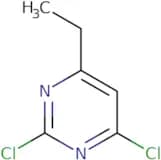
Fórmula:C9H6INPureza:Min. 95%Peso molecular:255.06 g/mol2,4-dichloro-6-ethylpyrimidine
CAS:Versatile small molecule scaffold
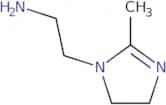
Fórmula:C6H6Cl2N2Pureza:Min. 95%Peso molecular:177 g/mol2-(2-Methyl-4,5-dihydro-1H-imidazol-1-yl)ethan-1-amine
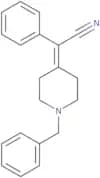
CAS:2-(2-Methyl-4,5-dihydro-1H-imidazol-1-yl)ethan-1-amine is an organic compound that has been used as a catalyst. It crystallizes in the triclinic system and exhibits high catalytic activity. The hydrothermal synthesis of 2-(2,4,5-trimethylphenyl)-N,N′,N″,N″′-[2(2,4,5-trimethylphenyl)ethenyl]-tetrahedrane (Cp*TiMe3) was achieved by using diethylenetriamine (DETA) as a starting material. This product catalyzes the cyclization of acetaldehyde to form benzaldehyde with high catalytic activity. The probe 2-(2,4,5-trimethylphenyl)-N,N′-[2(2,4,5-trimethylphenylFórmula:C6H13N3Pureza:Min. 95%Peso molecular:127.19 g/mol2-(1-Benzylpiperidin-4-ylidene)-2-phenylacetonitrile
CAS:Versatile small molecule scaffold
Fórmula:C20H20N2Pureza:Min. 95%Peso molecular:288.4 g/molL-152,804
CAS:L-152,804 is a potent inhibitor of the dopamine receptor. It has been shown to have an inhibitory effect on wild-type mice and functional assays in vitro. L-152,804 inhibits locomotor activity in wild type mice and increases energy metabolism in adipose tissue. L-152,804 binds to the dopamine receptor by competitive inhibition and inhibits the binding of glutamate and dopamine to the receptor. This drug has also been shown to have anti-inflammatory effects in a rat model of arthritis.
Fórmula:C23H26O4Pureza:Min. 95%Peso molecular:366.46 g/molRef: 3D-GAA50843
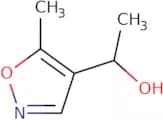
Producto descatalogado1-(5-Methyl-1,2-oxazol-4-yl)ethan-1-ol
CAS:Versatile small molecule scaffold
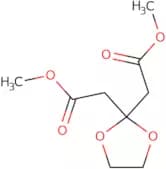
Fórmula:C6H9NO2Pureza:Min. 95%Peso molecular:127.14 g/molDimethyl 1,3-dioxolane-2,2-diacetate
CAS:Versatile small molecule scaffold
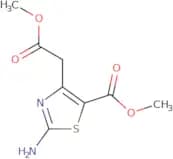
Fórmula:C9H14O6Pureza:Min. 95%Peso molecular:218.2 g/molMethyl 2-amino-4-(2-methoxy-2-oxoethyl)-1,3-thiazole-5-carboxylate
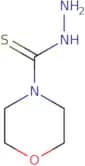
CAS:Versatile small molecule scaffoldFórmula:C8H10N2O4SPureza:Min. 95%Peso molecular:230.24 g/molN-Aminomorpholine-4-carbothioamide
CAS:N-Aminomorpholine-4-carbothioamide is a ligand that binds to the carboxylates of chloroform. It is produced by the enzyme subtilisin from the amino acid L-alanine and the compound 2-acetylpyridine. This ligand has been found in microorganisms such as Escherichia coli, Staphylococcus aureus, and Saccharomyces cerevisiae. N-Aminomorpholine-4-carbothioamide has been shown to be an effective inhibitor of yeast growth but not bacterial growth. The molecular weight of this ligand is 226.2 g mol−1 and it is a dimer at room temperature with two molecules linked together by hydrogen bonds.
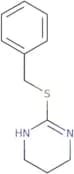
Fórmula:C5H11N3OSPureza:Min. 95%Peso molecular:161.23 g/mol2-(Benzylsulfanyl)-1,4,5,6-tetrahydropyrimidine
CAS:Versatile small molecule scaffoldFórmula:C11H14N2SPureza:Min. 95%Peso molecular:206.31 g/mol2-(4-Bromo-phenyl)-acetamidine hydrochloride
CAS:Versatile small molecule scaffold
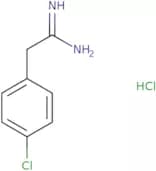
Fórmula:C8H10BrClN2Pureza:Min. 95%Peso molecular:249.53 g/mol4-Chlorobenzeneethanimidamide hydrochloride
CAS:Versatile small molecule scaffold
Fórmula:C8H10Cl2N2Pureza:Min. 95%Peso molecular:205.08 g/mol2-Methylquinazoline-4-thiol
CAS:2-Methylquinazoline-4-thiol is a heterocyclic compound with a thione group. Its amide groups are similar to those found in peptides, which play an important role in the coordination chemistry of the molecule. The 2-methylquinazoline-4-thiol skeleton is tetracyclic and can be used for synthetic purposes. This compound has been shown to have hepatoprotective properties, but also has cytotoxic effects on cells.
Fórmula:C9H8N2SPureza:Min. 95%Peso molecular:176.24 g/mol5-(3-Chloropropyl)-4-methyl-1,3-thiazole
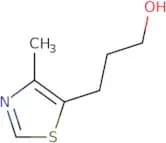
CAS:5-(3-Chloropropyl)-4-methyl-1,3-thiazole is a hydrophobic antibiotic that is used as a diluent in iontophoresis. It has been shown to have targetable properties and high concentrations when it is used in phase chromatography. 5-(3-Chloropropyl)-4-methyl-1,3-thiazole also serves as a fixative agent and can be used as a diagnostic tool for the detection of salicylic acid. This compound has been found to be insoluble at high concentrations, so it cannot be reconstituted with water.Fórmula:C7H10ClNSPureza:Min. 95%Peso molecular:175.68 g/mol3-(4-Methyl-1,3-thiazol-5-yl)propan-1-ol
CAS:Versatile small molecule scaffold
Fórmula:C7H11NOSPureza:Min. 95%Peso molecular:157.24 g/mol3-Phenylumbelliferone
CAS:3-Phenylumbelliferone is a coumarin derivative that is used as an antidiabetic drug. It is a competitive inhibitor of the enzyme phosphatase, which inactivates tyrosine kinase, and inhibits the formation of DOPA from L-tyrosine, resulting in inhibition of glucose uptake by cells. 3-Phenylumbelliferone also fluoresces at wavelengths of 340 nm when excited with ultraviolet light. This property has been shown to be helpful in the detection of phenylurea herbicides, polycyclic aromatic hydrocarbons, and other compounds.
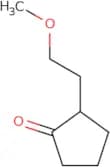
Fórmula:C15H10O3Pureza:Min. 95%Peso molecular:238.24 g/mol2-(2-Methoxyethyl)cyclopentan-1-one
CAS:Versatile small molecule scaffold
Fórmula:C8H14O2Pureza:Min. 95%Peso molecular:142.2 g/mol1-[(1-Aminopropan-2-yl)oxy]-3-methoxybenzene
CAS:Versatile small molecule scaffoldFórmula:C10H15NO2Pureza:Min. 95%Peso molecular:181.23 g/mol1-(o-Methoxyphenoxy)-2-propanone
CAS:1-(o-Methoxyphenoxy)-2-propanone is a guaifenesin precursor that is used as a supercritical solvent. It has been shown to liquefy benzyl groups, which are difficult to dissolve in other solvents. The 1-(o-methoxyphenoxy)-2-propanone molecule contains methoxy groups and benzyl groups, which are both susceptible to irradiation. The optimum irradiation time for the 1-(o-methoxyphenoxy)-2-propanone molecule was found to be about 15 hours at room temperature. This compound has high affinity values for gas chromatography/mass spectrometry parameters and can be reused up to ten times without significant change in its properties.
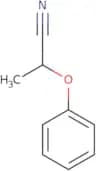
Fórmula:C10H12O3Pureza:Min. 95%Peso molecular:180.2 g/mol2-Phenoxypropanenitrile
CAS:2-Phenoxypropanenitrile is a hydrogen chloride derivate of an amide. It reacts with ethylene diamine to form 2-aminoethanol. This compound can be further reacted with sulfide to form the sulfide derivative, cysteamine. The reaction time for this process is between 10 and 20 hours at room temperature. 2-Phenoxypropanenitrile has been shown to inhibit tyrosine kinase and other enzymes that are important for cancer cell growth. This substance also has anti-inflammatory properties, which may be due to its ability to scavenge hydroxyl radicals and react with ROS (reactive oxygen species) such as hydrogen peroxide and superoxide anion radicals.
Fórmula:C9H9NOPureza:Min. 95%Peso molecular:147.17 g/mol






![1-[(1-Aminopropan-2-yl)oxy]-3-methoxybenzene](/_next/image/?url=https%3A%2Fstatic.cymitquimica.com%2Fproducts%2F3D%2Fthumb-webp%2FGAA44096.webp&w=3840&q=75)