Ácidos carboxílicos
Los ácidos carboxílicos son moléculas orgánicas caracterizadas por tener un grupo funcional de tipo carboxilo (-COOH). Estos ácidos son fundamentales en varias reacciones químicas, incluyendo esterificación, amidación y descarboxilación. Los ácidos carboxílicos se utilizan ampliamente en la producción de productos farmacéuticos, polímeros y agroquímicos. En esta sección, puede encontrar una gran cantidad de ácidos carboxílicos listos para ser utilizados. En CymitQuimica, ofrecemos una amplia gama de ácidos carboxílicos de alta calidad para apoyar sus aplicaciones de investigación e industriales.
Se han encontrado 12454 productos de "Ácidos carboxílicos"
Ordenar por
Pureza (%)
0
100
|
0
|
50
|
90
|
95
|
100
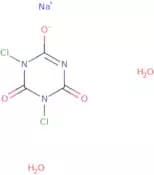
Dichloroisocyanuric acid sodium dihydrate
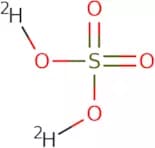
CAS:<p>Dichloroisocyanduric acid sodium salt (DCD) is a disinfectant that is used to control bacteria, fungi, and algae in wastewater treatment plants. DCD has been shown to be an effective antimicrobial agent against bacterial spores and the fungal plant pathogen "Botrytis cinerea" when used at concentrations of 0.1-0.3%. DCD also has a low toxicity for mammals, with LD50 values of 3.5g/kg for rats and 2g/kg for mice. The chemical stability of DCD can be increased by adding sodium carbonate or other alkaline substances in a neutral pH environment.</p>Fórmula:C3HCl2N3O3•(H2O)2•NaPureza:Min. 95%Forma y color:PowderPeso molecular:256.98 g/molDideuterosulfuric acid
CAS:Producto controlado<p>Dideuterosulfuric acid is a protonated molecule that is found in the tropone class of organic compounds. It has been shown to have optical properties similar to those of ferrocene, which is why it is often used as a replacement for this compound. Dideuterosulfuric acid has been studied extensively using a kinetic method with the goal of determining its mechanism and rate constants. Hydroxyl groups are found on the molecule's trifluoroacetic acid side chains, which may contribute to its reactivity with chloride ions and nitrogen atoms. Electrophotographic measurements show that hydrogen bonding occurs between molecules in dilute solutions.</p>Fórmula:D2SO4Pureza:Min. 95%Peso molecular:100.09 g/molRef: 3D-FD167508
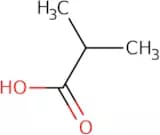
Producto descatalogadoIsobutyric acid
CAS:<p>Isobutyric acid is a short-chain carboxylic acid that has been shown to be a potent inhibitor of congestive heart failure. Isobutyric acid binds to the dinucleotide phosphate and is then hydrolyzed by glycol ethers to release isobutyric acid, which can induce vasodilation. The surface methodology used in this study revealed that Isobutyric acid inhibits the polymerase chain reaction activity of human DNA. This inhibition may be due to its structural similarity with mycobacterial sesquiterpene lactones, which have been shown to inhibit protein synthesis in human cells. Isobutyric acid also has antibacterial properties, and has been shown to have an activity index of 0.5 against methicillin-resistant Staphylococcus aureus (MRSA) isolates and erythromycin-resistant Mycobacterium avium complex isolates.</p>Fórmula:C4H8O2Pureza:Min. 95%Forma y color:Colorless Clear LiquidPeso molecular:88.11 g/molRef: 3D-FI46255
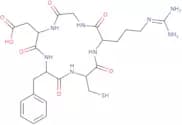
Producto descatalogadoCyclo(-Arg-Gly-Asp-D-Phe-Cys) acetate salt
CAS:<p>Cyclo(-Arg-Gly-Asp-D-Phe-Cys) acetate salt is a peptide that has been modified to be an active targeting agent. It is an amphipathic molecule that can be used to deliver therapeutic agents specifically to cancer cells. Cyclo(-Arg-Gly-Asp-D-Phe-Cys) acetate salt is conjugated to a drug and is taken up by cells through the process of endocytosis. Once inside the cell, the drug is released and binds with the cell membrane, which leads to cell death. The uptake of this peptide has been shown to be pH dependent; it is taken up more readily in acidic environments than in neutral or alkaline environments. This peptide has also been shown to have cytotoxic effects on both MFC7 cells and rat liver cells.</p>Fórmula:C24H34N8O7SPureza:Min. 95%Peso molecular:578.64 g/molRef: 3D-FC110008
Producto descatalogado4-Piperazinylphenylboronic acid, pinacol ester
CAS:<p>Please enquire for more information about 4-Piperazinylphenylboronic acid, pinacol ester including the price, delivery time and more detailed product information at the technical inquiry form on this page</p>Fórmula:C16H25BN2O2Pureza:Min. 95%Forma y color:PowderPeso molecular:288.19 g/molRef: 3D-FP160911
Producto descatalogadoPeptide YY (3-36) (human) trifluoroacetate salt
CAS:<p>Peptide YY (3-36) (human) trifluoroacetate salt H-Ile-Lys-Pro-Glu-Ala-Pro-Gly-Glu-Asp-Ala-Ser-Pro-Glu-Glu-Leu-Asn -Arg -Tyr -Tyr -Ala -Ser -Leu -Arg <br>Peptide YY (3.36) is a peptide hormone that is secreted by L cells in the small intestine and colon. It has been shown to be an effective treatment for obesity, type 2 diabetes, and other metabolic disorders. Peptide YY (3.36) has been shown to increase insulin sensitivity, reduce food intake and body weight, increase metabolic rate, and improve glucose homeostasis in animal studies. In humans, it has been found to have similar effects on postprandial plasma levels of peptide YY (3.</p>Fórmula:C180H279N53O54Pureza:Min. 95%Peso molecular:4,049.47 g/molRef: 3D-FP110326
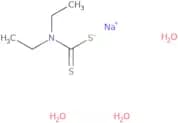
Producto descatalogadoDiethyldithiocarbamic acid sodium trihydrate
CAS:<p>Diethyldithiocarbamic acid sodium salt trihydrate (DDC) is an inhibitor of the response element that belongs to a class of pharmacological agents called diethyldithiocarbamates. DDC inhibits the growth of tumor cells by blocking enzyme activities and decreasing the production of GSH-Px enzymes, which are required for cellular protection against oxidative stress. DDC is also a potent inducer of experimental models for myocardial infarcts. The matrix effect is another mechanism by which DDC exerts its antitumor activity. This effect is due to its ability to inhibit protein synthesis in tumor cells and its ability to inhibit the synthesis of collagen in endothelial cells, thereby preventing angiogenesis.</p>Fórmula:C5H11NS2•Na•(H2O)3Pureza:Min. 95%Forma y color:PowderPeso molecular:226.32 g/molRef: 3D-FD21836
Producto descatalogadoPhosphomolybdic acid hydrate
CAS:<p>Phosphomolybdic acid hydrate is a molybdenum-containing compound that exhibits biological activity. It has been found to have an effect on water permeability and the biological sample, which can be detected by synchronous fluorescence. The electrochemical impedance spectroscopy can be used to measure the effects of phosphomolybdic acid hydrate on energy metabolism. This compound has also been shown to act as a catalyst in analytical methods, such as laser ablation, and can be used in a model system for hydrogen bonding interactions with zirconium oxide.</p>Fórmula:MoO3·H3PO4·xH2OPureza:Min. 95%Forma y color:Off-White To Dark Yellow SolidPeso molecular:1,825.49 g/molEndothelin-1 (human, bovine, dog, mouse, porcine, rat) acetate
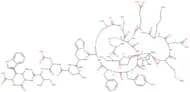
CAS:<p>Endothelin-1 (ET-1) is a peptide that is produced by the endothelium. ET-1 is involved in numerous biological processes, including vasoconstriction, inflammation, and cell proliferation. Endothelin-1 (human ET-1) acetate salt H-Cys-Ser-Cys-Ser-Ser-Leu-Met-Asp-Lys-(Glu)-Cys-(Val)-Tyr-(Phe)-Cys-(His)-Leu -Asp(-Ile)-Ile(-Trp)) acetate salt is a recombinant protein that has been shown to significantly upregulate the production of endothelin in primary pulmonary hypertension. It also plays an important role in bowel disease, where it may be involved in the development of chronic inflammatory bowel disease.</p>Fórmula:C109H159N25O32S5•(C2H4O2)xPureza:Min. 95%Peso molecular:2,491.91 g/molNaphthenic acid
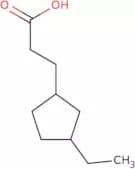
CAS:<p>Naphthenic acid is a metal chelate that is used in synchronous fluorescence spectroscopy. It has been shown to have biodegradation properties and can be used as an indicator for water quality. Naphthenic acid has been found to be a potent inhibitor of corrosion and is often used as an additive to petroleum products, such as gasoline, that are made from crude oil. Naphthenic acid also has acute toxicities and can cause toxicity studies on humans. It is able to inhibit energy metabolism in cells by binding to the mitochondrial membrane, which may be due to its ability to bind with benzalkonium chloride. Naphthenic acid can also be used for analytical methods, such as electrochemical impedance spectroscopy, because it has high sensitivity and specificity.</p>Fórmula:C7H10O2Forma y color:Clear LiquidPeso molecular:126.15 g/molRef: 3D-FN139341
Producto descatalogadoFmoc-L-Lys[Oct-(otBu)-Glu-(otBu)-AEEA-AEEA]-OH
CAS:<p>Please enquire for more information about Fmoc-L-Lys[Oct-(otBu)-Glu-(otBu)-AEEA-AEEA]-OH including the price, delivery time and more detailed product information at the technical inquiry form on this page</p>Fórmula:C64H101N5O16Pureza:Min. 95%Peso molecular:1,196.51 g/molOvalbumin (257-264) (chicken) trifluoroacetate salt
CAS:<p>Please enquire for more information about Ovalbumin (257-264) (chicken) trifluoroacetate salt including the price, delivery time and more detailed product information at the technical inquiry form on this page</p>Fórmula:C45H74N10O13·C2HF3O2Pureza:Min. 95%Peso molecular:1,077.15 g/molRef: 3D-FO109383
Producto descatalogadoAcetyl-(3,4-dehydro-Pro1,4-fluoro-D-Phe2,D-Trp3·6)-LHRH trifluoroacetate salt
CAS:<p>Please enquire for more information about Acetyl-(3,4-dehydro-Pro1,4-fluoro-D-Phe2,D-Trp3·6)-LHRH trifluoroacetate salt including the price, delivery time and more detailed product information at the technical inquiry form on this page</p>Fórmula:C69H85FN16O13Pureza:Min. 95%Peso molecular:1,365.51 g/molRef: 3D-FA109161
Producto descatalogadoLysergic acid hydrazide
CAS:Producto controlado<p>Lysergic acid hydrazide is a synthetic drug with an active form of lysergic acid. It is used in the synthesis of ergocryptine and other drugs. The compound can be synthesized using methyl alcohol, trifluoromethyl group, hydroxy group, skeleton, and C1-4 alkyl as reactants. Lysergic acid hydrazide can also be synthesized from an inorganic acid such as nitrous or oxoalkyl. This compound has been used as a pharmaceutical preparation for the treatment of psychotic disorders. Lysergic acid hydrazide has shown to have reactive amide groups that may react with organic amines to form neurotoxic compounds.</p>Fórmula:C16H18N4OPureza:Min. 95%Peso molecular:282.34 g/molRef: 3D-FL24963
Producto descatalogado



![Fmoc-L-Lys[Oct-(otBu)-Glu-(otBu)-AEEA-AEEA]-OH](/_next/image/?url=https%3A%2Fstatic.cymitquimica.com%2Fproducts%2F3D%2Fthumb-webp%2FFC165871.webp&w=3840&q=75)