Lactonas
Las lactonas son una clase de ésteres caracterizados por una estructura cíclica formada a través de la esterificación intramolecular de ácidos hidroxílicos. Estos compuestos son conocidos por sus estructuras anulares distintivas, que pueden variar de tres a siete o más miembros. Las lactonas se utilizan ampliamente en la industria de sabores y fragancias debido a sus agradables aromas, así como en farmacéuticos y agroquímicos por sus diversas actividades biológicas. En CymitQuimica, ofrecemos una selección completa de lactonas de alta calidad para apoyar sus aplicaciones de investigación e industriales, asegurando un rendimiento confiable y efectivo en sus proyectos.
Se han encontrado 490 productos de "Lactonas"
Ordenar por
Pureza (%)
0
100
|
0
|
50
|
90
|
95
|
100
Esculin hydrate
CAS:<p>Fluorescent dye used in diagnostic culture media</p>Fórmula:C15H16O9·xH2OPureza:Min. 98 Area-%Forma y color:White PowderPeso molecular:340.28 g/molRef: 3D-M-3330
25gA consultar50gA consultar100gA consultar250gA consultar500gA consultar-Unit-ggA consultarScopoletin
CAS:Scopoletin is a naturally occurring coumarin derivative, which is primarily isolated from plants such as those in the Solanaceae and Asteraceae families. It exhibits a diverse range of biological activities due to its multifaceted mode of action, which includes antioxidant, anti-inflammatory, and antimicrobial properties. As a phytochemical, scopoletin can modulate various biochemical pathways, influencing both enzymatic and receptor-mediated processes.Fórmula:C10H8O4Pureza:Min. 95%Forma y color:Slightly Yellow PowderPeso molecular:192.17 g/molDecursinol
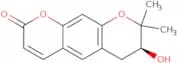
CAS:<p>Decursinol is a coumarin derivative, which is sourced from the roots of the plant Angelica gigas, commonly found in East Asia. The compound is recognized for its biochemical properties, specifically as a secondary metabolite in the umbelliferous family. Its mode of action involves the inhibition of key inflammatory pathways, notably through the suppression of pro-inflammatory cytokines and enzymes such as COX-2 and NF-κB. This molecular interaction effectively reduces inflammatory responses at the cellular level.</p>Fórmula:C14H14O4Pureza:Min. 98 Area-%Forma y color:White Off-White PowderPeso molecular:246.26 g/mol7-Ethoxycoumarin
CAS:<p>7-Ethoxycoumarin is a fluorescent substrate used in biochemical research, which is derived synthetically. It undergoes biotransformation primarily via oxidative dealkylation, catalyzed by cytochrome P450 enzymes, resulting in the formation of 7-hydroxycoumarin. By monitoring the fluorescent 7-hydroxycoumarin, researchers can assess enzymatic activity and study metabolic pathways.</p>Fórmula:C11H10O3Pureza:Min. 95%Forma y color:PowderPeso molecular:190.2 g/molEsculetin dibenzyl ether
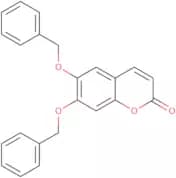
CAS:<p>Esculetin dibenzyl ether is a chemical compound, which is a derivative of esculetin, a natural coumarin obtained chiefly from plant sources such as the bark of horse chestnut and other similar species. The source of esculetin dibenzyl ether is typically synthesized from natural precursors through chemical modifications, allowing for the exploration of its structural analogs.</p>Fórmula:C23H18O4Pureza:Min. 95%Peso molecular:358.39 g/molOsthenol
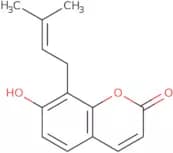
CAS:<p>Osthenol is a natural product compound, known for its osteogenic-promoting properties. It is derived from plant sources, specifically from the fruits of Cudrania tricuspidata, a member of the Moraceae family. This compound functions by modulating cellular activities associated with bone formation. Osthenol has been reported to promote the differentiation and maturation of osteoblasts, the bone-forming cells, through the activation of specific signaling pathways such as the BMP-2 and Wnt/β-catenin pathways. These pathways are crucial for enhancing the deposition of extracellular matrix and increasing the expression of osteogenic markers.</p>Fórmula:C14H14O3Pureza:Min. 95%Forma y color:PowderPeso molecular:230.26 g/molEpoxybergamottin
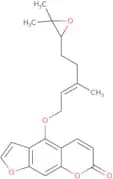
CAS:<p>Epoxybergamottin is a furanocoumarin derivative, which is a natural bioactive compound. It is primarily sourced from citrus fruits, particularly grapefruit. The primary mode of action of epoxybergamottin is the inhibition of cytochrome P450 enzymes, specifically CYP3A4. This enzyme is a major player in the metabolism of many pharmaceuticals, and its inhibition can lead to increased bioavailability and prolonged effects of drugs metabolized by this pathway.</p>Fórmula:C21H22O5Pureza:Min. 95 Area-%Forma y color:PowderPeso molecular:354.40 g/mol5,7-Dihydroxy-4-methylcoumarin monohydrate
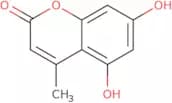
CAS:<p>5,7-Dihydroxy-4-methylcoumarin monohydrate is an organic chemical compound, specifically a type of coumarin derivative. Coumarins are a class of naturally occurring aromatic compounds that are found in various plant sources, such as tonka beans, sweet clover, and other botanicals. This particular compound, with its distinct hydroxyl and methyl groups, falls under the broader category of hydroxycoumarins, which are of significant interest in biochemical research due to their various functional properties.</p>Fórmula:C10H8O4·H2OPureza:Min. 95%Forma y color:Off-White Yellow PowderPeso molecular:210.18 g/mol6-Hydroxy-4-methylcoumarin
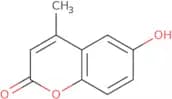
CAS:6-Hydroxy-4-methylcoumarin is a chemical compound that serves as a lactone derivative. It is commonly derived from synthetic sources through various organic reactions involving resorcinol and ethyl acetoacetate. The compound functions primarily through its ability to absorb ultraviolet light and fluoresce, making it highly valuable in spectroscopic analyses.Fórmula:C10H8O3Pureza:Min. 95%Peso molecular:176.17 g/molCalycanthoside
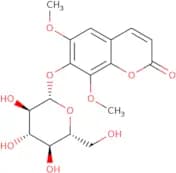
CAS:<p>Calycanthoside is a phenolic glycoside, which is a type of natural compound characterized by a glycosidic bond linking a phenolic moiety. It is derived from the plant Calycanthus chinensis, known for its rich array of bioactive compounds. The extraction and isolation processes of Calycanthoside involve sophisticated chromatographic techniques to ensure its purity and activity.</p>Fórmula:C17H20O10Pureza:Min. 95%Forma y color:PowderPeso molecular:384.33 g/mol4-Methylesculetin
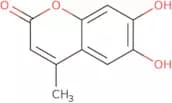
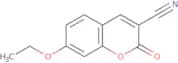
CAS:<p>4-Methylesculetin is a coumarin derivative, which is a type of organic compound. This compound is primarily sourced from various plant species, where it occurs naturally as a secondary metabolite. Known for its bioactive properties, 4-Methylesculetin exhibits significant antioxidant activity by scavenging free radicals and protecting against oxidative stress.</p>Fórmula:C10H8O4Pureza:Min. 95%Forma y color:PowderPeso molecular:192.17 g/mol3-Cyano-7-ethoxycoumarin
CAS:<p>3-Cyano-7-ethoxycoumarin is a specialized fluorescent probe, which is a synthetic organic compound designed for use in biochemical assays. This compound is sourced from the broader family of coumarins, which are known for their versatile fluorescence properties. The mode of action of 3-Cyano-7-ethoxycoumarin involves its ability to exhibit strong fluorescent emission when excited by specific wavelengths of light, making it a valuable tool for monitoring biochemical reactions and interactions.</p>Fórmula:C12H9NO3Pureza:Min. 95%Forma y color:PowderPeso molecular:215.2 g/molDaphnetin-8-glucoside
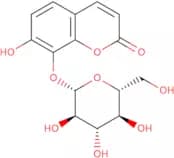
CAS:Daphnetin-8-glucoside is a natural phenolic glucoside compound derived from plants of the Thymelaeaceae family, specifically from the Daphne genus. This compound is produced by the glycosylation of daphnetin, a coumarin derivative found in various botanical sources. The glycoside linkage enhances its solubility and stability, facilitating its bioavailability. Daphnetin-8-glucoside exhibits potent antioxidant and anti-inflammatory activities, mediated through the scavenging of free radicals and inhibition of pro-inflammatory cytokine production. Additionally, it modulates signal transduction pathways involved in cellular oxidative stress responses.Fórmula:C15H16O9Pureza:Min. 95%Forma y color:PowderPeso molecular:340.28 g/molImperatorin
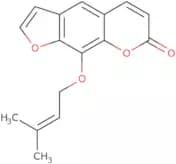
CAS:<p>Imperatorin is a furanocoumarin compound, which is a natural product primarily isolated from plants in the Apiaceae family, such as Angelica dahurica and Citrus species. This compound is characterized by its unique chemical structure that includes a furan ring fused to a coumarin backbone. Imperatorin exerts its biological activities through multiple modes of action, including the modulation of enzymatic activity, interference with cellular signaling pathways, and binding to specific biological targets.</p>Fórmula:C16H14O4Pureza:Min. 98 Area-%Forma y color:White PowderPeso molecular:270.28 g/mol8-Methoxypsoralen
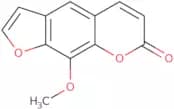
CAS:<p>8-Methoxypsoralen is a furocoumarin compound, which is derived from natural plant sources such as the seeds of the Ammi majus plant. Its primary mode of action involves intercalation into DNA strands and the formation of covalent bonds with pyrimidine bases upon exposure to ultraviolet A (UVA) light. This interaction results in the inhibition of DNA synthesis and cell proliferation.</p>Fórmula:C12H8O4Pureza:Min. 95%Forma y color:White PowderPeso molecular:216.19 g/molCoumarin
CAS:<p>Coumarin is an organic chemical compound, which is a naturally occurring substance found in various plants, including tonka beans, sweet clover, and cinnamon. Structurally, it is a benzopyrone, characterized by a benzene ring fused to a lactone. Coumarin acts primarily as an anticoagulant by inhibiting the synthesis of vitamin K-dependent clotting factors in the liver. This mode of action disrupts the coagulation cascade, reducing the blood’s ability to clot effectively.</p>Fórmula:C9H6O2Pureza:Min. 95%Forma y color:White PowderPeso molecular:146.14 g/molMeranzin
CAS:<p>Meranzin is a bioactive compound, which is a naturally occurring coumarin derivative found in various citrus fruits. Its source lies primarily in the peels and seeds of specific citrus species, notably within the Rutaceae family. The mode of action of Meranzin involves the inhibition of acetylcholinesterase, thereby influencing neurotransmitter activity, specifically in the modulation of acetylcholine levels. This action can have significant implications in research focused on neurodegenerative disorders.</p>Fórmula:C15H16O4Pureza:Min. 98 Area-%Forma y color:PowderPeso molecular:260.29 g/molColumbianadin
CAS:<p>Columbianadin is a coumarin derivative, which is a natural compound primarily extracted from plants in the Apiaceae family, such as Angelica species. This natural product possesses a unique molecular structure characterized by the presence of a coumarin skeleton, which is responsible for its diverse biological activities.</p>Fórmula:C19H20O5Pureza:Min. 98 Area-%Forma y color:PowderPeso molecular:328.36 g/molIsosibiricin
CAS:<p>Isosibiricin is a naturally occurring lignan, which is extracted from certain plant sources. This compound is derived from the genus Daphne, traditionally known for its diverse range of biologically active constituents. Its mode of action is primarily through the modulation of key signaling pathways involved in cell proliferation and apoptosis. Isosibiricin exhibits notable inhibitory effects on specific enzymes and receptors implicated in oncogenic processes, making it a subject of interest for cancer research.</p>Fórmula:C16H18O5Pureza:Min. 95%Forma y color:PowderPeso molecular:290.31 g/mol