Glycoscience
La glicociencia es el estudio de los carbohidratos y sus derivados, así como de las interacciones y funciones biológicas en las que participan. Este campo de investigación es crucial para comprender una amplia variedad de procesos biológicos, incluyendo el reconocimiento celular, la señalización, la respuesta inmune y el desarrollo de enfermedades. La glicociencia tiene aplicaciones importantes en la biotecnología, la medicina, y el desarrollo de nuevos fármacos y terapias. En CymitQuimica, ofrecemos una amplia selección de productos de alta calidad y pureza para la investigación en glicociencia. Nuestro catálogo incluye monosacáridos, oligosacáridos, polisacáridos, glicoconjugados, y reactivos específicos, diseñados para apoyar a los investigadores en sus estudios sobre la estructura, función y aplicaciones de los carbohidratos en sistemas biológicos. Estos recursos están destinados a facilitar descubrimientos científicos y aplicaciones prácticas en diversas áreas de la biociencia y la medicina.
Subcategorías de "Glycoscience"
- Aminoazúcares(108 productos)
- Anticuerpos relacionados con azúcares(282 productos)
- Glicolípidos(46 productos)
- Glicosaminoglicanos (GAGs)(55 productos)
- Glucósidos(419 productos)
- Monosacáridos(6.624 productos)
- Oligosacáridos(3.682 productos)
- Polisacáridos(503 productos)
Se han encontrado 11046 productos de "Glycoscience"
Ordenar por
Pureza (%)
0
100
|
0
|
50
|
90
|
95
|
100
Tri-b-GalNAcAc3-6-aminohexyl-NHCbz
CAS:<p>Tri-b-GalNAc-6-aminohexyl-NHCbz is the peracetylated form with a protected terminal amino group (NHCbz). It is a synthetic ligand designed to target the asialoglycoprotein receptor (ASGPR) on hepatocytes. The three terminal beta-N-acetylgalactosamine (GalNAc) sugars provide an efficient ASGPR binding. It serves as a platform for lysosomal targeting chimera (LYTAC) development, allowing for the creation of chimeras that specifically target unwanted proteins for degradation within hepatocytes. In addition, tri-b-GalNAc-6-aminohexanoate facilitates the delivery of therapeutic cargo, such as RNA or Cas9 complexes, directly to hepatocytes via ASGPR-mediated endocytosis. This approach is promising for gene therapy and RNAi applications in the liver due to the specificity of ASGPR targeting and the versatility of the conjugation moiety.</p>Fórmula:C93H145N11O39Pureza:Min. 95 Area-%Peso molecular:2,041.2 g/molD-Galacturonic acid monohydrate
CAS:D-Galacturonic acid (GalA) is a hexuronic acid with the CH2OH at C5 of galactose replaced by a carboxyl group (Collins, 2006). D-galacturonic acid is abundant in pectic polysaccharides which are characterized by a high α-1,4 linked galacturonic acid content and include pectic acid (polygalacturonic acid), rhamnogalacturonan I (Oomen, 2002), rhamnogalacturonan (RG) II (Vidal, 2000), xylogalacturonan, and homogalacturonan. These polymers play roles in strengthening cell walls, cell adhesion and are established as part of signaling cascades that detect cell wall degradation upon pathogen attack.Fórmula:C6H10O7·H2OPureza:(Titration) Min. 97%Forma y color:White Off-White PowderPeso molecular:212.15 g/mol2,6-di-O-n-pentyl-3-O-acetyl-γ-cyclodextrin
This gamma-cyclodextrin (γ-CD) derivative is a modified cyclic oligosaccharide composed of eight glucose units, featuring a larger cavity size than α- and β-cyclodextrins. This structural characteristic allows γ-CDs to form inclusion complexes with a wider range of guest molecules, making it particularly versatile in various industries. In the food sector, it is used as a carrier and stabilizer for flavors, fat-soluble vitamins, and polyunsaturated fatty acids, protecting volatile compounds from evaporation. In pharmaceuticals, it enhances the solubility and bioavailability of poorly water-soluble drugs and, thanks to its larger ring size, allows for the encapsulation of larger molecules or even entire drug molecules. γ-CDs and derivatives are also used for environmental remediation and, in analytical chemistry, for the extraction and concentration of target substances.Fórmula:C144H256O48Pureza:Min. 95%Peso molecular:2,755.54 g/mol1-Deoxy-D-tagatose
CAS:1-Deoxy-D-tagatose (1Dt) is a competitive inhibitor of glycolysis, which blocks the conversion of glucose to pyruvate. 1Dt has been shown to inhibit the growth of strain CAEN on media containing l-arabinose and d-xylose as carbon sources. 1Dt also inhibits the activity of dehydrogenase enzymes in C. elegans, leading to inhibition of mitochondrial respiration and impaired locomotion. It has been shown that 1Dt can be used as a substrate for bioproduction, with hydrazone as an intermediate product. Larger molecules are produced after hydrolysis and decarboxylation of 1Dt. The most common products are tagatose, l-fucitol, and l-arabinose. 1Dt has been shown to have anti-inflammatory properties in animal models by inhibiting the production of reactive oxygen species that are generated during inflammationFórmula:C6H12O5Pureza:Min. 95%Peso molecular:164.16 g/molArabinoxylan
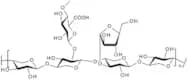
CAS:<p>Arabinoxylans consist of α-L-arabinofuranose residues attached as branch-points to β-(1,4)-linked D-xylopyranose main chains. These may be 2- or 3-substituted or 2- and 3- di-substituted. The arabinose residues may also be linked to other groups attached such as glucuronic acid residues, ferulic acid cross links and acetyl groups. Arabinoxylans generally consist of between 1500 - 5000 residues.</p>Pureza:Min. 95%Forma y color:Powder3-O-Benzyl-1-O-tert-butyldimethylsilyl- D- glucitol cyclic 5, 6- carbonate
3-O-Benzyl-1-O-tert-butyldimethylsilyl- D- glucitol cyclic 5, 6- carbonate (3BTBDMS) is an organic compound that is used as a synthetic intermediate. It can be used for the synthesis of oligosaccharides and saccharides. 3BTBDMS can also be fluorinated, glycosylated, or methylated to create other compounds. This product has a molecular weight of 288.36 g/mol and a CAS number of 106929–04–8.Pureza:Min. 95%Isosorbide dinitrate - 60% lactose and 40% Isosorbide dinitrate
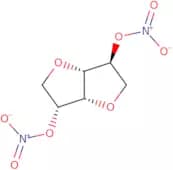
CAS:<p>Isosorbide dinitrate is used to treat chronic bronchitis and congestive heart failure. It dilates blood vessels, allowing more oxygen-rich blood to reach the heart. Isosorbide dinitrate is also used to relieve chest pain (angina) and reduce complications after a heart attack. Isosorbide dinitrate is a prodrug that is converted in vivo to its active form, isosorbide mononitrate, by the enzyme nitric oxide synthase in response to hypoxia. In addition, it has been shown that this drug reduces levels of low-density lipoprotein cholesterol (LDL-C) and may be useful for the treatment of high cholesterol.<br>The mechanism of action for reducing LDL-C levels is not known but may be due to increased clearance of LDL-C from plasma or decreased production of very low density lipoproteins (VLDL). This medication does not affect triglycerides or high density lip</p>Fórmula:C6H8N2O8Pureza:Min. 95%Forma y color:White PowderPeso molecular:236.14 g/molHeparin disaccharide II-S trisodium salt
CAS:Heparin breakdown productFórmula:C12H16NNa3O16S2Pureza:Min. 95 Area-%Forma y color:White Off-White PowderPeso molecular:563.35 g/molChondroitin sulfate sodium salt
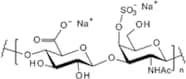
CAS:Chondroitin sulphate is the most abundant glycosaminoglycan in mammalian tissues and occurs both in skeletal and soft connective tissue. The disaccharide repeat unit consists of N-acetyl galactosamine sulphate linked β1,4 to glucuronic acid.Pureza:Min. 95%Forma y color:White Off-White PowderLevan - from Erwinia herbicola
CAS:Levan is a (2,6)-linked fructan produced by Erwinia herbicola. The polysaccharide contains branches every 10-12 fructose residues linked (1,2) and is reported to have a molecular weight in excess of 1000 KDa. Potential industrial applications of levan have been proposed as an emulsifier, formulation aid, stabilizer and thickener, surface-finishing agent, encapsulating agent, and carrier for flavor and fragrances. In addition, levan is promising in medicine as a plasma substitute, drug activity prolongator and antihyperlipidemic agent.Pureza:Min. 95%Forma y color:Powder(1R) -1- [(2S, 3R,4R) -4-(Acetylamino)methyl-N-butyl-3- hydroxy- 1- azetidinyl] -1, 2- ethanediol
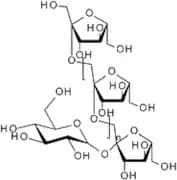
<p>(1R) -1- [(2S, 3R,4R) -4-(Acetylamino)methyl-N-butyl-3- hydroxy- 1- azetidinyl] -1, 2- ethanediol is a Glycosylation that is synthesized by the Click modification of a polysaccharide. It is custom synthesis with high purity and CAS No.</p>Pureza:Min. 95%Methyl 4,6-O-(4-methoxybenzylidene)-2,3-di-O-pivaloyl-a-D-galactopyranoside
Methyl 4,6-O-(4-methoxybenzylidene)-2,3-di-O-pivaloyl-a-D-galactopyranoside is a custom synthesis of a sugar that is Click modified with fluorine and glycosylated. Methyl 4,6-O-(4-methoxybenzylidene)-2,3-di-O-pivaloyl-a-D-galactopyranoside is an oligosaccharide that has saccharides and monosaccharides. This complex carbohydrate has been synthesized by methylation and modification. Methyl 4,6-O-(4-methoxybenzylidene)-2,3--di--pivaloyl--a--D--galactopyranoside belongs to the CAS No. of 689717–97–1.Fórmula:C25H36O9Pureza:Min. 95%Peso molecular:480.56 g/mol(2R, 3R, 4S) -3, 4- Dihydroxy- 2, 4- pyrrolidinedimethano l
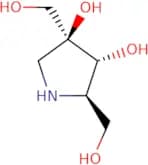
CAS:(2R, 3R, 4S) -3, 4- Dihydroxy- 2, 4- pyrrolidinedimethano l is a fluorinated methylated saccharide that is used in the synthesis of complex carbohydrates. It can be used as a glycosylation or a click modification reagent. This compound has been shown to be effective in the synthesis of oligosaccharides and glycosylations.Pureza:Min. 95%Heparin
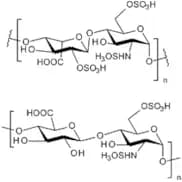
CAS:Heparin is a glycosaminoglycan which occurs in many mammalian tissues and has important anticoagulant and thrombolytic properties. The chemical structure is composed mainly of two disaccharide repeating units A and B. A is L-iduronic acid 2-suplhate linked α-(1,4) to 2-deoxy-2-sulfamido-D-galactose 6-sulphate while B is D-glucuronic acid β-(1,4) linked to 2-deoxy-2-sulfamido-D-glucose 6-sulphate.Fórmula:C26H42N2O37S5Pureza:Min. 95%Forma y color:PowderPeso molecular:1,134.9 g/mol4-Methoxyphenyl 2-deoxy-3-benzyl-4,6-O-(4-methoxybenzylidene)-2-phthalimido-β-D-glucopyranoside
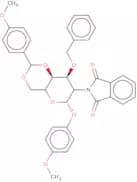
4-Methoxyphenyl 2-deoxy-3-benzyl-4,6-O-(4-methoxybenzylidene)-2-phthalimido-b-D-glucopyranoside is a custom synthesis that has been modified with fluorination and carbamoylation. This product is an oligosaccharide that belongs to the group of polysaccharides. It is a complex carbohydrate that has been synthesized from monosaccharides and sugar. 4MPBGP is soluble in water and has high purity levels. *The following content was automatically generated by eCommerce software:Fórmula:C36H33NO9Pureza:Min. 95%Peso molecular:623.65 g/mol1,3,4-Tri-O-acetyl-2-deoxy-2-fluoro-L-fucose
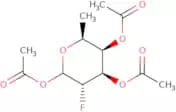
CAS:Peracetylated 2-fluoro-L-fucose is the acetylated form of 2-deoxy-2-fluoro-L-fucose which is a potent inhibitor of protein fucosylation. It exhibits improved cell permeability and is rapidly deacetylated into its active form, inside the cell. It is metabolised inside the cell into a corresponding donor substrate analogue of GDP-fucose or GDP-2FF, via the salvage pathway. GDP-2FF accumulates in the cell causing a shutdown of de novo pathway which leads to the desired fucosylation inhibition. The addition of 100 uM peracetylated-2-fluoro-L-fucose to plants severely inhibits root growth by 95% compared to an untreated plant, and is more potent compared to 2-fluoro-L-fucose. The material is soluble in DMSO at 10mg/ml.Fórmula:C12H17FO7Pureza:Min. 97 Area-%Forma y color:White Off-White PowderPeso molecular:292.26 g/molThermopsoside
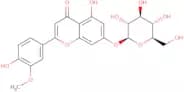
CAS:Thermopsoside is an organic acid that has been isolated from the plant species Vitex agnus-castus. Thermopsoside has shown antibacterial activity against a variety of bacteria and fungi, including Escherichia coli, Staphylococcus aureus, and Candida albicans. It is thought to act by inhibiting the synthesis of fatty acids and vitexin in the bacterial cell membrane or by binding to the bacterial ribosome. Thermopsoside also shows anti-inflammatory effects on skin cells and is used in some cosmetic products as an ingredient in skin-conditioning lotions. Thermopside inhibits prostaglandin production by blocking cyclooxygenase (COX) enzymes.Fórmula:C22H22O11Pureza:Min. 98 Area-%Forma y color:PowderPeso molecular:462.4 g/molN-Acetylneuraminic acid
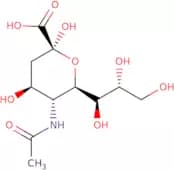
CAS:N-Acetylneuraminic acid (NANA or Neu5Ac), as the most common sialic acid, is a nine-carbon monosaccharide whose amino group is acetylated (Collins, 2006). Sialic acid is found across the animal kingdom and some prokaryotes. Sialic acid occurs as a component of oligosaccharides (N- and O-linked glycoproteins, glycolipids, human milk, blood groups), bacterial polysaccharides and glycoconjugates. Sialic acid is also found in free form in body fluids (Schauer, 1997).Fórmula:C11H19NO9Pureza:Min. 98 Area-%Forma y color:White PowderPeso molecular:309.27 g/mol1,2-a-1,2-a-L-Rhamnotriose
<p>1,2-a-1,2-a-L-Rhamnotriose is a carbohydrate that can be modified to suit your needs. It has a CAS number of 57749-83-5. This oligosaccharide is a sugar made up of two monosaccharides joined by an alpha 1,2 glycosidic bond. The product can be custom synthesized and its purity is high. It can be fluorinated or methylated and it can also be glycosylated. Click modification is also possible with this product.</p>Fórmula:C18H32O13Pureza:Min. 95%Forma y color:White PowderPeso molecular:456.44 g/molPhenyl 4,6-O-benzylidene-2-deoxy-2-phthalimido-b-D-thioglucopyranoside
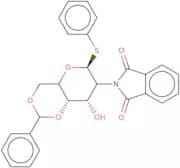
CAS:Phenyl 4,6-O-benzylidene-2-deoxy-2-phthalimido-b-D-thioglucopyranoside is a custom synthesis sugar that has been modified with fluorination, glycosylation, and carbamoylation. It is an oligosaccharide that contains a saccharide at the reducing end of the molecule. The CAS number for this compound is 79528-51-1.Fórmula:C27H23NO6SPureza:Min. 95%Forma y color:White PowderPeso molecular:489.54 g/mol




![(1R) -1- [(2S, 3R,4R) -4-(Acetylamino)methyl-N-butyl-3- hydroxy- 1- azetidinyl] -1, 2- ethanediol](/_next/image/?url=https%3A%2Fstatic.cymitquimica.com%2Fproducts%2F3D%2Fthumb-webp%2FMA163407.webp&w=3840&q=75)