Glycoscience
Subcategorías de "Glycoscience"
- Aminoazúcares(108 productos)
- Anticuerpos relacionados con azúcares(282 productos)
- Glicolípidos(46 productos)
- Glicosaminoglicanos (GAGs)(55 productos)
- Glucósidos(419 productos)
- Monosacáridos(6.616 productos)
- Oligosacáridos(3.718 productos)
- Polisacáridos(505 productos)
Se han encontrado 11017 productos de "Glycoscience"
1-Deoxy-1-nitro-L-glucitol
CAS:1-Deoxy-1-nitro-L-glucitol is a potent apoptosis-inducing compound that has shown promising results in cancer research. It is an analog of vanillin and nintedanib, two well-known cancer cell inhibitors. 1-Deoxy-1-nitro-L-glucitol has been shown to inhibit the activity of several kinases, including those involved in tumor growth and progression. In addition, it has been found to be effective against various types of cancer cells, including Chinese hamster ovary cells and human bladder cancer cells. This compound also exhibits synergistic effects with other anti-cancer drugs such as glimepiride and apomorphine. The presence of 1-Deoxy-1-nitro-L-glucitol in urine may serve as a potential biomarker for the diagnosis and monitoring of certain cancers.
Fórmula:C6H13NO7Pureza:Min. 95%Peso molecular:211.17 g/mol1,2,3-Tri-O-benzoyl-α-L-fucopyranose
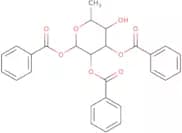
CAS:1,2,3-Tri-O-benzoyl-a-L-fucopyranose is a synthetic, fluorinated monosaccharide that can be synthesized from D-glucose in two steps. It is a useful building block for the synthesis of oligosaccharides and polysaccharides with different glycosylation patterns. This compound has been shown to react with methyl iodide to form 1,2,3-triiodo-a-L-fucopyranose. It has also been used as a click modification reagent for carbohydrates.Fórmula:C27H24O8Pureza:Min. 95%Peso molecular:476.47 g/mol2,3,4,6-Tetra-O-acetyl-a-D-mannopyranosyl azide
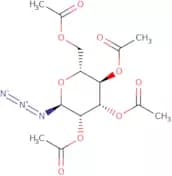
CAS:2,3,4,6-Tetra-O-acetyl-a-D-mannopyranosyl azide is a crystalline solid that can be obtained by heating 2,3,4,6-tetra-O-acetyl-a-D-mannopyranose with sodium azide. This compound has been used in the x-ray crystallographic technique for obtaining electron density maps. The x ray data collected from this compound showed the distinct difference between the electron density of the atoms and their surroundings.Fórmula:C14H19N3O9Forma y color:PowderPeso molecular:373.32 g/mol4-C-[[(Methylsulfonyl)oxy]methyl]-3-O-benzyl-1,2-di-O-acetyl 5-methanesulfonate D-erythro-pentofuranose
CAS:Methyl 4-C-[[(methylsulfonyl)oxy]methyl]-3-O-benzyl-1,2-di-O-acetyl 5-methanesulfonate D-erythro-pentofuranose is a methylated saccharide used in the synthesis of LNA amiditesFórmula:C19H26O12S2Pureza:Min. 95%Forma y color:PowderPeso molecular:510.53 g/molCornuside
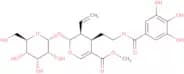
CAS:Cornuside is a natural compound that is found in the fruits of Cornus. It is a dihydrochalcone, which has been shown to have hypoglycemic effects and inhibit the activity of 5-hmf. Cornuside also inhibits the enzyme activities involved in energy metabolism, such as glucose-6-phosphate dehydrogenase and hexokinase. It has also been shown to have genotoxic properties and induce DNA damage. Cornuside may be useful for treating diabetes or cancer, but further research needs to be done before this can be confirmed.Fórmula:C24H30O14Pureza:Min. 95%Forma y color:PowderPeso molecular:542.49 g/mol2,3,4,6-Tetra-O-benzoyl-a-D-mannopyranosyl trichloroacetimidate
CAS:Glycosyl-donor for syntheses of mannosyl-glycoconjugatesFórmula:C36H28Cl3NO10Pureza:Min. 95%Forma y color:White PowderPeso molecular:740.98 g/mol2,5-Anhydro-1,3-O-isopropylidene-6-O-trityl-D-glucitol
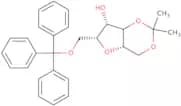
CAS:2,5-Anhydro-1,3-O-isopropylidene-6-O-trityl-D-glucitol is a complex carbohydrate that is synthesized by the modification of glucose. This product has been modified with methylation and glycosylation. 2,5-Anhydro-1,3-O-isopropylidene-6-O-trityl--D--glucitol is a white powder that is soluble in water and ethanol. It can be used for fluoroquinolone resistance studies, which are important for developing new antibiotics to combat bacterial infections.Fórmula:C28H30O5Pureza:Min. 95%Peso molecular:446.53 g/molkappa-Carrageenan
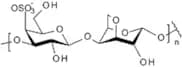
CAS:Kappa-Carrageenan is a gelling sulphated galactan extracted from red seaweed (typically Mastocarpus stellata and Chondrus crispus). The structure of all carrageenans consists of a strictly alternating masked repeating unit of 1,3-linked α-D-galactose and 1,4-linked β-D-galactose. The α-linked galactose occurs as α-3-6-anhydro unit and the β-linked sugar occurs as the 4-sulphate.
The image was kindly provided by Prof Mike Guiry from Cork who runs ‘The Seaweed Site’.Forma y color:White Powder2,3,4,6-Tetra-O-benzyl-5-thio-D-glucono-1,5-lactone
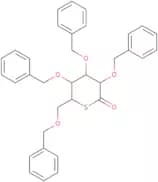
CAS:2,3,4,6-Tetra-O-benzyl-5-thio-D-glucono-1,5-lactone is a complex carbohydrate that can be modified with methylation and glycosylation. It is a saccharide that can be modified by fluorination and click modification. This compound is synthesized by the polymerization of allose in the presence of an enzyme to produce 2,3,4,6-tetra-O-(benzyloxymethyl)-5-thio--D--glucono--1,5--lactone.Fórmula:C34H34O5SPureza:Min. 95%Peso molecular:554.7 g/molHeparin derived dp6 saccharide ammonium salt
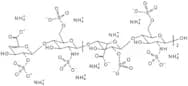
Heparin derived dp6 saccharide ammonium salt is a glycosylation product of heparin. It is a synthetic glycosaminoglycan consisting of alternating units of N-acetylglucosamine and glucuronic acid. This compound is highly water soluble and has been shown to be stable at pH 3-7 for up to 6 hours. The compound has also been subjected to a number of modifications, including methylation, click modification, fluorination, saccharide modification, sugar modification, and oligosaccharide synthesis. The structural formula of this compound can be found in the Chemical Abstracts Service (CAS) number: 234764-56-2 with a molecular weight of 735.81 g/mol. Custom synthesis is available on request.Pureza:Approx.75%Forma y color:PowderPeso molecular:~1800 (Average)Diosmetin-7-O-b-D-glucopyranoside
CAS:Diosmetin-7-O-b-D-glucopyranoside is a coumarin derivative that is found in the root of the Chinese herb Dioscorea tinctoria. It has been shown to have anti-inflammatory effects by inhibiting the expression of inflammatory genes, and it also has antioxidant properties. The chemical structure of diosmetin has been shown to be similar to protocatechuic acid, an important phenolic acid that can be found in wine and vinegar. Diosmetin has also been shown to inhibit mitochondrial apoptosis, which may contribute to its anti-cancer effects. Diosmetin has been shown to increase postprandial blood glucose levels in rats fed a high fat diet, and this effect may be due to its ability to inhibit peroxisome proliferator-activated receptor gamma (PPARγ) activity.Fórmula:C22H22O11Pureza:Min. 95%Forma y color:PowderPeso molecular:462.4 g/mol4-Nitrobenzyl β-D-thiogalactopyranoside
CAS:4-Nitrobenzyl b-D-thiogalactopyranoside is a synthetic glycosylation agent that can be used for the modification of saccharides and oligosaccharides. The product is available in different purity grades, custom synthesis, and custom modifications.Fórmula:C13H17NO7SPureza:Min. 95%Peso molecular:331.34 g/molLacto-N-neodifucohexaose
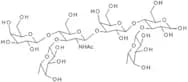
Neutral difucosylated hexasasaccharide naturally present in human breast milkFórmula:C38H65NO29Pureza:Min. 75%Forma y color:PowderPeso molecular:999.93 g/mol2-Acetamido-3-O-(2-acetamido-2-deoxy-b-D-glucopyranosyl)-2-deoxy-D-galactopyranose
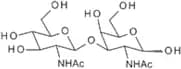
CAS:2-Acetamido-3-O-(2-acetamido-2-deoxy-b-D-glucopyranosyl)-2-deoxy-D-galactopyranose is a methylated, saccharide, Polysaccharide. It is a custom synthesis of a carbohydrate sugar. It is fluorinated to increase its bioavailability. 2 Acetamido 3 O 2 acetamido 2 deoxy b D glucopyranosyl 2 deoxy D galactopyranose has CAS No. 95673 98 6 and the molecular weight is 524.87 g/mol. It has a purity of >99% and comes in powder form.Fórmula:C16H28N2O11Pureza:Min. 95%Forma y color:White PowderPeso molecular:424.4 g/mol2,3-Di-O-benzyl-6-O-tert-butyldimethylsilyl-gamma-cyclodextrin
This gamma-cyclodextrin (γ-CD) derivative is a modified cyclic oligosaccharide composed of eight glucose units, featuring a larger cavity size than α- and β-cyclodextrins. This structural characteristic allows γ-CDs to form inclusion complexes with a wider range of guest molecules, making it particularly versatile in various industries. In the food sector, it is used as a carrier and stabilizer for flavors, fat-soluble vitamins, and polyunsaturated fatty acids, protecting volatile compounds from evaporation. In pharmaceuticals, it enhances the solubility and bioavailability of poorly water-soluble drugs and, thanks to its larger ring size, allows for the encapsulation of larger molecules or even entire drug molecules. γ-CDs and derivatives are also used for environmental remediation and, in analytical chemistry, for the extraction and concentration of target substances.
Fórmula:C208H288O40SI8Pureza:Min. 95%Peso molecular:4,475.79 g/molMonofucosyllacto-N-hexaose II
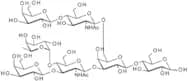
CAS:Monofucosyllacto-N-hexaose II is a tetraol that is used as a reagent in the synthesis of enantioenriched and synthetically tetrasaccharidic products. Monofucosyllacto-N-hexaose II can be obtained by the reaction of Grignard reagents with glucose or by stereoselective reduction of an alpha, beta unsaturated ketone. The presence of the glucose residue in Monofucosyllacto-N-hexaose II makes it an acceptor for esterification reactions. This compound has chiral centers due to its two stereogenic centers at C2 and C3, which are both beta positions on the glucose residue. Monofucosyllacto-N-hexaose II also has a free hydroxyl group at C5 that can be esterified to produce chiral esters.Fórmula:C46H78N2O35Pureza:Min. 95%Peso molecular:1,219.1 g/molN-Acetylneuraminic acid hexamer disodium salt
N-Acetylneuraminic acid hexamer disodium salt is a custom synthesis of a fluorinated, methylated and acetylated N-acetylneuraminic acid. This molecule is an oligosaccharide with three sugar rings. It has been modified by click chemistry and glycosylation to create a complex carbohydrate. The CAS number for this compound is 156587-48-2.Fórmula:C66H98N6O49Na6Pureza:Min. 95%Forma y color:White PowderPeso molecular:1,897.43 g/molGlyco-diosgenin
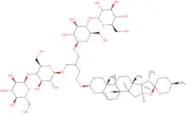
CAS:Glyco-diosgenin is an amphipathic molecule that has been found to stabilize proteins. It has the potential to be developed as a drug target for stabilizing proteins in cells. Glyco-diosgenin was synthesized by chemical modification of diosgenin, which is a steroidal saponin found in plants. The chemical modification that occurred at the 3-hydroxyl position of glyco-diosgenin produced a more effective molecule due to increased solubility and decreased toxicity. The protein stabilization properties of glyco-diosgenin have been shown by cryo-electron microscopy on plant cells, titration calorimetry, and functional studies on various proteins.Fórmula:C56H92O25Pureza:Min. 97 Area-%Forma y color:PowderPeso molecular:1,165.31 g/molNeoagarooctaose
CAS:Agarose is a polysaccharide found in red algae, typically Gelidium and Gracilaria. It is a strictly alternating polysaccharide of α-1,3 linked D-galactose and β-1,4 linked L-3,6 anhydrogalactose with occasional sulfation at position 6 of the anhydrogalactose residue. Agaro-oligosaccharides result from cleavage at galactose residues and neoagaro-oligosaccharides from cleavage at 3,6-anhydro residues. Neoagarooctaose is reported to have potential for novel cosmeceuticals.Fórmula:C48H74O37Pureza:Min. 98 Area-%Forma y color:White PowderPeso molecular:1,243.08 g/molBlood group B trisaccharide 8-methoxycarbonyloctyl ester
CAS:8-methoxycarbonyl ester of Gal-a1-3(Fuc-a1-2)GalFórmula:C28H50O17Pureza:Min. 95%Forma y color:PowderPeso molecular:658.69 g/mol


![4-C-[[(Methylsulfonyl)oxy]methyl]-3-O-benzyl-1,2-di-O-acetyl 5-methanesulfonate D-erythro-pentofur…](/_next/image/?url=https%3A%2Fstatic.cymitquimica.com%2Fproducts%2F3D%2Fthumb-webp%2FMM76880.webp&w=3840&q=75)