Terpenoides
Los terpenoides, también conocidos como isoprenoides, son la clase más grande de compuestos orgánicos naturales, derivados de unidades de isopreno de cinco carbonos. Se encuentran en una variedad de plantas y son conocidos por sus propiedades aromáticas, así como por su papel en la defensa y señalización de las plantas. Los terpenoides han sido ampliamente estudiados por sus efectos terapéuticos, incluidas sus propiedades antiinflamatorias, antimicrobianas y anticancerígenas. Se utilizan en las industrias farmacéutica, cosmética y alimentaria por sus beneficios para la salud y sus cualidades aromáticas. En CymitQuimica, encontrarás una amplia selección de terpenoides, esenciales para la investigación en biología vegetal, farmacología y síntesis de productos naturales.
Subcategorías de "Terpenoides"
- Diterpenos (C₂₀)(671 productos)
- Hemiterpenos (C₅)(21 productos)
- Monoterpenos (C₁₀)(709 productos)
- Sesquiterpenos (C₂₅)(452 productos)
- Tetraterpenos (C₄₀)(63 productos)
- Triterpenos (C₃₀)(1.130 productos)
Se han encontrado 1423 productos de "Terpenoides"
Ordenar por
Pureza (%)
0
100
|
0
|
50
|
90
|
95
|
100
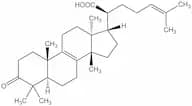
Β-elemonic acid
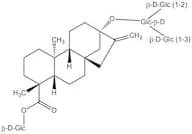
CAS:Carboxylic acid with ketone functionFórmula:C30H46O3Pureza:≥ 90.0 % (HPLC)Forma y color:PowderPeso molecular:454.7Rebaudioside a
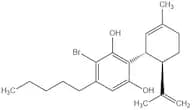
CAS:Natural glycosideFórmula:C44H70O23Pureza:≥ 95.0 % (HPLC)Forma y color:PowderPeso molecular:967.034-monobromocannabidiol
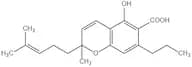
CAS:Halogen derivative of polyphenolFórmula:C21H29BrO2Pureza:≥ 90.0 % (HPLC)Forma y color:Viscous liquidPeso molecular:393.36Cannabichromevarinic acid
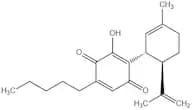
CAS:Carboxylic acid with phenol functionFórmula:C20H26O4Pureza:≥ 98.0 % (HPLC)Forma y color:PowderPeso molecular:330.42Cannabidiol hydroxyquinone
CAS:QuinoneFórmula:C21H28O3Pureza:≥ 90.0 % (HPLC)Forma y color:PowderPeso molecular:328.45(R)-(-)-Carvone
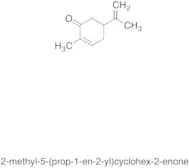
CAS:<p>Applications (R)-(-)-Carvone, is an antinociceptive monoterpene found as the main active constituent of essential oils obtained from plants of the genus Mentha. It is a novel agonist of TRPV1 channels. It can also be used as a chiral starting material.<br>References Goncalves, J.C., et al.: Cytometry part A., 83(2), 212 (2013); Liebigs ann., Chem., 403 (1993);<br></p>Fórmula:C10H14OForma y color:ColourlessPeso molecular:150.22Carvone
CAS:Producto controlado<p>Stability Light Sensitive<br>Applications Carvone is useful for the treatment of various metabolic disorders and GI related disorders.<br>References Shabi, M. M., et al.: Res. J. Pharm. Biol. Chem. Sci., 8, 328 (2017)<br></p>Fórmula:C10H14OForma y color:Light Yellow To Light BrownPeso molecular:150.22Limetol
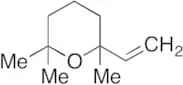
CAS:Producto controlado<p>Applications Limetol, is the cyclized derivative of linalool (L465950), melanol, and other unsaturated alcohols, that was shown to give a product mixture that can be used in fragrance and perfumery industry.<br>References Klimánková, E., et al.: Food Chem., 107, 464 (2008); Nakamura, A., et al.: J. Agric. Food Chem., 57, 5480 (2009); Soni, A. et al.: Synth. Comm., 40, 74 (2010);<br></p>Fórmula:C10H18OForma y color:NeatPeso molecular:154.25D-(+)-Carvone
CAS:<p>Applications D-(+)-Carvone, is used for the synthesis of (-)-terpestacin, a fungal metabolite with anticancer activity.It is also found in the essential oils of the in vitro M. longifolia plantlets and callus, that can be used as a potential source of a safe flavouring agent.<br>References Jin , Y., et al.: Org. Biomol. Chem., 10(28), 5452 (12012); Morcia, C., et al.: Acta. Biochimica. Polonica., 58(4), 581 (2011);<br></p>Fórmula:C10H14OForma y color:NeatPeso molecular:150.22Levopimaric Acid
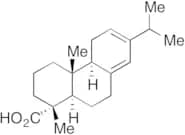
CAS:Producto controlado<p>Stability Air Sensitive<br>Applications Levopimaric Acid is a major component of pine oleoresin. It is an abietane-type of diterpene resin acid and has antibacterial, cardiovascular, and antioxidant properties.<br>References Kersten, P. J., et al.: J. Chem. Ecol., 32(12), 2679-85 (2006)<br></p>Fórmula:C20H30O2Forma y color:White To Off-WhitePeso molecular:302.45Zederone
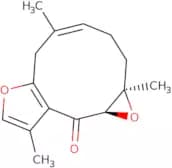
CAS:<p>Zederone is a bioactive sesquiterpene, which is a type of terpenoid compound. It is primarily sourced from the rhizomes of several Curcuma species, particularly Curcuma zedoaria. These plants are native to regions of Asia and have been used in traditional medicine for various purposes.</p>Fórmula:C15H18O3Pureza:Min. 98 Area-%Forma y color:Off-White PowderPeso molecular:246.3 g/molKaurenoic acid
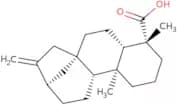
CAS:<p>Selective antibacterial and anti-inflammtory activity; uterine relaxant</p>Fórmula:C20H30O2Pureza:Min. 98 Area-%Forma y color:White PowderPeso molecular:302.45 g/molSabinene
CAS:<p>Sabinene is a bicyclic monoterpene, which is a volatile organic compound typically derived from the essential oils of various plants, including Norway spruce and some culinary herbs like black pepper, nutmeg, and tea tree. It is characterized by its distinct spicy and woody aroma, contributing to the complex bouquet of these plant essences.</p>Fórmula:C10H16Pureza:Min. 98 Area-%Forma y color:Clear LiquidPeso molecular:136.23 g/molHarpagoside
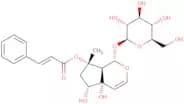
CAS:<p>Harpagoside is a bioactive compound, which is an iridoid glycoside derived from the root of the plant Harpagophytum procumbens, commonly known as Devil’s Claw. This compound is predominantly sourced from Southern Africa, where the plant is native to semi-arid regions and has been traditionally used in herbal medicine.</p>Fórmula:C24H30O11Pureza:Min. 95%Forma y color:PowderPeso molecular:494.5 g/molγ-Himachalene
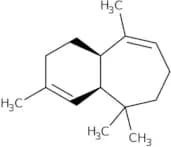
CAS:<p>Gamma-Himachalene is a sesquiterpene hydrocarbon, which is primarily sourced from the essential oils of certain plants, such as cedarwood. As a naturally occurring compound, its biosynthesis within the plant involves the cyclization of isoprenoid units, which gives rise to its unique chemical structure. This process is typically mediated by enzymes that facilitate the formation of various terpene compounds.</p>Fórmula:C15H24Pureza:Min. 95%Peso molecular:204.35 g/molRyanodine
CAS:<p>Ryanodine receptor effector</p>Fórmula:C25H35NO9Pureza:Min. 98 Area-%Forma y color:PowderPeso molecular:493.55 g/molSoyasaponin I
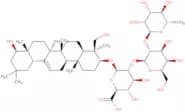
CAS:Inhibits L-iodose and HNE reduction; aldose reductase differential inhibitorFórmula:C48H78O18Pureza:Min. 98 Area-%Forma y color:PowderPeso molecular:943.12 g/molStrigolactone GR24
CAS:<p>Strigolactone GR24 is a synthetic analog of strigolactones, which are a class of plant hormones derived from the carotenoid biosynthetic pathway. These compounds play a critical role in plant development and interaction with the environment. Strigolactone GR24 functions by mimicking the action of natural strigolactones, influencing plant architecture and facilitating communication with symbiotic organisms.</p>Fórmula:C17H14O5Pureza:Min. 98 Area-%Forma y color:White PowderPeso molecular:298.29 g/mol