Enzimas en Proteínas Recombinantes
Las enzimas aceleran las reacciones químicas, actuando como catalizadores biológicos, actuando sobre sustratos y convirtiéndolos en diferentes moléculas llamadas productos. Estas proteínas son indispensables en procesos bioquímicos y aplicaciones industriales, facilitando reacciones en condiciones suaves con alta especificidad y eficiencia. En CymitQuimica, ofrecemos una amplia selección de enzimas de alta calidad para apoyar sus aplicaciones en investigación, industriales y clínicas.
Se han encontrado 3315 productos de "Enzimas en Proteínas Recombinantes"
Ordenar por
Pureza (%)
0
100
|
0
|
50
|
90
|
95
|
100
Glyceraldehyde-3-phosphate dehydrogenase
CAS:<p>75u/mg - Glyceraldehyde 3-phosphate dehydrogenase (GAPDH; EC 1.2.1.12) is an enzyme that catalyzes the following reaction: glyceraldehyde 3-phosphate + NAD+ + Pi ⇌ glycerate 1,3-bisphosphate + NADH + H+ One unit of GAPDH will convert 1.0 μmole of glyceraldehyde 3-phosphate into glycerate 1,3-bisphosphate per minute at pH 8.5 and 37 °C in the presence of NAD+ and phosphate. NAD+ is available here.</p>Fórmula:C3H7O6PPureza:Min. 95%Peso molecular:170.06 g/molα-Glucosidase from bacillus stearothermophilus, lyophilized powder, 250 Units
CAS:<p>α-Glucosidase is a glycoside hydrolase enzyme that hydrolyzes α-1,4-linked D-glucose residues to produce α-D-glucose. This enzyme has been isolated from Bacillus stearothermophilus and is used as an industrial catalyst in the production of glucose syrups. One Unit of α-Glucosidase will release 1.0 µmole of p-nitrophenol from the chromogenic substrate mimic 4-nitrophenyl α-D-glucopyranoside per minute under optimum conditions.</p>Forma y color:PowderProtease - from bacillus licheniformis
CAS:<p>Protease enzymes break down proteins and are essential for many biological processes, including digestion, cellular regulation and blood clotting. They are also used in many industrial and biotechnological applications for example in food processing and in detergents.</p>Forma y color:PowderMaltose phosphorylase (from bacteria), ammonium sulphate suspension
CAS:<p>Maltose phosphorylase (systematic name maltose:phosphate 1-beta-D-glucosyltransferase; EC 2.4.1.8) is an enzyme that catalyzes the following reaction: maltose + Pi ⇌ D-glucose + beta-D-glucose 1-phosphate One unit of maltose phosphorylase will produce 1.0 μmole of D-Glucose from maltose per minute at pH 7.0 and 30°C.</p>Pureza:Min. 95%Peso molecular:0 g/molCocarboxylase hydrochloride
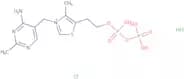
CAS:<p>Cocarboxylase hydrochloride is a coenzyme derivative, which is primarily sourced from thiamine (vitamin B1). It plays a crucial role in biochemical processes by facilitating the enzymatic decarboxylation of alpha-keto acids within the cellular environment. This action is fundamental in energy production as it aids in the conversion of pyruvate to acetyl-CoA, subsequently entering the citric acid cycle. Cocarboxylase hydrochloride’s involvement in carbohydrate metabolism is especially vital for tissues with high metabolic rates, such as the heart and brain.</p>Fórmula:C12H19N4O7P2S·ClHClPureza:Min. 95%Peso molecular:497.23 g/molCholine oxidase
CAS:<p>Choline oxidase (EC 1.1.3.17) is an enzyme that catalyzes the following reaction: choline + O2 + H20 ⇌ betaine aldehyde + H2O2One unit of choline oxidase will form 1 μmole of H2O2 by oxidizing choline to betaine aldehyde per min at pH 8.0 and 37 °C. You can remove the build-up of hydrogen peroxide using catalase.</p>Pureza:Min. 95%Urokinase
CAS:<p>Urokinase (urokinase-type plasminogen activator, uPA; EC 3.4.21.73) is as serine protease. Its physiological substrate is plasminogen. Urokinase converts plasminogen into an active enzyme, plasmin, which is also a serine protease. In its active form plasmin plays an important role in dissolving blood clots. Despite its name, Urokinase is not a kinase.</p>Fórmula:C21H25BrN2O3Pureza:(%) Min. 85%Glucosidase from aspergillus niger
CAS:<p>Glucosidases are enzymes belonging to the family of oxidoreductases. They catalyse the hydrolysis of starches to simple sugars. Glucosidase is widely used in the food, carbohydrate and biofuels industries. In recent years, its applicability has expanded to biotechnology for its potential application in bioenzymatic fuel cells.</p>Pureza:Min. 95%Forma y color:PowderInvertase
CAS:<p>Invertase is an enzyme that catalyzes the hydrolysis of sucrose to glucose and fructose and can be found in plants and microorganisms</p>Forma y color:Beige PowderAcetylcholinesterase, type VI-S, 200-1,000 units/mg protein
CAS:<p>Acetylcholinesterase is an enzyme that breaks down acetylcholine</p>Pureza:Min. 95%Forma y color:PowderProteinase K - from Tritirachium album
CAS:<p>Proteinase K is used for the general digestion of proteins and removal of protein contamination in nucleic acids. Addition of Protease K also stabilizes nucleic acids by degrading any nucleases present. Proteinase K is active in wide range of pH range, in the presence of SDS, urea and Guanidinium chloride at low to moderate concentrations. Proteinase K is also known under names of protease K and endopeptidase K.</p>Carboxypeptidase Y from baker's yeast
CAS:<p>Carboxypeptidase Y (EC 3.4.16.1) is an exopeptidase enzyme. It hydrolyzes peptide bonds of C-terminal residues and it remains active in the presence of urea at low to moderate concentrations. One unit of the Carboxypeptidase Y will hydrolyze 1.0 μmole of a chromogenic peptide substrate, releasing C-terminal alanine and generating a light-absorbing product.</p>Pureza:Min. 95%Glucose dehydrogenase
CAS:<p>Glucose Dehydrogenase is an enzyme, which is typically derived from microbial sources such as bacteria and fungi. It functions by catalyzing the oxidation of glucose to gluconolactone, concurrently reducing a cofactor such as NAD⁺ or PQQ. This biochemical reaction is critical in various analytical applications due to its specificity and efficiency in glucose detection.Glucose Dehydrogenase is widely employed in the development of biosensors and diagnostic assays. Its primary application is in blood glucose monitoring devices, where its ability to accurately quantify glucose levels is crucial for managing diabetes. Additionally, it is utilized in research and development settings for biochemical assays that require precise glucose measurements. The enzyme's rapid and specific action on glucose molecules makes it an indispensable tool in both clinical and laboratory environments, contributing to advancements in biosensing technologies and metabolic studies.</p>Myokinase (from Yeast)
CAS:<p>Myokinase (Adenylate kinase, EC 2.7.4.3) catalyzes interconversion between ATP, ADP and AMP by catalyzing the following reaction:ATP + AMP ⇌ 2 ADPOne unit of Myokinase will convert 1.0 µmol ATP and 1.0 µmol AMP to 2.0 µmol ADP per min at 25°C and pH 7.5.</p>CMP Sialic acid synthetase
<p>E. coli recombinant α-2,6 sialyltransferase from Neisseria meningitidis. One unit is defined as the amount of enzyme that catalyses the formation of 1 μmol CMP-Neu5Ac from CTP and Neu5Ac per minute at 37 ºC.Activity: 100U/mg</p>Lysozyme - Enzyme activity min 40000 FIP/mg
CAS:<p>Lysozyme is a bacteriolytic enzyme, which is primarily derived from hen egg whites. It functions by hydrolyzing the β-1,4-glycosidic linkages in the peptidoglycan layer of bacterial cell walls, particularly in Gram-positive bacteria. This enzymatic activity results in the lysis and subsequent death of the bacterial cells, providing a potent antimicrobial effect.</p>Forma y color:PowderNucleoside phosphorylase from microorganisms
CAS:<p>Nucleoside phosphorylase (Purine nucleoside phosphorylase, PNP, PNPase, inosine phosphorylase, inosine-guanosine phosphorylase; EC 2.4.2.1) is an enzyme that catalyzes the following reaction: purine nucleoside + Pi ⇌ purine + alpha-D-ribose 1-phosphate One unit of nucleoside phosphorylase will phosphorylate 1.0 micromole of inosine to hypoxanthine and alpha-D-ribose 1-phosphate per min at pH 7.4 and 25°C.</p>Fórmula:C5H6ClN3Pureza:Min. 95%Peso molecular:143.57 g/molD-Alanine Aminotransferase, Bacilus subtilis, Recombinant
<p>D-Alanine aminotransferase (L-glutamic-pyruvic transaminase; EC 2.6.1.21) is an enzyme that catalyzes the following reaction: D-alanine + α-ketoglutarate ⇌ pyruvate + D-glutamate Please enquire for more information about D-Alanine Aminotransferase, Bacilus subtilis, Recombinant including the price, delivery time and more detailed product information at the technical inquiry form on this page</p>Pureza:>90% By Sds-Page.endo-β-1,4-Mannanase
CAS:<p>Endo-β-1,4-Mannanase (other names Mannan endo-1,4-β-mannosidase, endo-β-1,4-mannase, β-mannanase B, β-1, 4-mannan 4-mannanohydrolase, endo-β-mannanase, β-D-mannanase, 1,4-β-D-mannan mannanohydrolase; EC 3.2.1.78) is an enzyme, catalyzing the hydrolysis of -1, 4-mannosidic linkages in mannans, glucomannans and galactomannans. One unit of Endo-β-1,4-Mannanase will release 1.0 µmole of mannose reducing-sugar per minute from a 3mg/ml mannan solution at pH 5.5 and 37degC. Expressed in U/g.</p>Endoproteinase Glu-C
CAS:<p>Endoproteinase Glu-C (Glutamyl endopeptidase, V8 protease, GluV8, EC 3.4.21.19) is a protease that hydrolyzes peptide bonds at the carboxylic side of either exclusively Glu, or Glu and Asp residues, depending on the buffer conditions. One unit of endoproteinase Glu-C will generate 1.0 μmole of p-nitroaniline from Z-Phe-Leu-Glu-pNA peptide mimic substrate per minute at pH 7.8 and 25 °C. Z-Phe-Leu-Glu-pNA substrate is available here.molecular weight ~ 27000.</p>Fórmula:C65H98N16O19Peso molecular:1,407.56 g/mol