Monosacáridos
Los monosacáridos son la forma más simple de los carbohidratos y sirven como bloques fundamentales para azúcares más complejos y polisacáridos. Estas moléculas de azúcar única juegan roles críticos en el metabolismo energético, la comunicación celular y los componentes estructurales de las células. En esta sección, encontrará una amplia variedad de monosacáridos esenciales para la investigación en bioquímica, biología molecular y glicociencia. Estos compuestos son cruciales para estudiar las rutas metabólicas, los procesos de glucosilación y el desarrollo de agentes terapéuticos. En CymitQuimica, ofrecemos monosacáridos de alta calidad para apoyar sus necesidades de investigación, asegurando precisión y fiabilidad en sus investigaciones científicas.
Subcategorías de "Monosacáridos"
- Allosas(11 productos)
- Arabinosas(21 productos)
- Eritrosas(11 productos)
- Fructosas(9 productos)
- Fucosas(36 productos)
- Galactosamina(41 productos)
- Galactosa(260 productos)
- Glucosas(365 productos)
- Ácidos glucurónicos(51 productos)
- Glico-sustratos para enzimas(77 productos)
- Gulosas(6 productos)
- Idosas(4 productos)
- Inositoles(15 productos)
- Lyxosas(4 productos)
- Manosas(65 productos)
- O-glicanos(48 productos)
- Psicosas(3 productos)
- Ramnosas(10 productos)
- Ribosas(61 productos)
- Ácidos siálicos(100 productos)
- Sorbosas(4 productos)
- Azúcares(173 productos)
- Tagatosis(4 productos)
- Taloses(8 productos)
- Xilosas(20 productos)
Mostrar 17 subcategorías más
Se han encontrado 6088 productos de "Monosacáridos"
Ordenar por
Pureza (%)
0
100
|
0
|
50
|
90
|
95
|
100
Hyacinthine crystals
<p>Hyacinthine is a sugar that is synthesized in the laboratory. It is modified with fluorine, methyl, and click chemistry. Hyacinthine has been shown to have antifungal, antiviral, and antitumour properties. It also has been shown to have anti-inflammatory effects. Hyacinthine can be used as a probe for the study of glycosylation reactions or as a model for the synthesis of complex carbohydrates.</p>Pureza:Min. 95%2,3,5-Tri-O-benzyl-L-xylofuranose
CAS:<p>2,3,5-Tri-O-benzyl-L-xylofuranose is a sugar molecule that has been modified to inhibit glycosidases. 2,3,5-Tri-O-benzyl-L-xylofuranose is an iminosugar that inhibits the enzyme β-glucosidase and α-galactosidase. The compound is not metabolized and it binds to the enzyme's active site. 2,3,5-Tri-O-benzyl L xylofuranose has been shown to be effective at inhibiting all of the glycosidases tested in this study with inhibition potencies ranging from 0.1 mM to 10 mM. This compound also inhibits epoxides and cyclic enzymes such as azido reductase and dihydropyrimidine dehydrogenase.</p>Fórmula:C26H28O5Pureza:Min. 95%Forma y color:PowderPeso molecular:420.5 g/molUDP-b-L-arabinopyranose
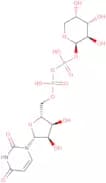
CAS:<p>UDP-b-L-arabinopyranose is a nucleotide sugar that is used in the synthesis of proteins and other macromolecules. It is synthesized from uridine and d-ribulose 5-phosphate by the enzyme ribulokinase. The reaction between UDP, b-L-arabinofuranose, and ATP, catalyzed by arabinofuranosyl transferase, produces UDP-b-L-arabinopyranose. This nucleotide sugar can be converted to UDP-b-(1→4)-glucuronate by the enzyme glucuronosyltransferase. This process plays an important role in plant physiology as well as in cell wall biosynthesis. The optimal pH for this conversion is 7.5 to 8.2.</p>Fórmula:C14H22N2O16P2Pureza:Min. 95%Forma y color:PowderPeso molecular:536.28 g/molL-Tagatose
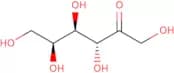
CAS:<p>Low-calorie sweetener; additive in detergents, cosmetics, and pharmaceuticals</p>Fórmula:C6H12O6Pureza:Min. 98 Area-%Forma y color:White PowderPeso molecular:180.16 g/molLentinan
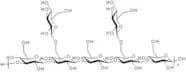
CAS:<p>The polysaccharide Lentinan is isolated from the mushroom L. edodes (shitake mushroom). The primary structure is a β-(1–3)-glucose backbone with two (1–6)-β-glucose branches for each five glucose resiodues. Lentinan is clinically used for cancer treatment both in China and Japan. According to the clinical studies published in and outside of China, lentinan-based drugs are used for the treatment of various cancers, including lung, gastric, colorectal and other cancers. In addition, lentinan-based drugs are also used for treating HIV, hepatitis and malignant pleural effusion.</p>Forma y color:Brown PowderN-(Fmoc)-C-b-D-galacturonyl methylamine
<p>Fmoc-C-b-D-galacturonyl methylamine is a custom synthesis that is used in the modification of oligosaccharides and carbohydrates. It is also used as a precursor for the synthesis of glycosylated saccharides by methylation, glycosylation, and fluorination. Fmoc-C-b-D-galacturonyl methylamine has been shown to be an excellent starting material for the production of high purity complex carbohydrates.</p>Pureza:Min. 95%epi-Inositol
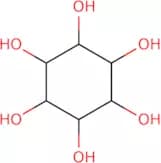
CAS:<p>Epi-inositol, also known as myo-inositol, is a member of the group of molecules known as sugar alcohols. It is a naturally occurring compound that is found in the human body and can be synthesized by the human body from glucose. Epi-inositol has been shown to have a number of biological effects, including inhibition of cell proliferation and energy metabolism in ovarian cancer cells. Epi-inositol has also been used in clinical trials for treatment of mood disorders such as depression.</p>Fórmula:C6H12O6Pureza:Min. 98 Area-%Forma y color:White PowderPeso molecular:180.16 g/molN-Acetyl-2-O-methyl-α-D-neuraminic acid
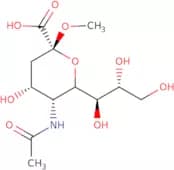
CAS:<p>N-acetylneuraminic acid derivative and a useful tool for the study of sialic acid binding to its ligands. It was previously used for such purpose in studies on the influenza binding to hemagglutinin. This compound was also used for investigation of Clostridium botulinum toxin binding to various sugars.</p>Fórmula:C12H21NO9Pureza:Min. 95%Forma y color:White PowderPeso molecular:323.3 g/mol1,3,4,6-Tetra-O-acetyl-2-deoxy-2-fluoro-D-galactopyranose
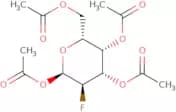
CAS:<p>1,3,4,6-Tetra-O-acetyl-2-deoxy-2-fluoro-D-galactopyranose is a fluorinated sugar that is used in the synthesis of glycosides. It is a synthetic compound that is prepared by reacting 1,3,4,6-tetraacetyl galactose with potassium bifluoride and diethyl oxalate in presence of anhydrous sodium sulfate. The product obtained has the following structural formula: The chemical name for this compound is 1,3,4,6-Tetraacetyl -2-[(1R)-1-(ethoxycarbonyl)propyl]-2-(fluorooxymethyl) -D-galactopyranose. The CAS number for this compound is 83697–45–4.</p>Fórmula:C14H19FO9Pureza:(As Sum Of Anomers) Min. 98 Area-%Forma y color:White PowderPeso molecular:350.3 g/molN-Acetyl-D-mannosamine-6-phosphate disodium salt
CAS:<p>Precursor of N-acetylneuraminic acid</p>Fórmula:C8H14NO9P·2NaPureza:Min. 95%Forma y color:White PowderPeso molecular:345.15 g/mol4-Methoxyphenyl 2,4,6-tri-O-benzyl-b-D-galactopyranoside
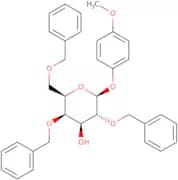
CAS:<p>4-Methoxyphenyl 2,4,6-tri-O-benzyl-b-D-galactopyranoside is a custom synthesis that belongs to the group of complex carbohydrates. It is an Oligosaccharide with CAS No. 247027-79-8 and Polysaccharide. 4MPG has been modified by Methylation, Glycosylation, Carbohydrate, Click modification, sugar, High purity, Fluorination and Synthetic methods. This product is available in high purity and can be used for research purposes.</p>Fórmula:C34H36O7Pureza:Min. 97 Area-%Forma y color:PowderPeso molecular:556.65 g/molPhenyl 2,4,6-Tri-O-acetyl-3-O-allyl-b-D-thioglucopyranoside
CAS:<p>Phenyl 2,4,6-tri-O-acetyl-3-O-allyl-β-D-thioglucopyranoside is an enantiomer that can be synthesized from the commercially available 2,4,6-triacetylphenyl boronic acid. It has been shown to have a positive effect on insulin sensitivity and uptake in plasma glucose in diabetic patients. Phenyl 2,4,6-tri-O-acetyl-3-O-allyl β D thioglucopyranoside also has a safety profile that is similar to other antidiabetic drugs. This drug has been shown to inhibit influenza virus uptake into cells by competitive inhibition of a transporter type.</p>Fórmula:C21H26O8SPureza:Min. 98 Area-%Forma y color:White Off-White PowderPeso molecular:438.49 g/mol4-Methoxyphenyl β-D-glucopyranoside
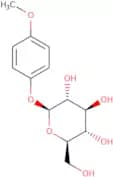
CAS:<p>Bearberry has been used for centuries to treat various disorders of the urinary tract and prostate. The active ingredient in bearberry is a flavonol glycoside called arbutin, which is converted to hydroquinone during metabolism. As an antioxidant, hydroquinone inhibits the oxidation of LDL cholesterol and may reduce the risk of atherosclerosis. Hydroquinone has also been shown to have anti-inflammatory properties in rat liver microsomes and tissue culture, inhibiting prostaglandin synthesis by blocking cyclooxygenase activity. In vitro, bearberry extracts have been shown to inhibit bacterial growth on agar plates with pH levels from 4-7 and at concentrations between 0.1-1%. It was found that bearberry extracts were most effective against Pseudomonas aeruginosa strains, with MIC values ranging from 2-4 mg/mL. Bearberry extract was observed to be more effective than ampicillin against these strains in a chromatographic assay.</p>Fórmula:C13H18O7Pureza:Min. 95%Forma y color:PowderPeso molecular:286.28 g/moltrans-Zeatin-7-glucoside
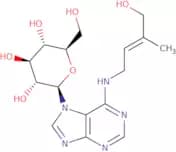
CAS:<p>Trans-zeatin-7-glucoside is an abscisic acid (ABA) metabolite that can be found in plant tissue. It is used as a natural product to regulate growth and development. Trans-zeatin-7-glucoside has been shown to inhibit the biosynthesis of gibberellins, which are plant hormones that promote cell elongation. This compound is purified from plant tissues by chromatographic methods, such as reversed phase HPLC or ion exchange chromatography. The sample preparation involves extraction with a solvent such as methanol or chloroform followed by purification on an analytical column. Immunoaffinity chromatography is also used for sample preparation, which involves binding to antibody molecules on the surface of a solid support material. Trans-zeatin-7-glucoside can be detected using analytical methods such as gas chromatography or liquid chromatography coupled with mass spectrometry. Trans-zeatin-7-</p>Fórmula:C16H23N5O6Pureza:Min. 95 Area-%Forma y color:PowderPeso molecular:381.38 g/mola-D-Glucopyranosyl fluoride
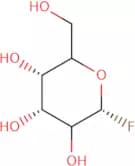
CAS:<p>a-D-Glucopyranosyl fluoride is an irreversible inhibitor of the enzyme glycosidase. This product has been used to study the kinetic and mechanism of human serum alpha-glucosidase, which is a key enzyme in the digestion of carbohydrates. Kinetic studies have shown that 4-hydroxycinnamic acid and glucose are competitive inhibitors of the enzyme. The reaction mechanism for this product involves hydrogen fluoride cleavage of the glycosidic bond. The optimum pH for this product is 7.</p>Fórmula:C6H11FO5Pureza:Min. 95%Forma y color:White PowderPeso molecular:182.15 g/molAllyl 2-acetamido-2-deoxy-β-D-glucopyranoside
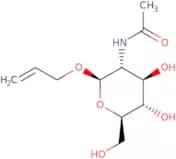
CAS:<p>Allyl 2-acetamido-2-deoxy-β-D-glucopyranoside is a modification of the sugar molecule. It is an oligosaccharide composed of a monosaccharide and one or more other saccharides.</p>Fórmula:C11H19NO6Pureza:Min. 98 Area-%Forma y color:PowderPeso molecular:261.27 g/mol4-Methylphenyl 4,6-O-[bis(1,1-dimethylethyl)silylene]-1-thio-β-D-galactopyranoside
CAS:<p>4-Methylphenyl 4,6-O-[bis(1,1-dimethylethyl)silylene]-1-thio-β-D-galactopyranoside is a synthetic sugar that is used in the glycosylation of proteins. It is synthesized from 4-methylphenol and 1,1'-dimethylethylsilylene in the presence of trichlorosilane, followed by silylation with trimethylchlorosilane. The fluorinated site can be modified to suit your needs by following a Click chemistry protocol. This product has CAS No. 1242144-05-3 and is available for custom synthesis upon request.</p>Fórmula:C21H34O5SSiPureza:Min. 95%Peso molecular:426.64 g/mol1,3,5-Tri-O-benzoyl-a-D-ribofuranose
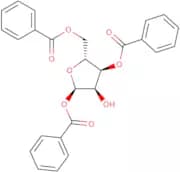
CAS:<p>1,3,5-Tri-O-benzoyl-a-D-ribofuranose is a modified carbohydrate. It is synthesized by the methylation of 1,3,5-tri-O-benzoyl-a-D-arabinopyranose followed by glycosylation with 3,6-dideoxyhexose. This compound has been used as a substrate in enzymatic studies to investigate the modification of carbohydrates by glycosylation and methylation and can be used for the synthesis of other saccharides.</p>Fórmula:C26H22O8Pureza:Min. 95%Forma y color:White PowderPeso molecular:462.45 g/molMethyl 2,3,4,6-tetra-O-benzyl-b-D-thiogalactopyranoside
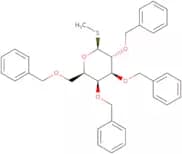
CAS:<p>Methyl 2,3,4,6-tetra-O-benzyl-b-D-thiogalactopyranoside is a synthetic monosaccharide that has been modified with fluorination and glycosylation. It is a product of the click reaction, which is a chemical modification that involves the formation of an aziridine and an alkene in one step. This product has been used for the synthesis of oligosaccharides and complex carbohydrates.</p>Fórmula:C35H38O5SPureza:Min. 95%Forma y color:PowderPeso molecular:570.74 g/molMethyl 2,3,4,6-tetra-O-benzyl-α-D-glucopyranoside
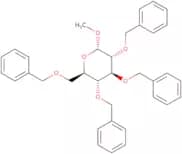
CAS:<p>Methyl 2,3,4,6-tetra-O-benzyl-α-D-glucopyranoside is a benzylated glycoside that inhibits the activity of β-glucosidases and glycoside hydrolases. It is used as an inhibitor in ecological studies to investigate the effects of benzyl groups on biotic and abiotic stressors. Methyl 2,3,4,6-tetra-O-benzyl-α-D-glucopyranoside has been shown to have inhibitory potency against the transition state in enzymatic reactions. This compound also has been shown to be effective in treating diabetes.</p>Fórmula:C35H38O6Pureza:Min. 95%Forma y color:PowderPeso molecular:554.67 g/mol




![4-Methylphenyl 4,6-O-[bis(1,1-dimethylethyl)silylene]-1-thio-β-D-galactopyranoside](/_next/image/?url=https%3A%2Fstatic.cymitquimica.com%2Fproducts%2F3D%2Fthumb-webp%2FMM182806.webp&w=3840&q=75)