Monosacáridos
Los monosacáridos son la forma más simple de los carbohidratos y sirven como bloques fundamentales para azúcares más complejos y polisacáridos. Estas moléculas de azúcar única juegan roles críticos en el metabolismo energético, la comunicación celular y los componentes estructurales de las células. En esta sección, encontrará una amplia variedad de monosacáridos esenciales para la investigación en bioquímica, biología molecular y glicociencia. Estos compuestos son cruciales para estudiar las rutas metabólicas, los procesos de glucosilación y el desarrollo de agentes terapéuticos. En CymitQuimica, ofrecemos monosacáridos de alta calidad para apoyar sus necesidades de investigación, asegurando precisión y fiabilidad en sus investigaciones científicas.
Subcategorías de "Monosacáridos"
- Allosas(11 productos)
- Arabinosas(21 productos)
- Eritrosas(11 productos)
- Fructosas(9 productos)
- Fucosas(36 productos)
- Galactosamina(41 productos)
- Galactosa(261 productos)
- Glucosas(365 productos)
- Ácidos glucurónicos(51 productos)
- Glico-sustratos para enzimas(77 productos)
- Gulosas(6 productos)
- Idosas(4 productos)
- Inositoles(15 productos)
- Lyxosas(4 productos)
- Manosas(65 productos)
- O-glicanos(48 productos)
- Psicosas(3 productos)
- Ramnosas(10 productos)
- Ribosas(61 productos)
- Ácidos siálicos(100 productos)
- Sorbosas(4 productos)
- Azúcares(173 productos)
- Tagatosis(4 productos)
- Taloses(8 productos)
- Xilosas(20 productos)
Mostrar 17 subcategorías más
Se han encontrado 6090 productos de "Monosacáridos"
Ordenar por
Pureza (%)
0
100
|
0
|
50
|
90
|
95
|
100
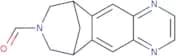
N-Formyl varenicline
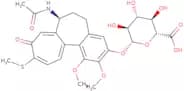
CAS:<p>N-Formyl varenicline is a drug substance that is used as a pharmaceutical preparation. It has the regulatory status of an investigational new drug (IND). N-Formyl varenicline is supplied in the form of a white to off-white powder and is incompatible with iron oxides, so care must be taken when handling this product. This material has been shown to have fluorescence properties and can be detected using a fluorimetric detector. The drug substance has not been evaluated for excipients or diode compatibility.</p>Fórmula:C14H13N3OPureza:Min. 95%Peso molecular:239.27 g/mol3-Desmethylthiocolchicine-3-O-D-glucuronide
CAS:<p>3-Desmethylthiocolchicine-3-O-D-glucuronide is a compound that has been custom synthesized, with a purity of >95%. The compound is an oligosaccharide and polysaccharide containing saccharides and carbohydrates.</p>Fórmula:C27H31NO11SPureza:Min. 95%Peso molecular:577.6 g/molMycophenolic acid phenolic b-D-glucoside
CAS:<p>Mycophenolic acid phenolic b-D-glucoside is a high purity custom synthesis that can be modified to suit customer requirements. It is a complex carbohydrate with a methyl group, fluorine atom, and glycosylation. The chemical name for Mycophenolic acid phenolic b-D-glucoside is CAS No. 55533-52-3. This product is also known as Glycosylation, Oligosaccharide, sugar, Synthetic, Fluorination, Custom synthesis, Methylation, Monosaccharide, Polysaccharide, saccharide. Click modification or Modification.</p>Fórmula:C23H30O11Pureza:Min. 95%Peso molecular:482.48 g/mol2,3,4,6-Tetra-O-(4-methoxybenzyl)-D-galactopyranosyl fluoride
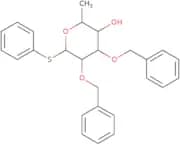
CAS:<p>2,3,4,6-Tetra-O-(4-methoxybenzyl)-D-galactopyranosyl fluoride is a custom synthesis. It is a complex carbohydrate that belongs to the group of carbohydrates and saccharides. This product has been modified by glycosylation, carbamoylation, methylation, and fluorination. The purity of this product is high.</p>Fórmula:C38H43FO9Pureza:Min. 95%Peso molecular:662.74 g/molPhenyl 2,3-di-O-benzyl-6-deoxy-b-D-thioglucopyranoside
CAS:<p>Phenyl 2,3-di-O-benzyl-6-deoxy-b-D-thioglucopyranoside is a synthetic glycosylated sugar with a fluorinated benzene ring. It is used as an intermediate in the synthesis of oligosaccharides, polysaccharides and saccharides. Phenyl 2,3-di-O-benzyl-6-deoxy-b-D-thioglucopyranoside has an appearance of a white powder and a melting point of around 100°C. This compound has been evaluated for its purity and quality by analytical methods such as high performance liquid chromatography (HPLC), gas chromatography (GC) and nuclear magnetic resonance (NMR).</p>Fórmula:C26H28O4SPureza:Min. 95%Peso molecular:436.56 g/mol4-Isothiocyanatophenyl-b-D-glucopyranoside
CAS:4-Isothiocyanatophenyl-b-D-glucopyranoside is an electrophilic compound that can be used as a reagent in organic synthesis. It reacts with nucleophiles and is used for nitro reduction, sulfoxide formation, and phenoxy formation. The structure of the molecule is characterized by two chiral centers. The reactivity of this molecule depends on the orientation of the substituents on the two chiral centers. 4-Isothiocyanatophenyl-b-D-glucopyranoside can also be used to form esters. The ethoxycarbonyl group (C=O) on one end of the molecule reacts with carboxylic acids to form esters, while at the other end of the molecule, hydroxy groups (OH) react with alcohols to form ethers.Fórmula:C13H15NO6SPureza:Min. 95%Peso molecular:313.33 g/molMethyl 2,4-di-O-acetyl-b-D-xylopyranoside
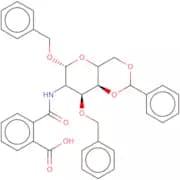
CAS:<p>Methyl 2,4-di-O-acetyl-b-D-xylopyranoside (MDX) is an epoxide that has been found to stimulate the growth of Schizophyllum commune and other fungi. It is structurally related to vicinal diols, which are known to inhibit esterases and hydrolyze acetyl groups. The acetyl groups on MDX can be reduced by hydride reduction or by hydrolysis with acetylated esters. MDX inhibits bacterial growth by inhibiting protein synthesis through its structural similarity to deoxyribose phosphate, a component of DNA.</p>Fórmula:C10H16O7Pureza:Min. 95%Peso molecular:248.2 g/mol1,3-Di-O-benzyl-4,6-O-benzylidene-2-(2-carboxybenzimido)-2-deoxy-b-D-glucopyranoside
<p>1,3-Di-O-benzyl-4,6-O-benzylidene-2-(2-carboxybenzimido)-2-deoxy-b-D-glucopyranoside (1,3DBG) is a glycosylation compound that is a natural product of the reaction between 1,3,4,6 tetra-, 2,3-, or 3,4-, dihydroxyacetone and benzaldehyde. This compound is an important building block for the synthesis of complex carbohydrates. 1,3DBG can be modified with methyl groups through click chemistry and fluorination reactions. It can also be modified by saccharide modification and acetal formation with polyols. The CAS number is 139027-06-0.</p>Fórmula:C35H33NO8Pureza:Min. 95%Peso molecular:595.64 g/mol(5-Hydroxy rosiglitazone)-b-D-glucuronide
CAS:<p>(5-Hydroxy rosiglitazone)-b-D-glucuronide is a custom synthesis of a fluorinated derivative of rosiglitazone. This compound is modified by methylation, monosaccharide, and glycosylation to form a complex carbohydrate. The saccharide structure includes glucose, galactose, xylose, and arabinose. This molecule has CAS number 288853-59-8 and is listed in the Polysaccharides category.</p>Fórmula:C24H27N3O10SPureza:Min. 95%Forma y color:Off-white solid.Peso molecular:549.55 g/mol3,2',3',4'-Tetra-O-acetyl-6,6'-di-O-tert-butyldiphenylsilyl-lactal
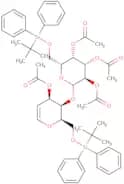
CAS:<p>3,2',3',4'-Tetra-O-acetyl-6,6'-di-O-tert-butyldiphenylsilyl-lactal is a modification of the oligosaccharide. The structure of this compound is an alpha-(1→4)-linked beta-D-galactopyranosyl residue, which is attached to a 3,2',3',4'-tetra-O-acetyl 6,6'-di-O-[ tert -butyldiphenylsilyl] lactal residue. This compound has been shown to be synthesized by methylation and glycosylation of the monosaccharide maltose. This modification has also been shown to inhibit the growth of bacteria. CAS No. 308103-45-9</p>Pureza:Min. 95%3,6-Di-O-benzyl-D-glucal
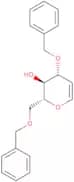
CAS:3,6-Di-O-benzyl-D-glucal is a substrate for the enzyme fatty acid hydroxylase. This enzyme catalyzes the hydroxylation of fatty acids to produce hydroxy fatty acids and 3,6-di-O-benzyl-D-glucal. The stereoselective nature of this enzyme has been shown using microscopy to examine the reaction time in both monolayers and bilayers. The kinetics of this reaction have also been analyzed by kinetic analysis. It is thought that this reaction takes place in the cytosol, although it may also occur in mitochondria or chloroplasts.Fórmula:C20H22O4Pureza:Min. 95%Peso molecular:326.39 g/molPhenyl 3,4-O-(2',3'-dimethoxybutan-2',3'-diyl)-a-L-thiorhamnopyranoside
CAS:Phenyl 3,4-O-(2',3'-dimethoxybutan-2',3'-diyl)-a-L-thiorhamnopyranoside is a custom synthesis of an oligosaccharide, monosaccharide, and fluorinated sugar. This synthetic compound is a complex carbohydrate that is glycosylated with a polysaccharide. The modification of this molecule includes methylation and sugar modifications. This product is high purity and can be used as a research chemical.Fórmula:C18H26O6SPureza:Min. 95%Peso molecular:370.46 g/molPhenyl 2-O-benzoyl-4,6-O-benzylidene-3-O-(4-methoxybenzyl)-a-D-thiomannopyranoside
<p>Phenyl 2-O-benzoyl-4,6-O-benzylidene-3-O-(4-methoxybenzyl)-a-D-thiomannopyranoside is a custom synthesis. It is a polysaccharide that can be modified with methylation, glycosylation, click modification and fluorination. This compound is a white powder that has high purity and is suitable for use in the production of oligosaccharides or polysaccharides.</p>Fórmula:C34H32O7SPureza:Min. 95%Peso molecular:584.68 g/molErigeside C
CAS:<p>Erigeside C is a flavonoid derivative that has been shown to be effective in treating allergic symptoms. Erigeside C inhibits the production of various pro-inflammatory cytokines, such as IL-6 and TNF-α, by inhibiting the activity of protein kinase C (PKC). The compound also inhibits the production of prostaglandin E2 by inhibiting cyclooxygenase-2. In addition, Erigeside C is able to inhibit the release of histamine from mast cells. This antihistamine effect is due to its ability to inhibit oxidation reactions in the cell membrane and block cellular calcium channels.</p>Pureza:Min. 95%p -Coumaroyl L-arabinofuranoside
Coumaroyl L-arabinofuranoside is a glycosylation agent that has been used in the synthesis of complex carbohydrates, polysaccharides, and oligosaccharides. The compound can be fluorinated to give p-coumaroylfluoride. It is also possible to methylate the compound with methanol and methyl iodide. The compound can be modified by Click chemistry reactions to form a reactive ester or an amine. Coumaroyl L-arabinofuranoside is available as a CAS number and can be custom synthesized. It is available at high purity. !--Pureza:Min. 95%1,2-Dideoxy-2'-dimethylamino-a-D-glucopyranoso-[2,1-d]-2'-thiazoline
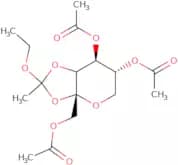
CAS:<p>1,2-Dideoxy-2'-dimethylamino-a-D-glucopyranoso-[2,1-d]-2'-thiazoline is a synthetic sugar that is used in the synthesis of complex carbohydrates. It can be used to modify polysaccharides and glycosyls with methyl groups. This product has high purity and custom synthesis.</p>Fórmula:C9H16N2O4SPureza:Min. 95%Peso molecular:248.3 g/mol3,4,6-Tri-O-acetyl-1,2-O-ethoxyethylidene-a-D-fructopyranose
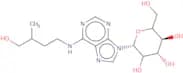
<p>3,4,6-Tri-O-acetyl-1,2-O-ethoxyethylidene-a-D-fructopyranose is a modified carbohydrate with the chemical formula C 12 H 20 O 8 . It is a white crystalline solid that is soluble in water. 3,4,6-Tri-O-acetyl-1,2-O-ethoxyethylidene-a-Dfructopyranose can be used as a monosaccharide or an oligosaccharide. This compound has been synthesized by methylation and glycosylation of glucose.</p>Fórmula:C16H24O10Pureza:Min. 95%Peso molecular:376.36 g/molDihydrozeatin-9-glucoside
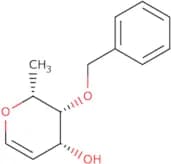
CAS:<p>Dihydrozeatin-9-glucoside is a conjugate of the natural product dihydrozeatin and glucose. The glucoside has been found to inhibit the growth of plants, which may be due to its ability to bind to polyclonal antibodies. Dihydrozeatin-9-glucoside is also an immunogen that has been shown to produce monoclonal antibodies in tissue culture. It has been used for immunoaffinity chromatography and as a biochemical marker for plant tissue cultures. Dihydrozeatin-9-glucoside binds to wheat leaf cells and inhibits their growth, making it a potential tool for the study of plant cell death.</p>Fórmula:C16H25N5O6Pureza:Min. 95 Area-%Forma y color:White PowderPeso molecular:383.4 g/mol4-O-Benzyl-D-galactal
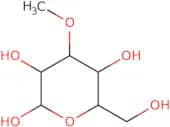
CAS:<p>4-O-Benzyl-D-galactal is a benzylated Oligosaccharide. It can be custom synthesized and modified according to your requirements. 4-O-Benzyl-D-galactal can be used as a raw material for the synthesis of polysaccharides and saccharides. This product has high purity with low impurities, and can be used for the synthesis of highly functional polysaccharides and saccharides.</p>Fórmula:C13H16O4Pureza:Min. 95%Peso molecular:236.26 g/mol2-C-Methyl-D-mannopyranose
CAS:2-C-Methyl-D-mannopyranose is a low molecular weight sugar that is found in the cell walls of bacteria and some plants. It has been shown to have an immunostimulating effect when administered to mice with murine sarcoma. 2-C-Methyl-D-mannopyranose has also been shown to be cytotoxic against murine leukemia cells. This compound has a glycosidic structure and can be hydrolyzed by acid or alkali to form mannose. 2-C-Methyl-D-mannopyranose can be synthesized using ion exchange chromatography, which separates compounds according to their molecular weight. The molecular weights of this compound range from low to high, with a monomeric unit of 160 Da. The nmr spectra of this compound show peaks at 1.5 ppm corresponding to the C=O stretching vibration and at 7 ppm corresponding to the C=N stretchingFórmula:C7H14O6Pureza:Min. 95%Peso molecular:194.18 g/mol









![1,2-Dideoxy-2'-dimethylamino-a-D-glucopyranoso-[2,1-d]-2'-thiazoline](/_next/image/?url=https%3A%2Fstatic.cymitquimica.com%2Fproducts%2F3D%2Fthumb-webp%2FMD15731.webp&w=3840&q=75)