Monosacáridos
Los monosacáridos son la forma más simple de los carbohidratos y sirven como bloques fundamentales para azúcares más complejos y polisacáridos. Estas moléculas de azúcar única juegan roles críticos en el metabolismo energético, la comunicación celular y los componentes estructurales de las células. En esta sección, encontrará una amplia variedad de monosacáridos esenciales para la investigación en bioquímica, biología molecular y glicociencia. Estos compuestos son cruciales para estudiar las rutas metabólicas, los procesos de glucosilación y el desarrollo de agentes terapéuticos. En CymitQuimica, ofrecemos monosacáridos de alta calidad para apoyar sus necesidades de investigación, asegurando precisión y fiabilidad en sus investigaciones científicas.
Subcategorías de "Monosacáridos"
- Allosas(11 productos)
- Arabinosas(21 productos)
- Eritrosas(11 productos)
- Fructosas(9 productos)
- Fucosas(36 productos)
- Galactosamina(41 productos)
- Galactosa(261 productos)
- Glucosas(365 productos)
- Ácidos glucurónicos(51 productos)
- Glico-sustratos para enzimas(77 productos)
- Gulosas(6 productos)
- Idosas(4 productos)
- Inositoles(15 productos)
- Lyxosas(4 productos)
- Manosas(65 productos)
- O-glicanos(48 productos)
- Psicosas(3 productos)
- Ramnosas(10 productos)
- Ribosas(61 productos)
- Ácidos siálicos(100 productos)
- Sorbosas(4 productos)
- Azúcares(173 productos)
- Tagatosis(4 productos)
- Taloses(8 productos)
- Xilosas(20 productos)
Mostrar 17 subcategorías más
Se han encontrado 6090 productos de "Monosacáridos"
Ordenar por
Pureza (%)
0
100
|
0
|
50
|
90
|
95
|
100
1-Amino-1-deoxy-D-glucitol hydrochloride
CAS:1-Amino-1-deoxy-D-glucitol hydrochloride (AMDG) is a compound that has been synthesized to inhibit the enzyme chondroitin sulfate. Chondroitin sulfate is an important component of cartilage and plays a role in the inflammatory response. It also inhibits the production of gamma-aminobutyric acid, which is an inhibitory neurotransmitter. AMDG can be used as a treatment for pain by inhibiting the transmission of pain signals through the nervous system. AMDG also has anti-inflammatory effects, which may be due to its ability to suppress prostaglandin synthesis.Pureza:Min. 95%Keto-D-fructose phthalazin-1-ylhydrazone
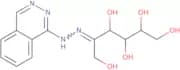
CAS:<p>Keto-D-fructose phthalazin-1-ylhydrazone is an Methylation and saccharide that can be used for the Click modification of polysaccharides, oligosaccharides, and carbohydrates. It is also used for the Modification of glycosylated proteins, as well as for the synthesis of complex carbohydrates. This compound has been shown to be effective in a number of synthetic reactions, including Fluorination. Keto-D-fructose phthalazin-1-ylhydrazone has a CAS Number of 1082040-10-5.</p>Fórmula:C14H18N4O5Pureza:Min. 95%Peso molecular:322.32 g/mol1,2,3,5,6-Penta-O-propanoyl-b-D-glucofuranose
<p>1,2,3,5,6-Penta-O-propanoyl-b-D-glucofuranose is a methylated sugar. It is a polysaccharide consisting of 1,2,3,5,6-penta-O-propanoyl-b-D-glucopyranosyl units linked by β-(1→4)-glycosidic bonds. This carbohydrate can be used in the synthesis of oligosaccharides and glycosylation reactions. 1,2,3,5,6-Penta-O-propanoyl b -D -glucofuranose has been fluorinated to give pentafluorobenzoyl b -D -glucofuranose which is used for click modification.</p>Pureza:Min. 95%2-Azido-3,4,6-tri-O-benzyl-2-deoxy-D-glucopyranose
<p>Silver trifluoromethanesulfonate is an ionic silver reagent that is used to modify polysaccharides. It has been shown that the triethylamine can be substituted with other strong bases, such as potassium t-butoxide. This reagent reacts with chlorides to produce 2-azido-3,4,6-tri-O-benzyl-2-deoxy-D-glucopyranose. The modification of this compound is important for the study of glycosylation reactions and for understanding the structure of polysaccharides.</p>Pureza:Min. 95%2,6-Di-O-benzoyl-methyl-a-D-glucopyranoside
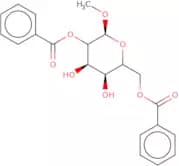
CAS:2,6-Di-O-benzoyl-methyl-a-D-glucopyranoside is a custom synthesis that is an oligosaccharide. It has a molecular weight of 590.17 g/mol and a formula weight of 594.22 g/mol. 2,6-Di-O-benzoyl-methyl-a-D-glucopyranoside has the following structure:Fórmula:C21H22O8Pureza:Min. 95%Peso molecular:402.39 g/molMethyl 2,3,4-tri-O-methyl-b-D-glucopyranoside
CAS:<p>Methylated glucose glycoside with 6 position free</p>Pureza:Min. 95%5-Deoxy-1,2-O-isopropylidene-5-[(2R-pyridin-4-yl-pyrrolidine)-1-yl]-a-D-xylofuranose
CAS:5-Deoxy-1,2-O-isopropylidene-5-[(2R-pyridin-4-yl-pyrrolidine)-1-yl]-a-D-xylofuranose is a synthetic sugar that can be custom synthesized. This sugar has been modified with fluorination and glycosylation. It is also methylated and has been modified by the addition of saccharide chains.Fórmula:C17H24N2O4Pureza:Min. 95%Peso molecular:320.39 g/molD-myo-Inositol-1,3,4,5-tetraphosphate sodium salt
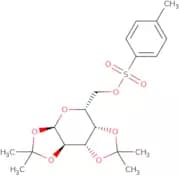
CAS:<p>D-Myo-Inositol-1,3,4,5-tetraphosphate sodium salt (DMIPS) is a naturally occurring form of inositol that has been shown to lower the glycaemic index of foods and increase the absorption of carbohydrates. DMIPS is a chromatographic method for quantifying phytate in food. Phytate is an anion that binds to dietary minerals such as iron and zinc and prevents their absorption. DMIPS can be used to reduce the level of phytate in food by adding it to the meal before cooking or boiling. The use of DMIPS in combination with phytase has been shown to be beneficial for those who are suffering from diabetes and nutrient deficiencies, such as those who have undergone gastric bypass surgery.</p>Fórmula:C6H8O18P4·8NaPureza:Min. 95%Peso molecular:675.93 g/mol1,2:3,4-Di-O-isopropylidene-6-O-p-toluenesulfonyl-a-D-galactopyranose
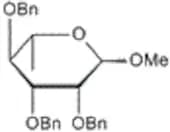
CAS:<p>1,2:3,4-Di-O-isopropylidene-6-O-p-toluenesulfonyl-a-D-galactopyranose is a liquid at room temperature. It has been shown to form gas at temperatures below -78°C and solid at higher temperatures. 1,2:3,4 Di-O-isopropylidene-6-O p toluenesulfonyl a D galactopyranose has been shown to have magnetic properties that can be used in a particle detector. The compound has also been studied using simulations and spectrometry. 1,2:3,4 Di-O-isopropylidene 6 O p toluenesulfonyl a D galactopyranose is an electron acceptor and an electron donor. It has been shown to have absorption bands in the range of 190 nm - 400 nm as well as in</p>Fórmula:C19H26O8SPureza:Min. 95%Forma y color:Brown PowderPeso molecular:414.47 g/molMethyl 2,3,4-tri-O-benzyl-L-rhamnopyranoside
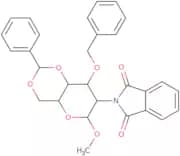
CAS:Methyl 2,3,4-tri-O-benzyl-L-rhamnopyranoside is a sugar that is used in the synthesis of oligosaccharides and saccharides. This compound has been shown to be an intermediate for the synthesis of benzylidene acetone phosphate, which can be used as a precursor for polymers that have potential use in biomedical applications.Fórmula:C28H32O5Pureza:Min. 95%Peso molecular:448.55 g/molMethyl 3-O-benzyl-4,6-O-benzylidene-2-deoxy-2-phthalimido-b-D-glucopyranose
CAS:Methyl 3-O-benzyl-4,6-O-benzylidene-2-deoxy-2-phthalimido-b-D-glucopyranose is a synthetic chemical that is used in the modification of saccharides. It has been shown to be an efficient and economical way to introduce methyl groups into saccharide chains. This product is a white solid that is soluble in water, ethanol, and chloroform. Methyl 3-O-benzyl-4,6-O-benzylidene-2-deoxy -2 -phthalimido -b -D -glucopyranose has a molecular weight of 564.1 grams per mole and an empirical formula of C14H22N2O8P. It has CAS number 97276–96–5 and can be found under code XA0433.Fórmula:C29H27NO7Pureza:Min. 95%Peso molecular:501.53 g/mol4,5-O-Isopropylidene-b-D-fructopyranose
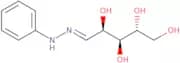
CAS:<p>4,5-O-Isopropylidene-b-D-fructopyranose is a fluorinated monosaccharide that is synthesized by the glycosylation of an aldonic acid with an appropriate sugar. It is soluble in water and many organic solvents. 4,5-O-Isopropylidene-b-D-fructopyranose can be used to synthesize a variety of oligosaccharides and polysaccharides. This product has been modified with methyl groups at various positions on the sugar ring. The chemical name for this product is 4,5-O-[2-(1,1,3,3,-tetramethylbutyl)phenoxy]isopropylidene b-[2-(2,2,6,6,-tetramethylpiperidiniumoxy)ethoxy] D-[beta]-D -fructopyran</p>Fórmula:C9H16O6Pureza:Min. 95%Peso molecular:220.22 g/molD-Arabinose phenylhydrazone
CAS:D-Arabinose phenylhydrazone is a synthetic compound that is used in the study of stereoisomers. It has a D-arabinose and a phenylhydrazine group, which are connected through an amide linkage. D-Arabinose phenylhydrazone is structurally similar to the natural ligand for phosphatase, bovine serum albumin (BSA). This similarity allows it to be used as a substrate for BSA, and also as a ligand for phosphatase enzymes. The acidic functional groups on this molecule allow it to react with tissues and tissue samples that contain carboxylic acid groups. This makes it useful in the study of human urine and tissue samples from other mammals.Fórmula:C11H16N2O4Pureza:Min. 95%Peso molecular:240.26 g/mol(2R,3R,4S,5R,6S)-3,4,5-Trihydroxy-2-hydroxymethyl-7,9-diaza-1-oxa-spiro[4,5]decane-10-one-8-thione
CAS:<p>(2R,3R,4S,5R,6S)-3,4,5-Trihydroxy-2-hydroxymethyl-7,9-diaza-1-oxa-spiro[4,5]decane-10-one-8-thione is a custom synthesis of a polysaccharide. It has been modified to include fluorination and methylation. The monosaccharides present are glucose and galactose. This polysaccharide also has a saccharide linkage to an oligosaccharide that contains glycosylation sites for sugar groups.</p>Fórmula:C8H12N2O6SPureza:Min. 95%Peso molecular:264.26 g/mol2-Acetyl-5-methoxyphenyl beta-D-Glucopyranoside
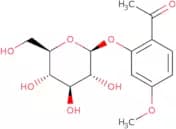
CAS:<p>2-Acetyl-5-methoxyphenyl beta-D-glucopyranoside is a flavonoid that belongs to the group of dihydroquercetin. It can be prepared by liquid chromatography. 2-Acetyl-5-methoxyphenyl beta-D-glucopyranoside inhibits tumor cells in vitro and in vivo, through the inhibition of protein synthesis and DNA replication. In addition, it has been shown to inhibit the growth of leptadenia species with a high degree of selectivity. It also exhibits an antitumor effect on mouse sarcoma 180 cells, as well as on human melanoma cells. This compound binds to macroporous adsorbents such as sephadex and tricusposide, which are used for purification purposes.</p>Fórmula:C15H20O8Pureza:Min. 95%Peso molecular:328.31 g/mol5-Deoxy-2-O-methanesulfonyl-5-tridecyl-D-ribofuranose
<p>5-Deoxy-2-O-methanesulfonyl-5-tridecyl-D-ribofuranose is a fluorinated saccharide that is an important structural component of glycosaminoglycans. It can be used in the synthesis of oligosaccharides, which are complex carbohydrates, and has been shown to be useful for the modification of glycoproteins. 5DMSTDF is a synthetic monosaccharide that has been modified with methyl groups and fluorine atoms.</p>Fórmula:C19H38O6SPureza:Min. 95%Peso molecular:394.57 g/molMethyl-2,3-O-isopropylidene-a-D-mannopyranoside
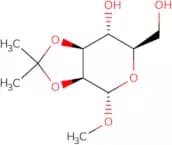
CAS:<p>Methyl-2,3-O-isopropylidene-a-D-mannopyranoside is a glycosyl compound synthesized by the enzymatic hydrolysis of mannose. It has an alcohol group and a heptopyranoside group. The glycosyl compound is used in the synthesis of various pharmaceuticals and agrochemicals.</p>Pureza:Min. 95%D-myo-Inositol-2,3-O-cyclohexylidene
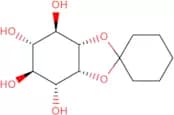
CAS:<p>D-myo-Inositol-2,3-O-cyclohexylidene is a lipase. It hydrolyzes esters and triglycerides, which are found in many natural and synthetic products. D-myo-Inositol-2,3-O-cyclohexylidene is more effective at hydrolyzing fats than porcine pancreatic lipase. This enzyme has been shown to be enantioselective for some solvents, such as vinyl acetate. D-myo-Inositol-2,3-O-cyclohexylidene also has the ability to produce butyrate from fatty acids.</p>Fórmula:C12H20O6Pureza:Min. 95%Peso molecular:260.28 g/molMethyl β-neuraminic acid
CAS:<p>Methyl β-neuraminic acid is a neuraminidase inhibitor that is used to treat influenza. It inhibits the action of the influenza virus by blocking its ability to attach to the host cell and enter. Methyl β-neuraminic acid has been shown to be effective in treating influenza A and B, with an efficacy of 92%. The drug is also effective against respiratory syncytial virus and adenovirus, as well as for prevention of flu in healthy adults. In addition, methyl β-neuraminic acid is able to prevent or reduce the severity of influenza when taken prophylactically. It can be administered orally or intravenously. Methyl β-neuraminic acid is often used as a synthetic reagent because it has both acetyl groups and hydroxyl groups. The optimum pH for this compound is 5.5-7.5 at room temperature.</p>Fórmula:C10H19NO8Pureza:Min. 95%Forma y color:White PowderPeso molecular:281.26 g/mol3-Methylphenyl 2-acetamido-3,4,6-tri-O-acetyl-2-deoxy-b-D-glucopyranoside
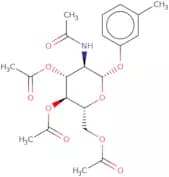
CAS:3-Methylphenyl 2-acetamido-3,4,6-tri-O-acetyl-2-deoxy-b-D-glucopyranoside is a synthetic chemical compound. It has been shown to have antiviral activity and inhibit the growth of bacteria.Fórmula:C21H27NO9Pureza:Min. 95%Peso molecular:437.44 g/mol



![5-Deoxy-1,2-O-isopropylidene-5-[(2R-pyridin-4-yl-pyrrolidine)-1-yl]-a-D-xylofuranose](/_next/image/?url=https%3A%2Fstatic.cymitquimica.com%2Fproducts%2F3D%2Fthumb-webp%2FMD07488.webp&w=3840&q=75)


![(2R,3R,4S,5R,6S)-3,4,5-Trihydroxy-2-hydroxymethyl-7,9-diaza-1-oxa-spiro[4,5]decane-10-one-8-thione](/_next/image/?url=https%3A%2Fstatic.cymitquimica.com%2Fproducts%2F3D%2Fthumb-webp%2FMT01909.webp&w=3840&q=75)