Péptidos
Subcategorías de "Péptidos"
Se han encontrado 29863 productos de "Péptidos"
Fmoc-Lys(Palmitoyl-Glu-OtBu)-OH
CAS:This is a building block for peptide synthesis. It is a protected lysine derivative that can be used in the formation of peptides. This functionalized lysine derivative can be deprotected and reacted with other amino acids to form peptides. The protecting group, Fmoc, protects the lysine from unwanted reactions during the synthesis process. The side chain, Palmitoyl-Glu-OtBu, allows for the attachment of other molecules to the lysine side chain.Fórmula:C46H69N3O8Pureza:Min. 95%Peso molecular:792.08 g/molGly-Pro
CAS:Gly-Pro is a cyclic peptide that binds to DPP-IV and inhibits proteolytic activity. It has been shown to have inhibitory properties against infectious diseases and cancer tissues, as well as a fluorescence probe for the detection of DPP-IV. Gly-Pro is also a potential inhibitor of neuronal death and has been shown to have structural analysis in the form of molecular docking analysis.
Fórmula:C7H12N2O3Pureza:Min. 95%Peso molecular:172.18 g/molH-Ala-Tyr-Pro-Gly-Lys-Phe-OH
CAS:H-Ala-Tyr-Pro-Gly-Lys-Phe-OH is a peptide that activates toll-like receptor 4 (TLR4). It is a potent inhibitor of the enzyme phospholipase A2 and has been shown to inhibit the production of proinflammatory cytokines, such as IL1β, IL6, IL8, and TNFα. This peptide also has anti-inflammatory effects on autoimmune diseases, such as rheumatoid arthritis. H-Ala-Tyr-Pro-Gly-Lys-Phe-OH has been shown to inhibit prostate cancer cell growth in vitro and in vivo. It appears to exert its action by interfering with the transcriptional process at the level of RNA polymerase II. The mechanism may involve inhibition of the activation of basic fibroblast cells or suppression of epidermal growth factor signaling. H-Ala-Tyr - Pro - Gly - Lys - Phe -
Fórmula:C34H47N7O8Pureza:Min. 95%Peso molecular:681.78 g/molAmyloid Beta-Protein (40-1)
CAS:Amyloid Beta-Protein (40-1) is a peptide that is found in the brain, and is thought to be involved in Alzheimer’s disease. Amyloid Beta-Protein (40-1) has been shown to inhibit protein interactions and activator functions, as well as act as a ligand for receptors. This protein can be used as a research tool for studying ion channels and antibodies. It also has high purity and can be used for life science experiments.Fórmula:C194H295N53O58SPureza:Min. 95%Peso molecular:4,329.8 g/molFmoc-D-Asp(OtBu)-OH
CAS:Fmoc-D-Asp(OtBu)-OH is a cell biology research tool that can be used to study protein interactions and ion channels. It also has been used as an inhibitor for the activation of receptor tyrosine kinases, including human epidermal growth factor receptor 2 (HER2) in breast cancer cells. Fmoc-D-Asp(OtBu)-OH is a high purity compound that is available with CAS No. 112883-39-3.
Fórmula:C23H25NO6Pureza:Min. 95%Peso molecular:411.46 g/molGuanylin
CAS:Guanylin peptide hormone which is an activator of the transmembrane receptor Guanylate Cyclase C located on the surface of intestinal epithelial cells. It is sourced from Rat, Mouse species and contains disulfide bonds between Cys4-Cys12 and Cys7-Cys15.
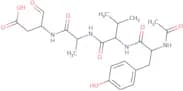
Fórmula:C60H90N16O22S4Pureza:Min. 95%Peso molecular:1,515.7 g/molAc-Tyr-Val-Ala-Asp-H (aldehyde)
CAS:Ac-Tyr-Val-Ala-Asp-H (aldehyde) is a peptide that inhibits the activity of protein tyrosine phosphatases, which are enzymes that remove phosphate groups from proteins. This agent binds to the amino acid side chains of an enzyme and prevents it from binding to its substrate. Ac-Tyr-Val-Ala-Asp-H (aldehyde) is a research tool that can be used in life sciences as an inhibitor or activator for peptides, receptors, and ion channels. Ac-Tyr-Val-Ala-Asp-H (aldehyde) has been shown to be active in the inhibition of protein tyrosine phosphatase 1B and 2A isoforms.
Fórmula:C23H32N4O8Pureza:Min. 95%Peso molecular:492.52 g/molPyClocK®
CAS:PyClocK® is a monoclonal antibody that binds to the HIV-1 surface protein, gp120. It is used in diagnostic immunoassays for the detection of anti-HIV antibodies and in preparative high performance liquid chromatography (HPLC) of glycopeptides, which are cyclic peptides that are produced by bacteria. PyClocK® also has been shown to bind to vasoactive intestinal peptide and cyclic peptide receptors, which may be involved in autoimmune diseases or metabolic disorders. The conformational properties of this antibody have been determined using X-ray crystallography on the monoclonal antibody.Fórmula:C18H27N6OF6ClP2Pureza:Min. 98.0 Area-%Peso molecular:554.85 g/molFibronectin Active Fragment (GRGDS)
CAS:Fibronectin is an extracellular matrix protein that plays a critical role in cell adhesion, migration, and differentiation. Fibronectin subunits are composed of repeating units of three types of modules: type I, type II, and type III. The active fragment of fibronectin refers to a small peptide sequence within the type III modules of fibronectin that has been shown to have potent biological activity.
The fibronectin active fragment, also known as the cell-binding domain or RGD domain, is a short peptide sequence consisting of the amino acid sequence Arg-Gly-Asp (RGD). This peptide sequence interacts with cell surface receptors known as integrins, which are important for mediating cell adhesion, migration, and signaling.
The fibronectin active fragment has been extensively studied as a research tool to investigate the mechanisms of cell adhesion and migration. It has also been used in tissue engineering applications to promote cell attachment and proliferation on synthetic biomaterials.Fórmula:C17H30N8O9CH3COOHH2OPureza:Min. 95%Peso molecular:490.47 g/molBoc-Leu-OH • 2O
CAS:Boc-Leu-OH • 2O is a monomer for the synthesis of peptides. It is hydrophobic and can be used as a polymer matrix for the synthesis of polypeptides. Boc-Leu-OH • 2O is obtained from nature and can be prepared by hydrolysis of chloroformate ester or hydrogen chloride in dioxane.
Boc-Leu-OH • 2O has been shown to have chiral properties and can be detected using microscopy, dichroism, or amino acid analysis.Fórmula:C11H21NO4•H2OPureza:Min. 95%Peso molecular:249.31 g/molCOMU Reagent
CAS:COMU reagent is a copper-containing, natural compound that can be used in intrauterine diagnosis. The COMU reagent has been shown to have potent antagonistic activity against the CB2 receptor and hydrogen bond donor site. This product also can be used to detect the presence of peptide hormones, such as LH and FSH, in urine samples. The COMU reagent has been shown to bind to integrin receptors on cells, which are involved in cell adhesion and migration. The conformational properties of this compound allow it to form a complex with cyclic peptides that are found in human liver cells infected with hepatitis C virus (HCV).Fórmula:C12H19N4O4F6PPureza:Min. 95%Peso molecular:428.27 g/molFmoc-D-Cys(Trt)-OH
CAS:Fmoc-D-Cys(Trt)-OH is a synthetic peptide that can be used as a research tool in cell biology and pharmacology. It has an ion channel blocking effect and is a potent activator of the receptor GPR75. Fmoc-D-Cys(Trt)-OH is soluble in water and displays high purity, with a CAS No. 167015-11-4. This product can be used to study protein interactions, ion channels, and receptors. Fmoc-D-Cys(Trt)-OH can also be used as an antibody or cell biology reagent, as well as an inhibitor for certain enzymes such as tyrosine hydroxylase.Fórmula:C37H31NO4SPureza:Min. 95%Peso molecular:585.73 g/molBoc-Glu(OcHex)-OH
CAS:Boc-Glu(OcHex)-OH is a peptide inhibitor that is used in research to study the effects of protein interactions. Boc-Glu(OcHex)-OH binds specifically to the receptor and blocks ligand binding, preventing activation. This drug is an ion channel activator and an antibody against this drug has been developed. Boc-Glu(OcHex)-OH is soluble in water at ambient temperatures and has a purity of 99%.
Fórmula:C16H27NO6Pureza:Min. 95%Peso molecular:329.39 g/molBOP Reagent
CAS:BOP Reagent is a reagent that reacts with the phosphate group of dinucleotide phosphates, such as those found in DNA and RNA. It can be used for structural analysis and to determine the presence of nucleic acids in human serum or other biological samples. The BOP Reagent binds to the phosphate group by means of intramolecular hydrogen bonding. This reaction generates a transient, covalently-bound enzyme-substrate complex that can be detected by fluorescence probe.
Fórmula:C12H22N6OF6P2Pureza:Min. 95%Peso molecular:442.29 g/molFmoc-Gln(Trt)-OH
CAS:Fmoc-Gln(Trt)-OH is a synthetic, acid-stable, antimicrobial peptide that can be used as an analytical reagent. It has been shown to inhibit the growth of mammalian cells and bacterial cells in vitro by binding to nicotinic acetylcholine receptors. Fmoc-Gln(Trt)-OH contains sequences that are found in microbial proteins, suggesting that it may have antimicrobial activity against bacteria. The chemical diversity within this molecule may also contribute to its antimicrobial activity.
Fórmula:C39H34N2O5Pureza:Min. 98.0 Area-%Peso molecular:610.72 g/molBoc-His(Tos)-OH
CAS:Boc-His(Tos)-OH is an activating reagent for solid-phase peptide synthesis. It can be used as a building block for the synthesis of peptide chains on a solid support. Boc-His(Tos)-OH is typically used in conjunction with other reagents, such as Fmoc-amino acids and DCC, to synthesize amino acid sequences on the surface of the resin. This reagent is often used in high-throughput peptide synthesis protocols.
Fórmula:C18H23N3O6SPureza:Min. 95%Peso molecular:409.46 g/molPyBOP
CAS:PyBOP is an acyclic nucleoside phosphonate that is structurally similar to cyclic peptides and coumarin derivatives. It has been shown to be active against infectious diseases such as malaria and hepatitis C, as well as metabolic disorders such as obesity. PyBOP also has a number of physiological effects, including thermal expansion and immunomodulation. PyBOP binds to the 3'-hydroxyl group of RNA by hydrogen bonding interactions in vivo and inhibits rRNA synthesis, leading to the inhibition of protein synthesis. This drug also disrupts the disulfide bond between cysteine residues in proteins, which may lead to autoimmune diseases. PyBOP is water-soluble and highly soluble in organic solvents, but not soluble in water or polar solvents such as DMSO or acetone. br>br> The thermal expansion coefficient for PyBOP is about 10^6 K^-1mol^
Fórmula:C18H28N6OP2F6Pureza:Min. 95%Peso molecular:520.39 g/molH-Ser-Leu-Ile-Gly-Lys-Val-NH2
CAS:H-Ser-Leu-Ile-Gly-Lys-Val-NH2 is a synthetic peptide that is a cyclase inhibitor. It binds to the receptor for neurokinin 1, which has been shown to inhibit lacrimal gland function in rats. The compound also inhibits the synthesis of epidermal growth factor and has been shown to have anti-inflammatory effects in mouse models. H-Ser-Leu-Ile-Gly-Lys-Val-NH2 has also been shown to inhibit protease activity in rat prostate cells and can be used as a chemical inhibitor for proteases.Fórmula:C25H54N8O7Pureza:Min. 95%Peso molecular:614.79 g/molAbz-Leu-Ala-Gln-Ala-Val-Arg-Ser-Ser-Ser-Arg-Dap(Dnp)-NH2
CAS:Abz-Leu-Ala-Gln-Ala-Val-Arg-Ser-Ser-Ser-Arg-Dap(Dnp)-NH2 is a synthetic peptide that binds to the toll receptor. The binding of this peptide leads to the signal pathways, which are responsible for the body formation. Abz-Leu-Ala-Gln-Ala-Val-Arg-Ser-Ser-Ser Arg Dap (Dnp) -NH2 has been shown to have an antiinflammatory effect in rats. This peptide also has a dna binding activity and can be used as a marker for granule neurons in the brain.
Fórmula:C59H93N23O20Pureza:Min. 95%Peso molecular:1,444.54 g/molBNP-32 (Human)
CAS:BNP-32 is a peptide that has been shown to activate G-protein coupled receptors and ion channels. It is known to be an agonist of the receptor for bradykinin and vasoactive intestinal peptide, as well as the receptor for neurotensin, which is a member of the tachykinin family. BNP-32 can also inhibit ligand binding to some receptors, such as those for calcitonin gene-related peptide (CGRP) and substance P (SP). BNP-32 has been used as a research tool in cell biology and pharmacology.
Fórmula:C143H244N50O42S4Pureza:Min. 95%Peso molecular:3,464.05 g/mol