CAS 6915-15-7
:Acide malique
Description :
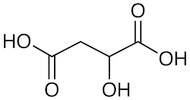
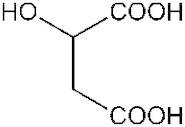
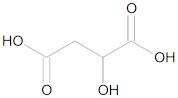
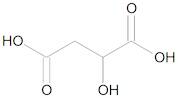
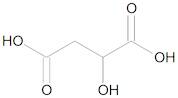
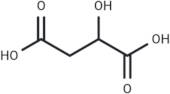
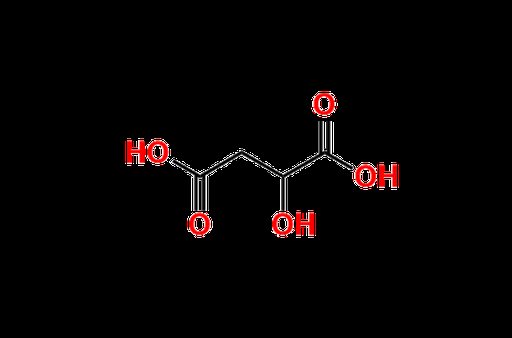
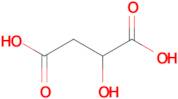
Acide malique, avec le numéro CAS 6915-15-7, est un composé organique naturellement présent, classé comme un acide dicarboxylique. Il se caractérise par ses deux groupes fonctionnels carboxyles (-COOH), qui contribuent à ses propriétés acides. Acide malique est un solide cristallin incolore, soluble dans l'eau et présente un goût acidulé, que l'on trouve couramment dans divers fruits, en particulier les pommes. Il joue un rôle significatif dans le cycle de Krebs, une voie métabolique cruciale pour la production d'énergie dans les organismes vivants. Le composé a une formule moléculaire de C4H6O5 et un poids moléculaire d'environ 134,09 g/mol. En plus de son importance biologique, Acide malique est utilisé dans l'industrie alimentaire et des boissons comme agent aromatisant et acidifiant, améliorant le goût des produits. Il trouve également des applications dans les cosmétiques et les produits pharmaceutiques en raison de ses propriétés exfoliantes. Dans l'ensemble, Acide malique est apprécié pour ses rôles multifonctionnels dans divers secteurs, grâce à sa structure chimique unique et à ses propriétés.
Formule :C4H6O5
InChI :InChI=1S/C4H6O5/c5-2(4(8)9)1-3(6)7/h2,5H,1H2,(H,6,7)(H,8,9)
Code InChI :InChIKey=BJEPYKJPYRNKOW-UHFFFAOYSA-N
SMILES :C(CC(O)=O)(C(O)=O)O
Synonymes :- (2R)-2-hydroxybutanedioate
- 2-Hydroxybutanedioic Acid
- 2-Hydroxyethane-1,2-dicarboxylic acid
- 2-Hydroxysuccinic acid
- <span class="text-smallcaps">DL</span>-Malic acid
- Acide malique
- Acido Malico
- Apfelsaeure
- Apfelsaure
- Butanedioic Acid, Hydroxy-, (D,L)-
- Butanedioic acid, 2-hydroxy-
- Butanedioic acid, hydroxy-
- DL-Hydroxysuccinic acid
- Deoxytetraric acid
- Dl-Malic Acid, Hydroxysuccinic Acid
- E 296
- Fda 2018
- Hydroxybutanedioic acid
- Hydroxysuccinic acid
- Malic Acid, Dl
- Malic acid
- Malicacidpfelsure
- Monohydroxybutanedioic acid
- Musashi-no-Ringosan
- Nanoveson M
- Nsc 25941
- Pomalus Acid
- Purac MA
- Purac Powder MA
- R,S(.+-.)-Malic acid
- Xeros
- Voir plus de synonymes
Filtrer par
Pourcentage de pureté
0
100
|
0
|
50
|
90
|
95
|
100
- Tri par prix ascendant
- Tri par prix descendant
- Puretés inférieures
- Puretés supérieures
- Livraison estimée la plus rapide
DL-Malic Acid
CAS :Formule :C4H6O5Degré de pureté :>99.0%(T)Couleur et forme :White to Almost white powder to crystalMasse moléculaire :134.09DL-Malic acid, 98%
CAS :DL-Malic acid, 98%, Thermo Scientific ChemicalsFormule :C4H6O5Degré de pureté :98%Couleur et forme :White to cream, Crystalline powder or crystalsMasse moléculaire :134.09Malic Acid
CAS :Carboxylic acids w/ alcohol function but w/o other oxygen function and their derivatives, nesoiFormule :C4H6O5Couleur et forme :White Crystalline PowderMasse moléculaire :134.02152Malic Acid, 10mM (in DMSO)
CAS :Malic Acid, 10mM (in DMSO)Formule :C4H6O5Degré de pureté :≥95%, 10 mM in DMSOCouleur et forme :LiquidMasse moléculaire :134.09Malic Acid
CAS :Malic AcidFormule :C4H6O5Degré de pureté :98%Couleur et forme :SolidMasse moléculaire :134.09DL-Malic acid
CAS :Formule :C4H6O5Degré de pureté :99.0 - 100.5 %Couleur et forme :White crystalline powderMasse moléculaire :134.09DL-Malic Acid
CAS :Formule :C4H6O5Degré de pureté :95%Couleur et forme :SolidMasse moléculaire :134.0874DL-Malic Acid
CAS :Applications The naturally occuring isomer is the L-form which has been found in apples and many other fruits and plants. Selective α-amino protecting reagent for amino acid derivatives. Versatile synthon for the preparation of chiral compounds including κ-opioid receptor agonists, 1α,25-dihydroxyvitamin D3 analogue, and phoslactomycin B.
References Rindi, G., et al.: Biochem. J., 80, 214 (1961), Wolfgang, M., et al.: J. Biol. Chem., 281, 37265 (2006), Navarro, D., et al.: Metab. Brain Dis., 23, 115 (2008),Formule :C4H6O5Couleur et forme :NeatMasse moléculaire :134.09Malic acid
CAS :Malic acid reduces L. monocytogenes in poultry and may help treat calcium kidney stones.Formule :C4H6O5Degré de pureté :99.86% - BRCouleur et forme :White SolidMasse moléculaire :134.0874DL-Malic acid
CAS :Formule :C4H6O5Degré de pureté :95.0%Couleur et forme :SolidMasse moléculaire :134.0872-Hydroxysuccinic acid
CAS :2-Hydroxysuccinic acidFormule :C4H6O5Degré de pureté :95%Masse moléculaire :134.09