Organoborane
6122 produits trouvés pour "Organoborane"
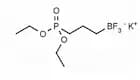
Potassium (3-(diethoxyphosphoryl)propyl)trifluoroborate
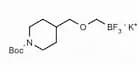
Degré de pureté :95%Masse moléculaire :286.078Potassium (1-Boc-4-piperidinylmethoxyoxy)methyltrifluoroborate
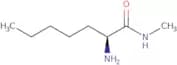
CAS :Degré de pureté :>95%Masse moléculaire :335.212Poly ε L-lysine HCl - Average MW 2000~4700Da
CAS :Antimicrobial cationic peptide; used for microscopy glass slides coating
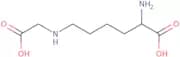
Formule :(C6H12N2O•HCl)nDegré de pureté :Min. 95 Area-%Couleur et forme :White Yellow PowderN-ε-(1-Carboxymethyl)-L-lysine
CAS :N-ε-(1-Carboxymethyl)-L-lysine (NEM) is a versatile building block that is used in the synthesis of complex compounds. It is a reagent and speciality chemical that can be used as an intermediate to produce other useful chemicals or as a reaction component. It has been shown to be useful in the synthesis of peptides, oligonucleotides, and organic molecules. NEM has also been shown to have high quality and purity, making it a useful scaffold for further research into new compounds.
Formule :C8H16N2O4Degré de pureté :Min. 97%Couleur et forme :White PowderMasse moléculaire :204.22 g/molRef: 3D-FC19791
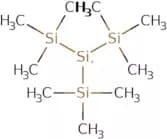
Produit arrêtéTris(trimethylsilyl)silane
CAS :Tris(trimethylsilyl)silane is a reactive functional group that is used in the synthesis of monoclonal antibodies. It reacts with halides to form an intermediate, which then undergoes chain reactions with other molecules to form the final product. Tris(trimethylsilyl)silane can be used for cancer therapy and for the detection of antibodies. It has been shown that tris(trimethylsilyl)silane will react with a light emitting compound (e.g., 4-dimethylaminopyridine) and a cationic polymerization initiator (e.g., diallyldimethylammonium chloride). This reaction produces high values of light emission, which can be detected by x-ray crystal structures.
Formule :C9H28Si4Degré de pureté :Min. 97 Area-%Couleur et forme :Clear LiquidMasse moléculaire :248.66 g/mol2,3-Dimethoxyphenylboronic acid
CAS :2,3-Dimethoxyphenylboronic acid is a synthetic molecule that contains a boronic acid group. This compound has been shown to interact with histones H3 and L6. It has also been shown to modify lysine residues on the histone H3 protein by methylation. In addition, 2,3-dimethoxyphenylboronic acid interacts with other molecules in a way that changes their conformation and this interaction can be studied using vibrational spectroscopy. Organic chemists may use 2,3-dimethoxyphenylboronic acid as a ligand for biological targets or as a means of modifying proteins.
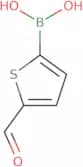
Formule :C8H11BO4Degré de pureté :Min. 95%Couleur et forme :PowderMasse moléculaire :181.98 g/mol5-Formyl-2-thiopheneboronic acid
CAS :5-Formyl-2-thiopheneboronic acid is a synthetic molecule that has been shown to be an effective electron microscope stabilizer. It is a boronate ester with a formyl group at the 2-position and a thiophene ring at the 5-position. The chloride in this molecule is used as a functional group, which can then react with other molecules to form new compounds. The functional theory of 5-formyl-2-thiopheneboronic acid includes its ability to form bonds with other molecules and its use as an inorganic base. The particle size of 5-formyl-2-thiopheneboronic acid is unsymmetrical, making it different from other molecules.
Formule :C5H5BO3SDegré de pureté :Min. 95%Couleur et forme :PowderMasse moléculaire :155.97 g/molTriphenylchlorosilane
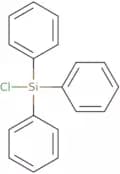
CAS :Triphenylchlorosilane is a reactive compound that has been used as a model system for studying the reaction of congestive heart failure. It has been shown to inhibit energy metabolism and cell factor, which are important factors in the progression of congestive heart failure. Triphenylchlorosilane also reacts with p-hydroxybenzoic acid to form an unstable intermediate, which undergoes intramolecular hydrogen transfer to give the final product. The reaction mechanism is proposed to be a coordination geometry involving three chlorine atoms. This compound is not reactive with sodium salts or structural analysis, but it does bind signal peptide in vivo models and can be used as a probe for protein-protein interactions.
Formule :C18H15ClSiDegré de pureté :Min. 95%Couleur et forme :PowderMasse moléculaire :294.85 g/mol4-Isopropylphenylboronic acid
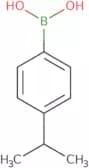
CAS :4-Isopropylphenylboronic acid is a chiral organic chemical that is used as a Grignard reagent. It is an optically pure compound that can be isolated by recrystallization. The optical purity of 4-isopropylphenylboronic acid has been confirmed by the red shift observed in its IR spectrum. This compound undergoes nucleophilic substitution reactions, and it also catalyses the hydrostannylation of styrene with phenyllithium or butyllithium. The synthesis of this molecule requires relatively mild reaction conditions, and it can be obtained in high yield.
Formule :C9H13BO2Degré de pureté :Min. 95%Couleur et forme :PowderMasse moléculaire :164.01 g/molNα-Z-Nε-Boc-D-lysine methyl ester
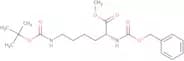
CAS :Please enquire for more information about Nα-Z-Nε-Boc-D-lysine methyl ester including the price, delivery time and more detailed product information at the technical inquiry form on this page
Formule :C20H30N2O6Degré de pureté :Min. 95%Couleur et forme :PowderMasse moléculaire :394.46 g/molRef: 3D-FB48942
Produit arrêté(-)-Bis(pinanediolato)diboron
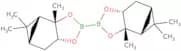
CAS :(-)-Bis(pinanediolato)diboron is a reactive component that can be used as a reagent. It reacts with alkenes to form pinacolboronates, which are useful for the synthesis of complex compounds. (-)-Bis(pinanediolato)diboron is also an intermediate in the synthesis of diboronic acid and pinacolborane. This compound has broad utility as a building block, scaffold, or intermediate in organic synthesis.
-Pinanediolato boron is also a versatile building block that can be used to synthesize many other chemical compounds. For example, it can be used as an intermediate to synthesize (-)-pinanediol and 3-hydroxy-1-methylpyridinium iodide (3HMPI), which are speciality chemicals.
-Pinanediolato boron is also an excellent building block for organic synthesis due to its abilityFormule :C20H32B2O4Degré de pureté :Min. 95%Couleur et forme :White SolidMasse moléculaire :358.09 g/mol1-(Trimethylsilyl)-2-naphthyl Trifluoromethanesulfonate
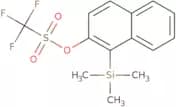
CAS :1-(Trimethylsilyl)-2-naphthyl Trifluoromethanesulfonate is a solvent that has been used for the synthesis of oxygen heterocycles. It is also used as a reagent to cleave bonds in organic molecules, such as alkene, solvents, aldehydes and activated esters. This compound is an unsymmetrical nucleophile that reacts with electron-poor alkenes to generate an unsaturated bond between two carbons. Mechanistic studies have shown that the reaction proceeds through a concerted mechanism involving the formation of a covalent phosphine intermediate.
Formule :C14H15F3O3SSiDegré de pureté :Min. 95%Couleur et forme :PowderMasse moléculaire :348.41 g/molO-(2-Trimethylsilylethyl)hydroxylamine HCl
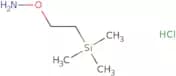
CAS :O-(2-Trimethylsilylethyl)hydroxylamine HCl is a fine chemical that can be used as a versatile building block in the synthesis of complex compounds. It is also an intermediate for research chemicals, reagents, and speciality chemicals. O-(2-Trimethylsilylethyl)hydroxylamine HCl can be used as a reaction component in organic synthesis and has been shown to be useful in the synthesis of new scaffolds.
Formule :C5H15NOSi·HClDegré de pureté :Min. 95%Couleur et forme :White PowderMasse moléculaire :169.72 g/molNonafluorohexyltrichlorosilane
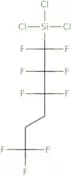
CAS :Nonafluorohexyltrichlorosilane is a silicon-based surfactant that can be used as a surface treatment agent. It is hydrophilic and has excellent wetting properties. Nonafluorohexyltrichlorosilane is also an effective coagulant, which makes it useful for the treatment of wastewater containing suspended solids. This agent can be used to coat surfaces with silicon to make them more hydrophobic, making it useful in the production of photoreceptors, emulsions, and immobilized cell culture. The chemical structure of Nonafluorohexyltrichlorosilane allows it to be easily synthesized by the reaction between chlorosilanes and alcohols.
Formule :C6H4Cl3F9SiDegré de pureté :Min. 95%Couleur et forme :Clear LiquidMasse moléculaire :381.53 g/mol