Organoborane
Les organoboranes sont des composés organiques caractérisés par la présence d'atomes de bore liés au carbone. Ces composés sont des dérivés de la molécule BH3 et jouent un rôle important dans diverses réactions chimiques, notamment comme intermédiaires en synthèse organique. Chez CymitQuimica, nous proposons une large gamme d'organoboranes pour répondre à vos besoins en recherche et en industrie. Nos produits sont conçus pour offrir des performances élevées et une fiabilité dans vos processus de synthèse.
6123 produits trouvés pour "Organoborane"
Trier par
Degré de pureté (%)
0
100
|
0
|
50
|
90
|
95
|
100
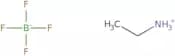
Ethylammonium Tetrafluoroborate
CAS :Produit contrôlé<p>Ethylammonium tetrafluoroborate is an ionic liquid that is a colorless, nonvolatile liquid at room temperature. It has a melting point of -9 °C and a boiling point of 230 °C. This compound is soluble in water and organic solvents, but insoluble in diethyl ether. Ethylammonium tetrafluoroborate can be used as an electrolyte for lithium-ion batteries. The reversible oxidation reaction of ethylammonium tetrafluoroborate can be catalyzed by the addition of fluorine or carbonyl groups to the molecule. The NMR spectra of ethylammonium tetrafluoroborate show that it contains an alcohol group with a phase transition temperature near 35 °C and an activation energy near 15 kJ/mol. This compound also undergoes polymerization reactions with various types of monomers, such as vinyl acetate and methyl methacrylate,</p>Formule :C2H7BF4NDegré de pureté :Min. 95%Couleur et forme :PowderMasse moléculaire :131.89 g/molIron(II) tetrafluoroborate - 40-45% aqueous solution
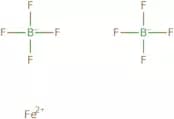
CAS :<p>Iron(II) tetrafluoroborate is a green-yellow crystalline solid that is soluble in water. It has been shown to have structural and optical properties that are similar to those of ferric chloride, but with the advantage of being less toxic. Iron(II) tetrafluoroborate is used as a homogeneous catalyst for organic reactions such as the hydrogenation of nitroarenes and the reduction of ketones. The catalytic activity of Iron(II) tetrafluoroborate arises from its ability to form hydrogen bonding interactions with other molecules and ions in solution.<br>Iron(II) tetrafluoroborate undergoes a number of reactions with other compounds, including cleavage products such as hydrogen sulfate and nitrogen atoms, which may be due to its chelate ligand. In coordination chemistry, Iron(II) tetrafluoroborate can form coordination complexes by reacting with potassium dichromate or calcium carbonate. These complexes are</p>Formule :B2F8FeDegré de pureté :About 45%Couleur et forme :Slightly Green Clear LiquidMasse moléculaire :229.45 g/mol(3,4,5-Trifluorophenyl)boronic acid
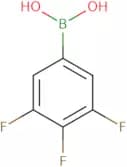
CAS :<p>The trifluorophenylboronic acid is a boronic acid that has been used in the synthesis of vitamin B12. This compound is often used as a catalyst for the Suzuki coupling reaction. It can also be used to synthesize amides and synthons. The trifluorophenylboronic acid is soluble in water, ethanol, and acetone. The pH of the solution depends on the type of base added. For example, when an amine is added to the solution, it increases to approximately 8-9. When a p-hydroxybenzoic acid is added to the solution, it decreases to approximately 2-3.</p>Formule :C6H4BF3O2Degré de pureté :Min. 95%Couleur et forme :PowderMasse moléculaire :175.9 g/mol