Glycosciences
Sous-catégories appartenant à la catégorie "Glycosciences"
- Aminosucres(108 produits)
- Anticorps Glyco-Related(284 produits)
- Glycolipides(46 produits)
- Glycosaminoglycanes (GAGs)(55 produits)
- Glycosides(419 produits)
- Monosaccharides(6.622 produits)
- Oligosaccharides(3.701 produits)
- Polysaccharides(505 produits)
11034 produits trouvés pour "Glycosciences"
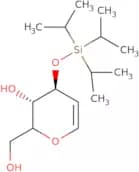
3-O-Triisopropylsilyl-D-galactal
3-O-Triisopropylsilyl-D-galactal is a carbohydrate that belongs to the group of sugars. It is an oligosaccharide with a complex structure, which is synthesized from D-galactal by treatment with triisopropylsilyl chloride in pyridine. 3-O-Triisopropylsilyl-D-galactal is used as a reagent for the methylation and glycosylation of proteins and nucleic acids. This compound has been shown to inhibit the enzyme carboxypeptidase A, which may be due to its ability to act as an inhibitor of carbohydrate binding. 3-O-Triisopropylsilyl-D-galactal has also been shown to bind specifically to erythrocyte membranes, suggesting that it could be used as a potential diagnostic marker for glycogen storage diseases.
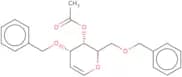
Formule :C15H30O4SiDegré de pureté :Min. 95%Masse moléculaire :302.48 g/mol4-O-Acetyl-3,6-di-O-benzyl-D-glucal
CAS :4-O-Acetyl-3,6-di-O-benzyl-D-glucal is a custom synthesized compound with high purity. This product is a complex carbohydrate that can be used as a monosaccharide or sugar. It has been modified with fluorination and methylation to produce a compound that is resistant to degradation by enzymes and oxidation. The CAS number for this product is 165524-87-8.
Formule :C22H24O5Degré de pureté :Min. 95%Masse moléculaire :368.43 g/molD-Ribopyranosyl thiosemicarbazide
CAS :D-Ribopyranosyl thiosemicarbazide is a glycosylation agent that can be used in the synthesis of complex carbohydrates. It also has the ability to modify sugar structures, such as methylation, click modification, and fluorination. This reagent can be used for the modification of saccharides, oligosaccharides, and monosaccharides. D-Ribopyranosyl thiosemicarbazide is synthesized from d-ribose and thiosemicarbazide. The CAS number for this product is 95352-77-5.
Formule :C6H13N3O4SDegré de pureté :Min. 95%Masse moléculaire :223.25 g/mol5-(S-2-Pyridin-3-yl-pyrrolidine)-1-yl-5-deoxy-1,2-isopropylidene-a-D-xylofuranose
CAS :5-(S-2-Pyridin-3-yl-pyrrolidine)-1-yl-5-deoxy-1,2-isopropylidene-a-D-xylofuranose is a glycosylated sugar which can be modified with methyl groups, fluorine atoms, and saccharides. This compound has been synthesized in the laboratory and has not been found in nature. It is soluble in water and ethanol. The compound is available for custom synthesis to order.Formule :C17H24N2O4Degré de pureté :Min. 95%Masse moléculaire :320.39 g/molDipalmitin
CAS :Dipalmitin is a chemical substance that belongs to the group of fatty acid esters. It has been shown to inhibit the activity of a number of enzymes, including proteases and lipases. Dipalmitin also inhibits the production of diacylglycerol and glycerides in cells, which are necessary for cellular growth. The exact mechanism by which dipalmitin inhibits these enzymes is unknown, but it has been hypothesized that it may function as a competitive inhibitor or an allosteric inhibitor. Dipalmitin also has been shown to have antiviral properties against HIV infection in model systems. The antiviral activity has been attributed to its ability to inhibit viral protein synthesis and block the assembly of viral particles at the cell membrane.
Formule :C35H68O5Degré de pureté :Min. 95%Masse moléculaire :568.91 g/mol(-)-Lyoniresinol 9'-O-glucoside
CAS :This chemical is a custom synthesis of (-)-Lyoniresinol 9'-O-glucoside. The chemical is a modification of (-)-Lyoniresinol 9'-O-glucoside and fluorinated at the C2 position. It is also methylated on the C3 position. The chemical is synthesized by click chemistry, which involves the use of copper(II) ions as catalysts to generate covalent bonds between two molecules. This chemical has been shown to be an oligosaccharide with saccharide chains that are linked together by glycosylation. There are six sugar residues in this compound: glucose, galactose, rhamnose, xylose, glucuronic acid, and mannitol. This compound has CAS number 143236-02-6 and molecular weight of 881.5 g/mol (CAS No.).
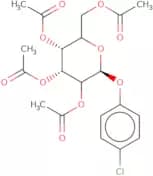
Formule :C28H38O13Degré de pureté :Min. 95%Masse moléculaire :582.59 g/mol4-Chlorophenyl-2,3,4,6-tetra-O-acetyl-b-D-glucopyranoside
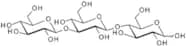
CAS :4-Chlorophenyl-2,3,4,6-tetra-O-acetyl-b-D-glucopyranoside is a custom synthesis of an Oligosaccharide. It is a synthetic compound that contains a sugar that is attached to a 4 chlorophenol. The glycosylation process has been completed with the addition of an acetate group. This product is fluorinated at the 2 and 4 positions with chlorine gas and methylated at the 6 position. The modification process has been completed with click chemistry, which involves the reaction of an azide and an alkyne to form a 1,3 dipole. The complex carbohydrate has been modified by adding a saccharide group to the Carbonyl group on the right side of the molecule.Formule :C20H23ClO10Degré de pureté :Min. 95%Masse moléculaire :458.9 g/mol1,3:1,4 b-Glucotriose (A)
CAS :1,3:1,4 b-Glucotriose (A) is a custom synthesis that is available with a purity of ≥98%. It is a fluorinated polysaccharide with a complex structure that can be modified to produce different variations. The methylation status of the compound can be customized as well. This product is an oligosaccharide and polysaccharide sugar that contains one glucose unit. It has been synthesized from the monosaccharide sugar and it can be used for chemical modification or for research purposes.
Formule :C18H32O16Degré de pureté :Min. 95%Couleur et forme :White PowderMasse moléculaire :504.44 g/molCellobiuronic acid
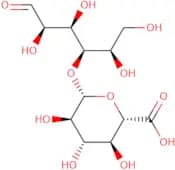
CAS :Cellobiuronic acid is a polysaccharide that contains glucose and uronic acids. It is found in the cell walls of gram-positive bacteria, where it may play an important role in maintaining the structural integrity of the cell wall. Cellobiuronic acid has been shown to be a potent antigen for pneumococcus. Cellobiuronic acid has also been shown to be conjugated with proteins and used as a vaccine adjuvant for inducing antibody responses against pneumococcal antigens. Cellobiuronic acid is synthesized from glucose by bacterial cells, which use it as a carbon source. The biosynthesis of cellobiuronic acid is poorly understood because it does not occur in mammalian cells.
Formule :C12H20O12Degré de pureté :Min. 95%Masse moléculaire :356.28 g/molMaltose solution
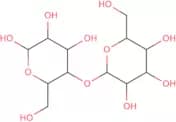
CAS :The maltose solution we offer is a 20% solution in water and of high purity and can be customized to meet your needs.
Formule :C12H22O11Degré de pureté :Min. 95%Masse moléculaire :342.3 g/mol2-(N-Octylcarboamido)phenyl-2-acetamido-2-deoxy-b-D-glucopyranoside
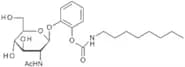
2-(N-Octylcarboamido)phenyl-2-acetamido-2-deoxy-b-D-glucopyranoside is a modified carbohydrate which is used as a synthetic monosaccharide. It is also used in the preparation of Oligosaccharides, Carbohydrates, and Complex Carbohydrates. 2-(N-Octylcarboamido)phenyl-2-acetamido-2-deoxy-b-D--glucopyranoside has been fluorinated to 2-(N-[3,5-(diiodo)phenyl]carboamido)phenyl)-2-[3,5-(diiodo)phenyl]-acetamide.
Formule :C23H36N2O8Degré de pureté :Min. 95%Masse moléculaire :468.54 g/molOctyl 2-acetamido-2-deoxy-b-D-glucopyranoside
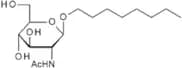
CAS :Octyl 2-acetamido-2-deoxy-b-D-glucopyranoside is a lyotropic liquid that is flammable. It can be used to prepare potassium hydride, which is an organometallic. Potassium hydride reacts with organic acids and atorvastatin to produce argon gas. This reaction can be done in the presence of chlorine gas instead of air. Preparative methods for octyl 2-acetamido-2-deoxy-b-D-glucopyranoside include heating it in a vacuum or under argon gas and then reacting it with potassium tetrachlorocobaltate in water or ethanol solution.
Formule :C16H31NO6Degré de pureté :Min. 95%Masse moléculaire :333.42 g/molN-Boc-1,5-imino-D-glucitol
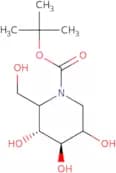
CAS :N-Boc-1,5-imino-D-glucitol is a complex carbohydrate that is synthesized by the N-Boc protection group. It is an oligosaccharide with a molecular weight of about 190 daltons and it can be modified at the C1 position to produce various saccharides. N-Boc-1,5-imino-D-glucitol has been shown to be effective as a glycosylation agent for protein modification and for its ability to form stable complexes with other complex carbohydrates. This compound has also been used in the synthesis of polysaccharides and as a fluorination reagent.
Formule :C11H21NO6Degré de pureté :Min. 95%Masse moléculaire :263.29 g/molRhamnolipid
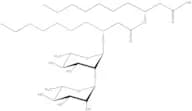
Rhamnolipids are a class of biosurfactants which contain rhamnose as the sugar moiety linked to β-hydroxylated fatty acid chains. Rhamnolipids can be widely applied in many industries including; petroleum, food, agriculture and bioremediation etc.
Formule :C26H48O9Degré de pureté :(%) Min. 95%Couleur et forme :Yellow PowderMasse moléculaire :504.65 g/molRef: 3D-DR45784
Produit arrêtém-Topolin-9-glucoside
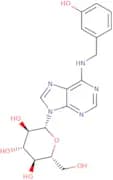
CAS :M-topolin-9-glucoside is a synthetic sugar that has been modified by the introduction of fluorine atoms at C-2, C-3, and C-4. This sugar is used to study the interactions between carbohydrates and proteins. It is also used for the synthesis of oligosaccharides as well as for glycosylation and methylation reactions. M-topolin-9-glucoside is a monosaccharide that has been glycosylated and methylated. It can be used as a replacement for glucose in some reactions due to its stability and low cost.
Formule :C18H21N5O6Degré de pureté :Min. 95%Couleur et forme :PowderMasse moléculaire :403.39 g/molp-Coumaroyl-b-D-glucose
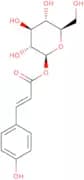
CAS :P-Coumaroyl-b-D-glucose is a flavanone that belongs to the class of flavonoids. It is an intermediate in the synthesis of many other flavonoids, such as apigenin, labiatae, and rhamnetin. P-Coumaroyl-b-D-glucose has been shown to downregulate the expression of genes encoding proteins involved in the biosynthesis of proanthocyanidins and anthocyanins. This compound also induces apoptosis by binding to the mitochondria membrane and increasing reactive oxygen species production. P-Coumaroyl-b-D-glucose can be used as a marker for phenylpropanoid metabolism in plants.
Formule :C15H18O8Degré de pureté :Min. 95%Couleur et forme :White PowderMasse moléculaire :326.3 g/mol3,4,2',3',6'-Penta-O-acetylsucrose
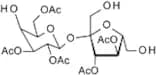
CAS :3,4,2',3',6'-Penta-O-acetylsucrose is a deuterated analog of sucrose. It can be synthesized by reacting sucrose with acetyl chloride in the presence of a base. The transesterification reaction yields the desired product in an overall yield of about 20%. This process is similar to that used for the synthesis of fatty acid esters, but 3,4,2',3',6'-Penta-O-acetylsucrose does not exist in nature and cannot be found as a natural product. The X-ray crystallography studies show that 3,4,2',3',6'-Penta-O-acetylsucrose has a conformation different from that of 6-phosphate sucrose.
Formule :C22H32O16Degré de pureté :Min. 95%Masse moléculaire :552.49 g/mola-D-Xylopyranosyl azide
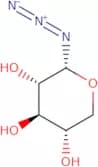
CAS :a-D-Xylopyranosyl azide is a sugar that can be synthesized from the reaction of 1,2-dichloroethane with 2,3,4,6-tetra-O-acetyl-a-D-xylopyranose. This compound has a high purity and can be custom synthesized to order. It is used in glycosylation reactions to modify saccharides and oligosaccharides. It has been shown to be useful for click modification and fluorination reactions.
Degré de pureté :Min. 95%Man-3Xyl N-Glycan
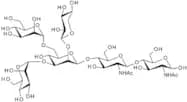
CAS :Man-3Xyl N-Glycan is a high purity, custom synthesized, synthetic and fluorinated monosaccharide. It is an Oligosaccharide that contains 3 mannose sugar residues. Man-3Xyl N-Glycan is used for Glycosylation in the synthesis of complex carbohydrate polymers, such as glycoproteins and glycolipids. Click modification can be used to introduce methyl groups onto the sugar residues of Man-3Xyl N-Glycan. This monosaccharide has been shown to have high stability and resistance to oxidation.
Formule :C39H66N2O30Degré de pureté :Min. 95%Masse moléculaire :1,042.94 g/molDi-a-D-galactosyl-mannopentaose
Di-a-D-galactosyl-mannopentaose is a mannopentaose derivative that has been modified with a methyl group at the C2 position and fluorinated at the C6 position. This compound can be used as an intermediate in the production of oligosaccharides and polysaccharides, which are complex carbohydrates that contain many sugar molecules. The product is of high purity, with no detectable impurities. It was synthesized using a custom synthesis approach, which allows for modification of the chemical structure to produce desired properties. This product is stable when stored at room temperature and does not require refrigeration. It does not contain any organic solvents or volatile compounds and is free from endotoxins or heavy metals.
Degré de pureté :Min. 95%Masse moléculaire :1,153 g/mol