Antimicrobiens
Sous-catégories appartenant à la catégorie "Antimicrobiens"
- Antibiotiques(4.144 produits)
- Antifongiques(910 produits)
- Antiparasitaires(710 produits)
- Antiviraux(768 produits)
2430 produits trouvés pour "Antimicrobiens"
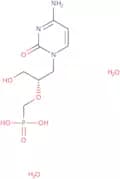
Cidofovir dihydrate - Bio-X ™
CAS :Cidofovir is an anti-viral agent that is used to treat Cytomegalovirus (CMV) retinitis in patients with AIDS. This drug suppresses CMV replication by inhibiting viral DNA synthesis.
Formule :C8H14N3O6P•(H2O)2Degré de pureté :Min. 98 Area-%Couleur et forme :PowderMasse moléculaire :315.22 g/molGatifloxacin
CAS :Gatifloxacin is an antibiotic, which is a synthetic fluoroquinolone with broad-spectrum antibacterial activity. Its source lies in its chemical synthesis, designed to inhibit bacterial enzymes necessary for DNA replication. The mode of action involves the inhibition of bacterial DNA gyrase and topoisomerase IV, which are critical enzymes for bacterial DNA replication, transcription, and repair. This dual inhibitory mechanism disrupts bacterial cell division and growth, leading to the eventual eradication of susceptible bacterial strains.
Formule :C19H22FN3O4Degré de pureté :Min. 95%Couleur et forme :White PowderMasse moléculaire :375.39 g/molD-Cycloserine
CAS :D-Cycloserine is a antibiotic and NMDA receptor partial agonist with action on bacterial cell wall synthesis and modulation of NMDA receptors and is used for treating tuberculosis and studying neuropsychiatric disorders.
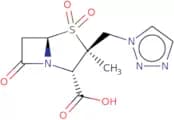
Formule :C3H6N2O2Degré de pureté :Min. 98 Area-%Couleur et forme :PowderMasse moléculaire :102.09 g/molTazobactam
CAS :Inhibitor of beta-lactamase; inhibitor of cell wall synthesis; beta-lactam class
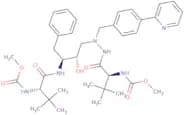
Formule :C10H12N4O5SDegré de pureté :Min. 95%Couleur et forme :White Off-White PowderMasse moléculaire :300.29 g/molAtazanavir
CAS :Atazanavir is a HIV-1 protease inhibitor, used in the anti-retroviral therapy of adult and sometimes paediatric patients infected with HIV. In in vitro studies with human pulmonary epithelial cells, atazanavir has been studied as a potential inhibitor of SARS-CoV-2 Mpro protease, with the aim of halting viral replication.
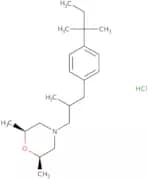
Formule :C38H52N6O7Degré de pureté :Min. 95%Couleur et forme :White Beige PowderMasse moléculaire :704.86 g/molAmorolfine HCl - Bio-X ™
CAS :Amorolfine is an antifungal drug that inhibits fungal enzymes (D14 reductase and D7-D8 isomerase). Its inhibition has an affect on fungal sterol synthesis pathways, and it depletes ergosterol. This drug can be used as a treatment for inflammatory lesions such as Tinea corporis, Tinea pedis, and Tinea cruris due to its ability to penetrate the skin barrier with ease.
Formule :C21H35NO•HClDegré de pureté :Min. 95%Couleur et forme :PowderMasse moléculaire :353.97 g/molMebendazole
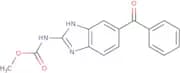
CAS :Mebendazole is a benzimidazole anthelmintic with action on microtubule formation in parasitic worms and is used for treating intestinal worm infections like threadworms and roundworms.
Formule :C16H13N3O3Degré de pureté :99.0 To 101.0%Couleur et forme :PowderMasse moléculaire :295.29 g/molOleandomycin phosphate
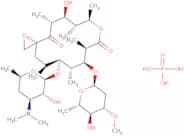
CAS :Produit contrôléOleandomycin phosphate is a macrolide antibiotic with action on bacterial protein synthesis inhibition and is used for treating respiratory tract infections and as a veterinary antibiotic.
Formule :C35H64NO16PDegré de pureté :(%) Reported (%)Couleur et forme :PowderMasse moléculaire :785.85 g/molRef: 3D-AO59785
Produit arrêtéValidamycin A
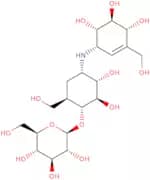
CAS :Validamycin A is an antibiotic and fungicide with action as a trehalase inhibitor, disrupting carbohydrate metabolism in fungi and is used for controlling fungal diseases like sheath blight in rice and damping-off in cucumbers.
Formule :C20H35NO13Degré de pureté :Min. 92 Area-%Couleur et forme :White PowderMasse moléculaire :497.49 g/molVancomycin hydrochloride (1:1)
CAS :Vancomycin hydrochloride (1:1) is a glycopeptide antibiotic with action on bacterial cell wall synthesis and is used for treating severe bacterial infections like septicemia, endocarditis, and skin infections.
Formule :C66H76Cl3N9O24Degré de pureté :Min. 95%Couleur et forme :PowderMasse moléculaire :1,485.72 g/molRef: 3D-XHA63825
Produit arrêtéMeayamycin B
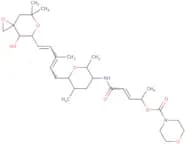
CAS :Meayamycin B is a synthetic macrolide, a complex organic compound, which is derived from the natural product FR901464. This compound functions as an antagonist of the spliceosome, the cellular machinery responsible for pre-mRNA splicing. By binding to specific components of the spliceosome, Meayamycin B disrupts the splicing process, leading to the accumulation of unspliced precursor mRNA. This action effectively induces apoptosis in cancer cells, making it a notable candidate for cancer therapy research.
Formule :C31H48N2O8Degré de pureté :Min. 95%Masse moléculaire :576.72 g/molRifamycin O
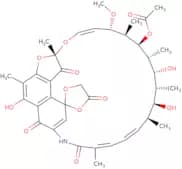
CAS :Rifamycin O is a rifamycin antibiotic with action on bacterial RNA polymerase to inhibit transcription and is used for treating tuberculosis and travelers' diarrhea.
Formule :C39H47NO14Degré de pureté :Min. 95%Couleur et forme :Slightly Yellow Yellow PowderMasse moléculaire :753.79 g/molEtravirine - Bio-X ™
CAS :Etravirine is a non-nucleoside reverse transcriptase inhibitor (NNRTI) medication used in the treatment of human immunodeficiency virus (HIV) infections. It works by blocking reverse transcriptase, an enzyme essential for replication of the virus, thereby preventing the virus from multiplying and spreading. Etravirine is often used in combination with other antiretroviral drugs to effectively treat HIV/AIDS. It is commonly prescribed for patients with virus strains that are resistant to other NNRTI medications due to mutations that confer resistance- mutations K103N and Y181C. Etravirine is a diarylpyrimidine (DAPY) and has conformational isomerism meaning that it binds reverse transcriptase in an fleible manner, under multiple conformations. The impact of specific point mutations in the virus is therefore lessened.
Formule :C20H15BrN6ODegré de pureté :Min. 95%Couleur et forme :PowderMasse moléculaire :435.28 g/molStavudine - Bio-X ™
CAS :Stavudine is an antiviral, reverse transcriptase inhibitor that is used to treat HIV/AIDS. It belongs to the group of nucleoside analogues of thymidine that is converted into stavudine monophosphate. Stavudine works by inhibiting viral replication by preventing the incorporation of viral dNTPs into the growing DNA chain, thus blocking DNA synthesis.
Formule :C10H12N2O4Degré de pureté :Min. 95%Couleur et forme :PowderMasse moléculaire :224.21 g/molPefloxacin
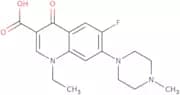
CAS :Pefloxacin is a mesylate prodrug that is converted to pefloxacin in the body. The optimum concentration for pefloxacin is 2 µg/mL, and it has been shown to be active against gram-positive bacteria such as Streptococcus pneumoniae, group A beta-hemolytic streptococci, and Enterococcus faecalis. Pefloxacin has also been shown to inhibit the growth of human leukemia cells (HL-60) and drug interactions have been documented with this drug. Pefloxacin is not active against Mycobacterium tuberculosis or Mycobacterium avium complex.
Formule :C17H20FN3O3Degré de pureté :Min. 95%Couleur et forme :Slightly Yellow PowderMasse moléculaire :333.36 g/moliso-Nystatin
CAS :iso-Nystatin is an antifungal compound, which is derived from the bacterium *Streptomyces noursei*. This specific strain of actinobacteria produces polyene macrolide antifungals, and iso-Nystatin is a derivative that exhibits similar bioactivity as its parent compound, Nystatin. Its mode of action is based on binding ergosterol, a crucial component of fungal cell membranes. This binding disrupts the membrane's structural integrity, inducing pore formation, which leads to ion leakage and ultimately cell lysis and fungal cell death.
Formule :C47H75NO17Degré de pureté :Min. 95%Masse moléculaire :926.09 g/molSulfasalazine
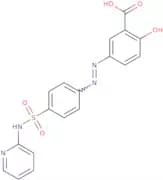
CAS :Sulfasalazine is a disease-modifying anti-rheumatic drug (DMARD) with action on reducing inflammation and immune system activity and is used for treating rheumatoid arthritis and inflammatory bowel disease.
Formule :C18H14N4O5SDegré de pureté :Min. 97 Area-%Couleur et forme :PowderMasse moléculaire :398.39 g/molAmikacin hydrate
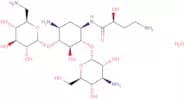
CAS :Inhibitor of protein synthesis; aminoglycoside
Formule :C22H43N5O13·xH2ODegré de pureté :Min. 900 Μg/MgCouleur et forme :PowderMasse moléculaire :585.6 g/molMicafungin sodium - Bio-X ™
CAS :Micafungin, as one of three echinocandina, has been proven to be a successful antifungal therapeutic in treating general Candida fungus infections. The treatment of immunocompromised patients is particularly important as Candida infections cause high mortality rates in patients in intensive care units, receiving chemotherapy, or stem cell transplants. This product acts as an anti-fungal by inhibiting the 1,3-beta-D-glucan synthase enzyme. As a result the production of 1,3-beta-D-glucan, which is crucial to the fungal cell wall, is hindered. Thus, the fungal cell wall loses integrity allowing for osmotic instability and cell lysis to occur.
Formule :C56H71N9O23S•NaDegré de pureté :Min. 95%Couleur et forme :PowderMasse moléculaire :1,293.27 g/molCefonicid sodium
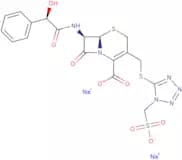
CAS :Cephalosporin antibiotic; interferes with cell wall biosynthesis
Formule :C18H18N6Na2O8S3Degré de pureté :Min. 95%Couleur et forme :PowderMasse moléculaire :588.55 g/mol