Nucléotides
Les nucléotides sont des composés organiques qui servent de building blocks aux acides nucléiques, essentiels à la formation de l'ADN et de l'ARN. Chaque nucléotide est composé d'une base azotée, d'une molécule de sucre et d'un ou plusieurs groupes phosphate. Ces nucléotides s'assemblent pour former de longues chaînes, créant le matériel génétique qui porte et transmet l'information génétique dans tous les organismes vivants. Dans cette section, vous trouverez une large gamme de nucléotides essentiels pour la recherche en génétique, biologie moléculaire et biochimie. Ils sont fondamentaux pour étudier les processus génétiques, synthétiser des acides nucléiques et développer des outils diagnostiques et thérapeutiques. Chez CymitQuimica, nous proposons des nucléotides de haute qualité pour soutenir vos recherches scientifiques et applications, garantissant précision et fiabilité dans vos expériences.
Sous-catégories appartenant à la catégorie "Nucléotides"
2634 produits trouvés pour "Nucléotides"
Trier par
Degré de pureté (%)
0
100
|
0
|
50
|
90
|
95
|
100
2'-Deoxy-L-uridine
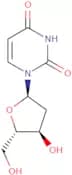
CAS :<p>2'-Deoxy-L-uridine is a nucleoside that is found in the human body. It phosphorylates l-thymidine, which is a natural substrate, and this reaction prevents the formation of diphosphate from d-ribose 5'-monophosphate. 2'-Deoxy-L-uridine is an exogenous substance that inhibits cell growth by affecting protein synthesis and DNA replication. 2'-Deoxy-L-uridine has been shown to be more efficient than wild type uridine in inhibiting cell growth in vitro at concentrations of 1 mM or greater. The enantiomers of 2'-deoxy-L-uridine affect cell growth differently, with the (R)-enantiomer being more potent than the (S)-enantiomer.</p>Formule :C9H12N2O5Degré de pureté :Min. 95%Couleur et forme :White PowderMasse moléculaire :228.2 g/mol2-Chloroadenosine hemihydrate
CAS :<p>2-Chloroadenosine hemihydrate is a synthetic purine nucleoside analog, closely related to adenosine, with a chlorine atom substituted at the 2-position on the adenine ring. This molecule has potential application in research.</p>Formule :C10H12ClN5O4H2ODegré de pureté :Min. 95%Couleur et forme :PowderMasse moléculaire :310.69 g/mol2-Hydrazinoadenosine
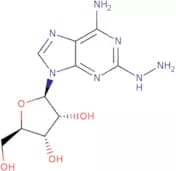
CAS :<p>2-Hydrazinoadenosine is an active analogue of adenosine. It is a potent agonist for the adenosine receptor subtypes A1 and A2A with high affinity. 2-Hydrazinoadenosine has been shown to inhibit cardiac contractility in animal models, as well as to produce hypotension, bradycardia, and bronchodilation in humans. This drug also has a functional effect on the heart by binding to adenosine receptors, which leads to the inhibition of catecholamine release. This drug is used clinically as an antiarrhythmic agent and a vasodilator in coronary artery disease.</p>Formule :C10H15N7O4Degré de pureté :Min. 95%Couleur et forme :PowderMasse moléculaire :297.27 g/molCytidine 5'-diphosphocholine
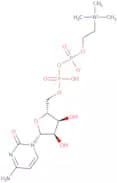
CAS :<p>Cytidine 5'-diphosphocholine is a nucleotide that is a precursor of uridine 5'-triphosphate and cytidine 5'-monophosphate, which are important for DNA synthesis. Cytidine 5'-diphosphocholine is used in the preparation of samples for experiments. This compound has been shown to induce neuronal death in an experimental model. It has also been shown to inhibit polymerase chain reactions and affect the activity of enzymes such as alpha-7 nicotinic acetylcholine receptors and glutamate decarboxylase. Cytidine 5'-diphosphocholine has been found to have no effect on basic fibroblast cells, but it does have physiological effects on human erythrocytes.</p>Formule :C14H26N4O11P2Degré de pureté :Min. 98 Area-%Couleur et forme :White PowderMasse moléculaire :488.32 g/moldNTP bundle, 4 x 100mM aqueous solution
CAS :Each dNTP supplied in a separate vialDegré de pureté :Min. 99 Area-%Couleur et forme :Clear Liquid4-[(1Z)-2-(4-Chlorophenyl)vinyl]pyridine
CAS :<p>4-[(1Z)-2-(4-Chlorophenyl)vinyl]pyridine is a modified nucleoside that is used in anticancer drugs. It has shown antiviral and antitumor effects. 4-[(1Z)-2-(4-Chlorophenyl)vinyl]pyridine is synthesized by condensing 4-chlorobenzaldehyde and 2,3-dichloropyridine. The nucleoside has been modified to be phosphorylated at the 5′ position and contains a ribonucleotide moiety and a deoxyribonucleotide moiety. This product is of high purity and quality, with an activator group at the 5′ position.</p>Formule :C13H10ClNDegré de pureté :Min. 95%Masse moléculaire :215.68 g/mol2'-O-(2-Methoxyethyl)cytidine
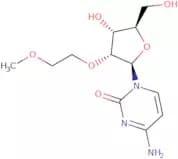
CAS :<p>2'-O-(2-Methoxyethyl)cytidine is a nutrient that is used to maintain the dry weight of Lactobacillus acidophilus cultures. It is also used as a texturizing agent in food products. 2'-O-(2-Methoxyethyl)cytidine has been shown to increase the rate of lactose hydrolysis and reduce the viscosity of yogurt by activating L. acidophilus. 2'-O-(2-Methoxyethyl)cytidine is also used as a dietary supplement for people with intestinal disorders, such as irritable bowel syndrome. It can be found in sodium salts and n-methyl-d-glucamine.</p>Formule :C12H19N3O6Degré de pureté :Min. 95%Couleur et forme :PowderMasse moléculaire :301.3 g/mol2'-Deoxyadenosine 5'-O-thiophosphate sodium salt
CAS :2'-Deoxyadenosine 5'-O-thiophosphate sodium salt is a synthetic nucleotide that has antiviral, anticancer and antitumor properties. It is a modified deoxyribonucleoside and it activates the synthesis of DNA by acting as an activator. This drug is not found in nature and it has shown to inhibit the growth of human breast cancer cells in cell culture.Formule :C10H14N5O5PSDegré de pureté :Min. 95%Masse moléculaire :347.29 g/mol8-Methyladenosine
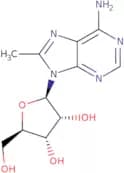
CAS :<p>8-Methyladenosine is an acid conjugate that can be found in the urine of healthy people. It is a protonated molecule that binds to a p2 subtype of the G protein-coupled receptor, which is activated by adenosine and 8-methyladenosine. This drug has been used in clinical trials for the treatment of herpes simplex virus and cervical cancer. The intramolecular hydrogen bond between the methyl group and the adenosine ring is responsible for its high binding affinity for this receptor. The glycosidic bond is formed when an 8-methyladenosine molecule attaches to a receptor on a cell surface, forming an intramolecular hydrogen bond with the receptor's amino acid side chain. This bond is broken when a protonated molecule of 8-methyladenosine enters the cell and interacts with the receptor, resulting in activation of this receptor.</p>Formule :C11H15N5O4Degré de pureté :Min. 95%Couleur et forme :White PowderMasse moléculaire :281.27 g/molN6-Cyclopentyladenosine
CAS :<p>N6-Cyclopentyladenosine is a nucleoside analog that binds to the kappa-opioid receptor. The physiological effects of this drug are mediated through its interaction with the kappa-opioid receptor, which is found in the central nervous system and mediates many of the effects of morphine. N6-Cyclopentyladenosine has been shown to increase blood flow and heart rate in humans. This drug also inhibits tetrazolium dye uptake by papillary muscle cells, suggesting that it may have cardiotonic effects. N6-Cyclopentyladenosine has been used as an analytical probe for adenosine, which is metabolized by cyclic AMP and cyclic GMP phosphodiesterases into adenosine 3',5'-cyclic monophosphate (cAMP).</p>Formule :C15H21N5O4Degré de pureté :Min. 95%Couleur et forme :PowderMasse moléculaire :335.36 g/mol5-Carboxymethylaminomethyluridine
CAS :5-Carboxymethylaminomethyluridine is a nucleoside analogue that is used in molecular modeling studies to investigate the role and interactions of uridine in the mitochondrial ribosome. It has been shown to bind to the mitochondrial ribosome, which may be due to hydrogen bonding interactions with adenine. 5-Carboxymethylaminomethyluridine also inhibits protein synthesis at the level of translation by inhibiting group P2 of eukaryotic cytosolic ribosomes. This inhibition results in decreased production of proteins necessary for mitochondrial biogenesis.Formule :C12H17N3O8Degré de pureté :Min. 95 Area-%Couleur et forme :White Off-White PowderMasse moléculaire :331.28 g/mol8-Amino[1''-(N''-dansyl)-4''-aminobutyl]-5'-(1-aziridinyl)-5'-deoxy adenosine
CAS :<p>8-Amino-[1''-(N''-dansyl)-4''-aminobutyl]-5'-(1-aziridinyl)-5'-deoxyadenosine is a novel nucleoside phosphoramidite that has antiviral and anticancer activity. It is currently under development as a potential treatment for Hepatitis C, HIV and cancer. 8-Amino-[1''-(N''-dansyl)-4''-aminobutyl]-5'-(1-aziridinyl)-5'-deoxyadenosine is an activator of the enzyme ribonucleotide reductase, which converts ribonucleotides to deoxyribonucleotides. It also inhibits the synthesis of DNA and RNA by inhibiting the enzyme DNA gyrase and topoisomerase IV. 8-Amino-[1''-(N''-dansyl)-4''-aminobutyl</p>Formule :C28H37N9O5SDegré de pureté :Min. 95%Couleur et forme :PowderMasse moléculaire :611.72 g/mol2'-Deoxy-2-fluoroadenosine
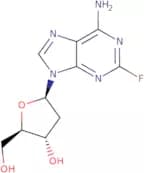
CAS :<p>2'-Deoxy-2-fluoroadenosine is an adenosine member and an organofluorine compound</p>Formule :C10H12FN5O3Degré de pureté :Min. 98 Area-%Couleur et forme :White PowderMasse moléculaire :269.23 g/mol2'-Deoxyinosine-5'-monophosphate disodium salt
CAS :<p>2'-Deoxyinosine-5'-monophosphate disodium salt is a synthetic nucleoside, phosphoramidite, and diphosphate that is used in the synthesis of DNA. It has been shown to have antiviral effects against HIV and herpes simplex virus type 2 (HSV-2). This drug also has anticancer activity and is an activator of novel nucleosides.</p>Formule :C10H11N4Na2O7PDegré de pureté :Min. 98 Area-%Couleur et forme :White PowderMasse moléculaire :376.17 g/mol2'-O-(tert-Butyldimethylsilyl)-5'-O-DMT-N2-isobutyryl-guanosine
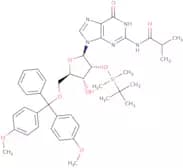
CAS :2'-O-(tert-Butyldimethylsilyl)-5'-O-DMT-N2-isobutyryl-guanosine is a synthetic nucleoside that has been modified with a tert-butyldimethylsilyl group. This modification is used to improve the efficiency of coupling reactions between nucleosides and phosphoramidites in oligonucleotide synthesis. The 2'-O-(tert-Butyldimethylsilyl)-5'-O-DMT-N2-isobutyryl guanosine is also used as a chromophore in spectroscopy experiments and as a ligand in metal coordination chemistry.Formule :C41H51N5O8SiDegré de pureté :Min. 98 Area-%Couleur et forme :Off-White PowderMasse moléculaire :769.96 g/mol2,4-Diamino-6-hydroxypyridine sulphate
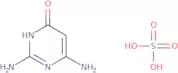
CAS :<p>2,4-Diamino-6-hydroxypyridine sulphate is a nucleoside for use in research applications</p>Formule :C4H6N4O•(H2SO4)xDegré de pureté :Min. 95%Couleur et forme :PowderMasse moléculaire :224.2 g/mol5-Fluorouridine-5'-triphosphate sodium salt
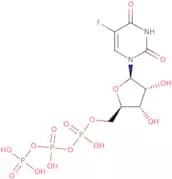
CAS :<p>5-Fluorouridine-5'-triphosphate sodium salt is an analog of uridine that has been used in the treatment of metastatic colorectal cancer. It is a prodrug that is metabolized to 5-fluorouracil, its active form. 5-Fluorouridine-5'-triphosphate sodium salt inhibits the synthesis of thymidylate, one of the precursors to DNA, and blocks the production of nucleotides. This results in cell lysis and death by apoptosis. The drug also inhibits epidermal growth factor receptor (EGFR), which may contribute to its antitumor effects.</p>Formule :C9H14N2O15P3FDegré de pureté :Min. 95%Masse moléculaire :502.13 g/mol7-Methyl-6-thioguanosine inner salt
CAS :<p>7-Methyl-6-thioguanosine inner salt is a compound that inhibits the activity of creatine kinase and phosphatase, which are enzymes involved in energy metabolism. It also binds to actin filaments and prevents their depolymerization. The binding mechanism of 7-methyl-6-thioguanosine inner salt is believed to be due to its ability to form disulfide bonds with cysteine residues on the surface of the enzyme. This inhibition has been shown to reduce the ATP production in mammalian cells and has been used as a model system for studying cellular processes.</p>Formule :C11H15N5O4SDegré de pureté :Min. 95 Area-%Couleur et forme :White PowderMasse moléculaire :313.33 g/mol2'-Deoxycytidine-5'-diphosphate trisodium salt hydrate
CAS :2'-Deoxycytidine-5'-diphosphate trisodium salt hydrate is a nucleoside that is used as an antiviral agent in the treatment of herpes zoster and varicella zoster. This drug also has anticancer properties, which may be due to its ability to inhibit DNA synthesis. 2'-Deoxycytidine-5'-diphosphate trisodium salt hydrate is a novel nucleotide analogue that has been modified to improve its stability, solubility and bioavailability. It can be used as a starting material for the synthesis of phosphoramidites by reacting with phosphorous pentoxide at elevated temperatures and pH. CAS No. 151151-32-5Formule :C9H12N3O10P2·Na3Degré de pureté :Min. 95%Couleur et forme :White Off-White PowderMasse moléculaire :453.12 g/molN3-Methylthymidine
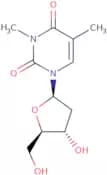
CAS :<p>N3-Methylthymidine is a metalloprotease inhibitor that has been shown to inhibit the activity of epidermal growth factor (EGF). N3-Methylthymidine is also an effective inhibitor of HIV infection. The inhibitory effect on HIV infection is due to the competitive inhibition of viral protease and subsequent degradation of viral proteins. N3-Methylthymidine inhibits the synthesis and release of infectious herpes simplex virus particles. This drug also inhibits the growth of human tumor cells in culture by inhibiting cell proliferation, most likely due to its ability to inhibit EGF. An analytical method for determining the concentration of this drug in plasma using chemical ligation has been developed.</p>Formule :C11H16N2O5Degré de pureté :Min. 95%Couleur et forme :White PowderMasse moléculaire :256.26 g/mol



![4-[(1Z)-2-(4-Chlorophenyl)vinyl]pyridine](/_next/image/?url=https%3A%2Fstatic.cymitquimica.com%2Fproducts%2F3D%2Fthumb-webp%2FNC65881.webp&w=3840&q=75)



![8-Amino[1''-(N''-dansyl)-4''-aminobutyl]-5'-(1-aziridinyl)-5'-deoxy adenosine](/_next/image/?url=https%3A%2Fstatic.cymitquimica.com%2Fproducts%2F3D%2Fthumb-webp%2FNA16503.webp&w=3840&q=75)